A symphony, not a jingle: Why Mark Carney’s Davos address connected
Mark Carney’s 16-minute speech at Davos earned a rare standing ovation. Linguists and scholars say his storytelling, word choice and restraint offer clear public-speaking lessons.
Copy link
By Torontoer Staff
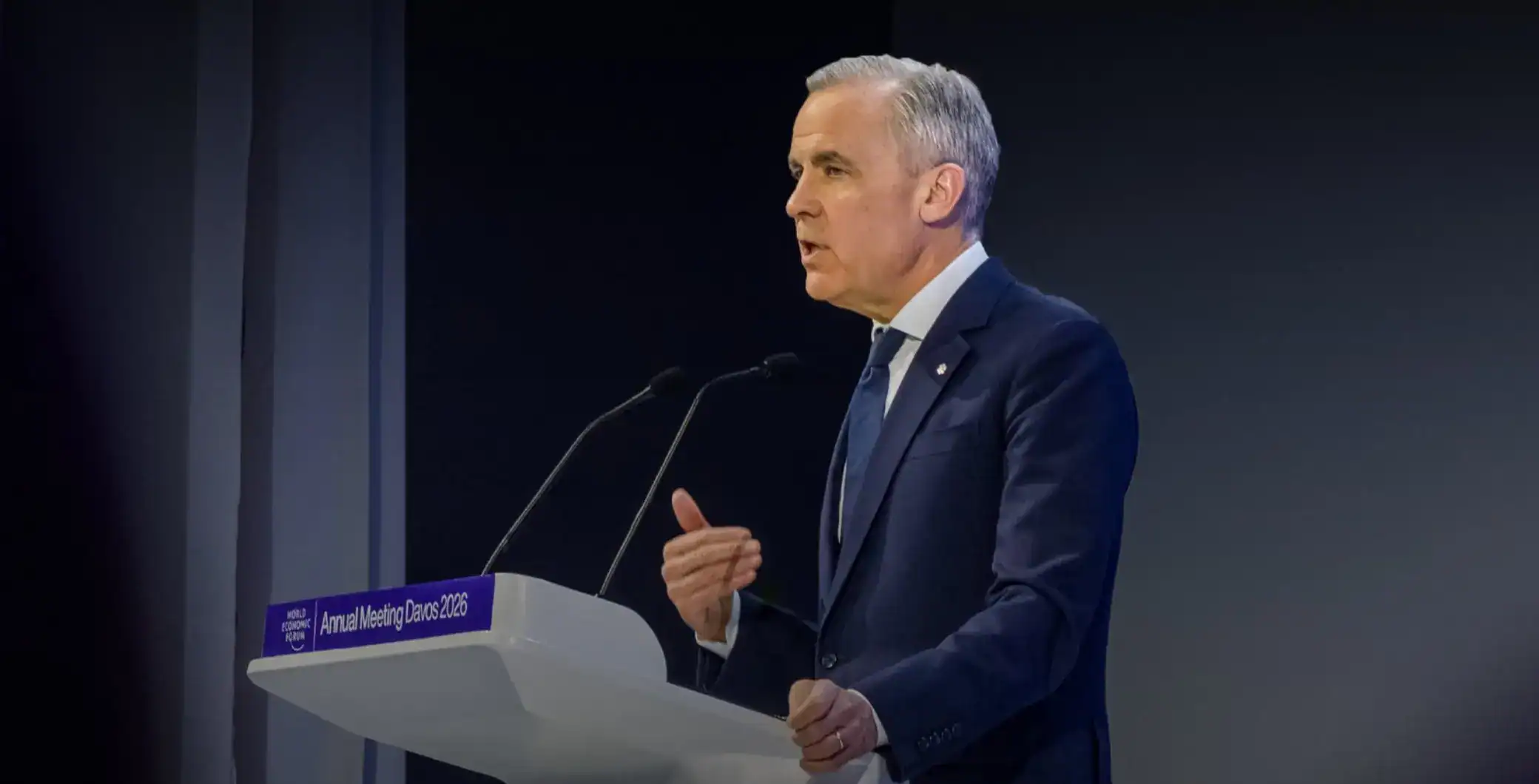
Mark Carney’s 16-minute address at the World Economic Forum in Davos drew a standing ovation, a rare response at the summit. The former Bank of Canada governor used measured language and narrative technique to press a geopolitical argument, and experts say the delivery mattered as much as the message.
Carney told the Davos audience that the postwar, rule-based order is fraying. He urged leaders to stop 'living within the lie' of unquestioned American hegemony, to 'take their signs down' and to reconsider alliances in an era he called one of 'great power rivalry.'
What listeners noticed
Observers and linguists who analysed the speech identified several clear techniques that made it land. The address stayed grounded in a coherent arc, avoided personal denigration, and reached a wide audience through simple, well chosen words.
He’s a masterful storyteller. His word choices were very clearly thoughtful without being pompous.
Sali Tagliamonte, linguistics professor, University of Toronto
Jack Cunningham, a University of Toronto international relations professor, said the speech matters because the world appears to be shifting between orders. 'We’re seeing a fairly sharp, pronounced, and probably lasting shift from one international order to another,' he said, adding that such transitions are rarely calm.
We’re seeing a fairly sharp, pronounced, and probably lasting shift from one international order to another. That happens rarely and is always a tumultuous process.
Jack Cunningham, international relations professor, University of Toronto
Language and technique that work
Analysts ran the speech through text tools and close reading. Carney’s full remarks totalled just over 2,000 words and used nearly 800 unique terms, a sign of lexical variety. At the same time, many of those words were common, accessible choices rather than obscure vocabulary.
That balance matters. Simple words make ideas available to a broad audience. Varied vocabulary keeps listeners engaged without feeling lectured. Tagliamonte emphasised that Carney avoided pompous flourishes while still speaking to an educated audience.
Carney also restrained negative language. He criticised aggressive statecraft with phrases like 'hard power' rather than using explicit insults. The result was forceful critique without alienation.
Storytelling, implication and rhythm
Two features of the speech stood out on a structural level. First, Carney used narrative, drawing on a parable from Václav Havel to frame his critique. Stories anchor arguments in memorable images, and listeners retain narrative arcs longer than lists of statistics.
Second, Carney relied on implication. When he described Canada as 'loud, diverse, and free,' the contrast pointed to places where public debate is loud but neither diverse nor free. That subtlety encouraged listeners to infer comparisons rather than receive explicit slights.
'[The speech] was a symphony, not a jingle. It’s an incredibly rich and well-articulated story that has a beginning, a middle, and an end.'
Sali Tagliamonte
Practical takeaways for speakers
- Tell a short story to frame your main point. Narrative arcs increase retention.
- Choose simple, familiar words for clarity, but avoid dumbing down your ideas.
- Vary vocabulary to avoid repetition and maintain engagement.
- Use inclusive pronouns like 'us' strategically to build collective buy-in.
- Critique behaviour or systems rather than attacking individuals or groups.
- Imply contrasts rather than spelling them out, so listeners do some of the cognitive work.
Those tips reflect the same techniques that drew attention to Carney’s remarks. His timing also mattered. He has been a consistent critic of disruptions to trade and of attempts to co-opt international institutions, so the Davos speech arrived as part of a broader, carefully branded position.
Why the applause matters
Standing ovations at Davos are uncommon. The applause signalled both approval of the argument and appreciation for the delivery. In a setting of diplomats, business leaders and journalists, measured rhetoric can expand an argument’s reach beyond national audiences, as international coverage of Carney’s speech demonstrated.
For anyone preparing an address, the lesson is straightforward: content and craft work together. A concise, well-structured message, delivered with linguistic restraint and narrative clarity, can have impact even on a global stage.
Mark Carneypublic speakingDavoscommunicationspeechwriting