Carney at Davos: Business leaders say diversify, but the U.S. still matters
Canadian business leaders welcomed Mark Carney’s Davos call to diversify export markets, while warning that replacing the U.S. is unrealistic and difficult for manufacturers.
Copy link
By Torontoer Staff
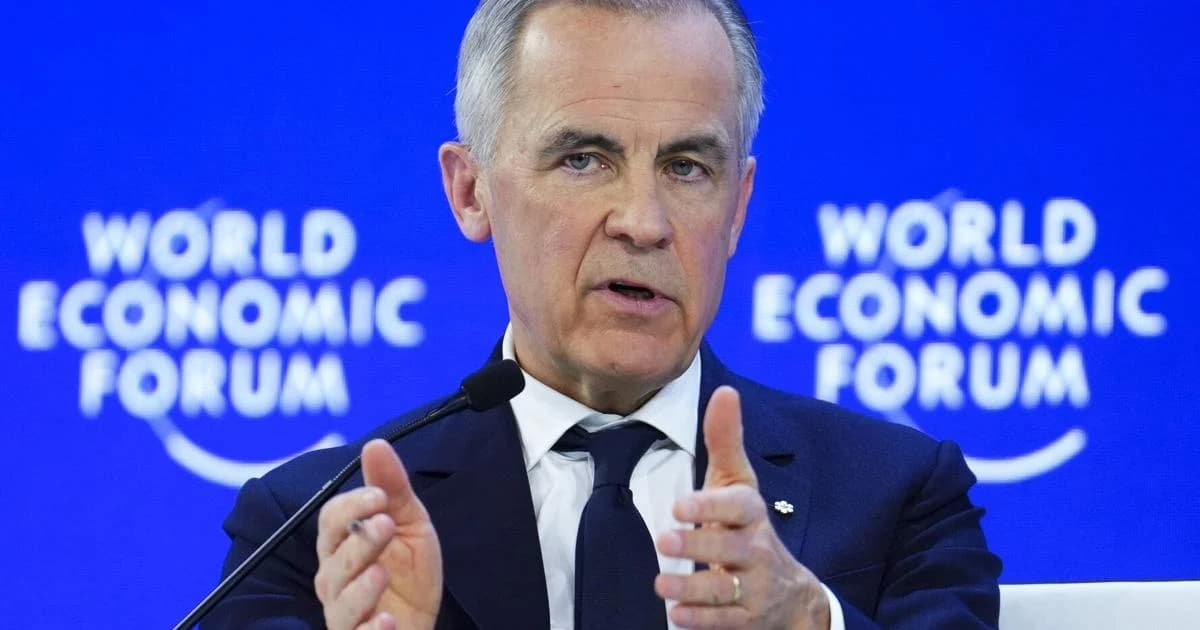
Mark Carney told the Davos audience this week that Canada needs to find new trading partners as global trade patterns shift. Business groups in Canada gave the message cautious support, saying diversification is sensible but not a substitute for the country’s dominant trade relationship with the United States.
Leaders from national associations and industry groups praised Carney’s realism, while also stressing the practical limits of redirecting Canadian exports away from a neighbour that remains the largest and closest market.
Why diversification is on the agenda
Matthew Holmes, head of public policy at the Canadian Chamber of Commerce, said Carney was acknowledging a new reality: the United States can no longer be taken for granted as a steady partner. Holmes called for more urgent action to broaden export markets rather than relying on past assumptions.
If the U.S. isn’t calling, are we going to sit by the phone, or try to stay busy in the meantime?
Matthew Holmes, Canadian Chamber of Commerce
Holmes and other business leaders framed diversification as a necessary strategic hedge. That view attracted some pushback from U.S. commentators, with a Bloomberg TV guest dismissing the concerns as overstated.
Give me a break, they have the second best deal in the world and all I got to do is listen to this guy whine and complain.
Howard Lutnick, on Bloomberg TV
Manufacturers face structural barriers
For Canadian manufacturers, the practical obstacles to finding new markets are significant. Dennis Darby, CEO of Canadian Manufacturers and Exporters, noted that roughly 80 per cent of manufactured goods are sent to the United States, reflecting decades of integrated supply chains and proximity advantages.
Diversification has always been difficult, and will continue to be difficult.
Dennis Darby, Canadian Manufacturers and Exporters
Darby explained that some products are simply cheaper to move next door. Bulk commodities such as canola or oil can easily travel by ship, but many value-added manufactured goods remain tied to short-distance supply chains built for North America.
Automotive sector: rethink assumptions
Flavio Volpe, CEO of the Automotive Parts Manufacturers Association, said Carney’s remarks should prompt a reassessment of long-standing assumptions. The automotive sector’s cross-border integration has anchored many supplier networks, and changing that will take time and policy support.
It’s not necessarily a positive message for manufacturers, but you have to get your head out of the sand.
Flavio Volpe, Automotive Parts Manufacturers Association
Volpe argued that shifts in U.S. economic policy have at times resembled a planned approach, and that Canada needs to adapt its industrial strategy accordingly to protect and grow value-added production.
Small business concerns and domestic policy hopes
Smaller firms have different priorities. Dan Kelly, CEO of the Canadian Federation of Independent Business, said he welcomed the message about global realities but was hoping for bolder domestic measures on taxes and regulation to spur entrepreneurship.
We were hoping for something eye-opening on the tax and regulatory agenda domestically.
Dan Kelly, Canadian Federation of Independent Business
Kelly said replacing the U.S. entirely is impractical. The market is large, wealthy and geographically close, factors that will continue to shape Canadian exporters’ choices.
- Manufacturers: supply chains and proximity make U.S. exports hard to replace
- Automotive suppliers: need for industrial policy to sustain value-added production
- Small businesses: want domestic tax and regulatory relief to boost competitiveness
- Consensus: diversify where possible, but retain strong U.S. ties
What this means for policy and business strategy
Business leaders broadly support a two-track approach: continue to cultivate and protect trade with the United States, while investing in market diversification and domestic competitiveness. That includes targeted government support for sectors with complex supply chains and incentives for firms seeking to expand into new regions.
Carney’s Davos speech, and the reaction it drew, highlights a transitional moment for Canadian trade strategy. The immediate implication is not a sudden pivot away from the United States. It is, instead, a call to prepare for a more uncertain global landscape while shoring up the advantages Canada still holds.
Leaders across industries agree on the bottom line: diversification matters, but the U.S. remains indispensable. The policy challenge for Ottawa and the business community is how to balance both objectives in a pragmatic way.
tradeexportsmanufacturingbusinessMark Carney