Eglinton Crosstown nears completion, Little Jamaica struggles to recover
Years of Crosstown construction have left Little Jamaica’s retail strip depleted, the local BIA says. New condos and transit could help, but community groups warn the recovery is not guaranteed.
Copy link
By Torontoer Staff
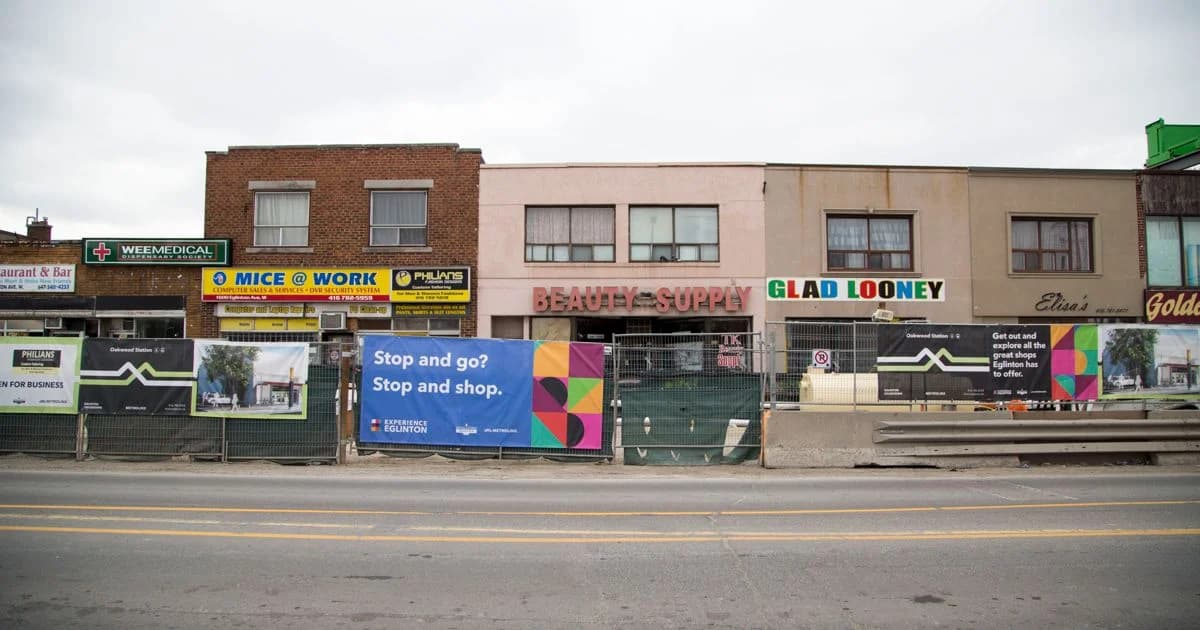
After more than a decade of construction, the Eglinton Crosstown appears close to beginning service. Little Jamaica, the stretch of Eglinton Avenue between Marlee and Keele, is still living with the fallout: the Little Jamaica BIA says more than 300 businesses have closed since work began in 2011, and it declared a state of emergency this week.
Local merchants and community groups now face two parallel timelines. One is the transit timeline, which finally seems to be reaching its end. The other is the long business timeline, in which lost foot traffic, years of dust and reduced revenue have eroded a commercial ecosystem that served as the neighbourhood’s cultural and economic backbone.
How extended construction hollowed out the strip
Small, independent retailers depend on chance encounters: a passerby, a commuter detouring into a shop, a neighbour stepping out for groceries. When sidewalks are fenced off, storefronts are obscured and noise and dust become constant, those encounters disappear. Business owners can absorb a short slump, but not a decade. The result on Eglinton West has been sustained closures and a thinning of services that residents relied on.
The Little Jamaica BIA has been blunt about responsibility. The association has repeatedly pointed to Metrolinx and the Crosstown project as the primary cause of the district’s decline, and said relief programs have not matched the scale of the damage. In 2022 Metrolinx transferred $1.38 million to the city to support 11 Eglinton West BIAs, but many merchants report they did not see material help where they needed it.
When you kick a dog and you kick a dog, after a while he gets used to your kicking him. That’s how I feel.
Jason McDonald, chair, Little Jamaica BIA
What development and transit will bring
Development projects are already reshaping the corridor. Fourteen high-density buildings are proposed or under construction that together could yield roughly 3,600 residential units. One prominent plan calls for a 39-storey mixed-use tower between the soon-to-open Oakwood and Fairbank stations, with 427 residences and designated family-sized units.
On paper, the neighbourhood will become one of midtown’s better connected areas. Increased local population and transit access can support retail, cultural institutions and services. But connectivity alone does not reverse years of lost business activity or guarantee that new ground-floor retail will serve the existing community’s needs.
Community responses and preservation efforts
Local leaders have moved to protect Little Jamaica’s cultural and economic character while construction continues. The Black-led Little Jamaica Community Land Trust is working to secure ownership tools and development priorities that prioritise community benefits and long-term affordability. The BIA has elevated the crisis to attract attention and resources.
Advocacy to date has focused on preserving commercial space, pushing for developer commitments to affordable retail leases, and securing funding for façade repairs and streetscape improvements so businesses can reopen with better visibility and access. These are steps seen in other Toronto neighbourhoods confronting rapid change, but they require coordinated public, private and community action to be effective.
Practical steps for businesses and neighbours
There is no single fix for a decade of hardship, but there are practical measures merchants and allies can pursue now to stabilise and rebuild. Strengthening online ordering, delivery and curbside pickup can recapture customers while sidewalks remain disrupted. Collaborations between shops, restaurants and cultural groups can create reasons for residents and new neighbours to return to Eglinton.
- Consolidate marketing and events to draw local traffic, for example block parties or weekend markets coordinated by the BIA or community groups
- Advocate for commercial rent protection and ground-floor retail guarantees in new developments
- Work with the community land trust on shared ownership or co-op models that lock in affordable commercial space
- Use temporary pop-ups and shared storefronts to lower operating costs while testing demand
Municipal and transit agencies can also speed streetscape repairs, prioritise clear signage to access open businesses and offer targeted grants that cover months of lost revenue rather than one-off façade work. Those measures make it easier for a fragile retail district to survive until new riders and residents arrive.
A future that keeps what matters
The arrival of the Crosstown will change Eglinton West. Increased connectivity and thousands of new homes could restore customers, but that outcome depends on intentional policies and community-centred development. Without dedicated efforts to retain affordable commercial space, preserve cultural institutions and support existing merchants, new housing can simply replace the street life that defined Little Jamaica.
Little Jamaica’s situation is a reminder that transit construction is also a neighbourhood intervention. Riding the new line will be faster for commuters. Preserving the businesses and culture that made the corridor unique will take different work, and it remains ongoing.
Little JamaicaEglinton Crosstownsmall businessdevelopmentcommunity