General Fusion is going public to raise cash for commercial fusion
Vancouver’s General Fusion will list via a Nasdaq SPAC to fund a push for commercial nuclear fusion, aiming for mid-2030s commercialisation and a US$724M enterprise value.
Copy link
By Torontoer Staff
Vancouver-based General Fusion is combining with Spring Valley Acquisition Corp. III, a Nasdaq-listed special purpose acquisition company, to become the first pure-play nuclear fusion company open to public investors. The move will put at least US$105 million on General Fusion’s balance sheet, with the potential for another US$230 million, and implies an enterprise value of US$724 million.
The company says the funding is aimed at commercialising fusion technology by the mid-2030s. General Fusion builds devices designed to generate energy by fusing atoms, a process that promises abundant, low-carbon power with much less long-lived radioactive waste than conventional nuclear fission.
Why the public listing matters
General Fusion has raised about US$400 million since 2002, but commercial fusion requires considerably more capital to scale demonstration machines, secure supply chains and build pilot plants. Going public via a SPAC gives the company access to retail and institutional investors beyond its existing backers, which reportedly include Bezos Expeditions.
There is a global race happening in fusion and we consider ourselves to be Canada’s horse in that race.
Greg Twinney, chief executive of General Fusion
How General Fusion’s approach differs
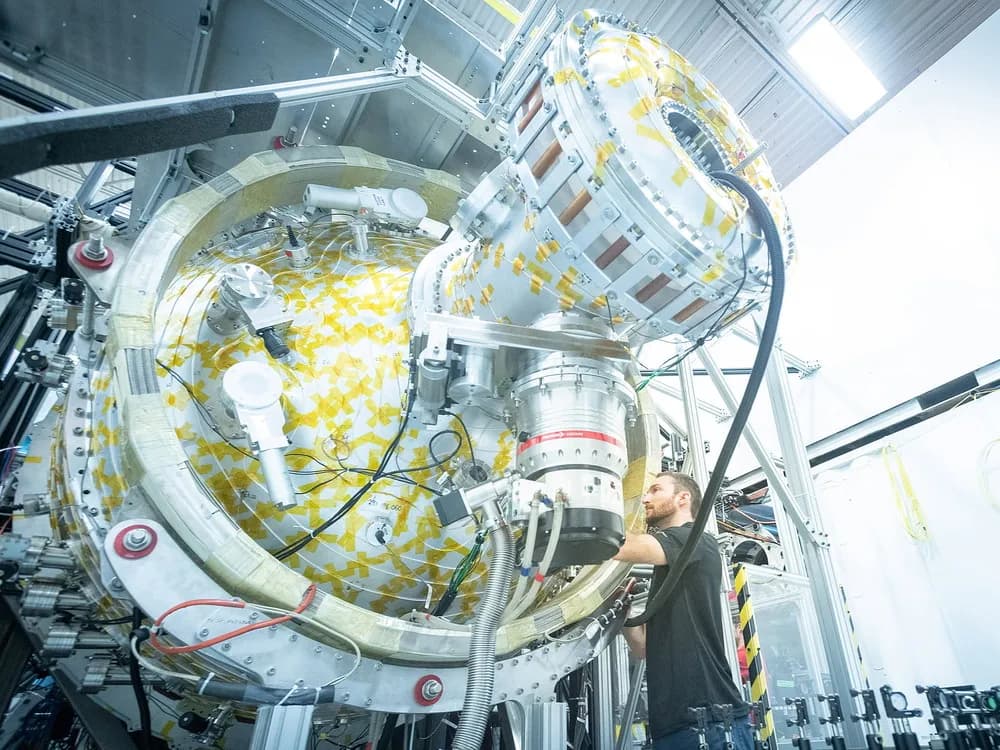
General Fusion says it is pursuing a practical path to commercialisation, emphasising compatibility with existing power plants and use of commonly available materials. Its LM26 machine is described as a 50 per cent commercial-scale device, and company presentations say LM26 is operational, forming and compressing plasma.
The company reports having heated plasma to 10 million C and 100 million C during tests. Those temperatures are part of the effort to reach the Lawson criterion, the combination of pressure, temperature and confinement time needed to produce net fusion energy.
We are now executing a demonstration program to achieve transformative milestones with our technology.
Megan Wilson, chief strategy officer, General Fusion
- Material degradation: fusion conditions can damage or destroy machine structures over time.
- Fuel sourcing: some fusion fuels, such as certain isotopes, are not readily available and may need to be produced in the reaction cycle.
- Energy capture: converting the fusion reaction into usable electricity efficiently is an engineering challenge.
- High costs: building and operating fusion devices remains expensive at current scales.
Finances, timeline and market context
Under the proposed deal, General Fusion would combine with Spring Valley Acquisition Corp. III, part of a group that has raised about US$690 million and taken other energy companies public. The transaction is expected to close in mid-2026, after which existing General Fusion shareholders would hold about 58 per cent of the combined company.
General Fusion’s chief executive says the company is focused on technical milestones rather than short-term market pressures. The target for commercialisation remains the mid-2030s, a timeline that reflects both technical risk and the scale of construction and testing needed to move from demonstration devices to grid-connected plants.
Other fusion-focused firms have also used public markets for funding. TAE Technologies, for example, announced a US$6-billion merger with a Nasdaq-listed company that will hold a variety of assets. General Fusion argues it will be the first company whose primary business is fusion to list, opening the sector to a broader set of investors.
What this could mean for energy and consumers
If fusion is commercialised at scale, the technology could add a large source of low-carbon baseload power, complementing renewables and other clean technologies. Fusion produces negligible quantities of long-lived radioactive waste compared with fission, and it relies on fuels that would not produce the same proliferation risks as current reactors.
That prospect is still speculative. Fusion has been pursued by research labs and private companies for decades without a sustained, commercially viable reaction. General Fusion’s public listing is intended to accelerate development by increasing funding and public accountability, but technical hurdles remain significant and timelines are uncertain.
What to watch next
- The closing of the Spring Valley transaction, expected in mid-2026.
- Demonstration milestones from LM26 and subsequent prototype programmes.
- Further capital raises or partnership agreements to fund pilot plants.
- Progress on the four technical challenges General Fusion highlights: materials, fuels, capture and costs.
General Fusion’s SPAC listing marks a notable moment for fusion as a sector. It shifts part of the conversation from laboratory proof points to financing and commercial planning, while leaving open the core question of when, and if, fusion will join the grid as a practical energy source.
General Fusionnuclear fusionenergyinvestmentCanadatechnology