Goderich salt ships south as Ontario cities ration supplies
Ontario’s municipalities are trimming road-salt use even though the world’s largest salt mine sits in Goderich. Shipments to the U.S. and supply-chain bottlenecks are constraining local stocks.
Copy link
By Torontoer Staff
Municipalities across Ontario are cutting back on road-salt use this winter, citing dwindling inventories, even though Goderich hosts the world’s largest underground salt mine. Contractors and local stores report constrained supplies and rising prices as some Canadian salt is shipped to U.S. markets.
Cities including London and Pickering have put operational limits in place to preserve existing stockpiles. Private contractors that service airports, hospitals and government facilities are spending part of their days sourcing salt and planning for rationed use.
Where the salt is going
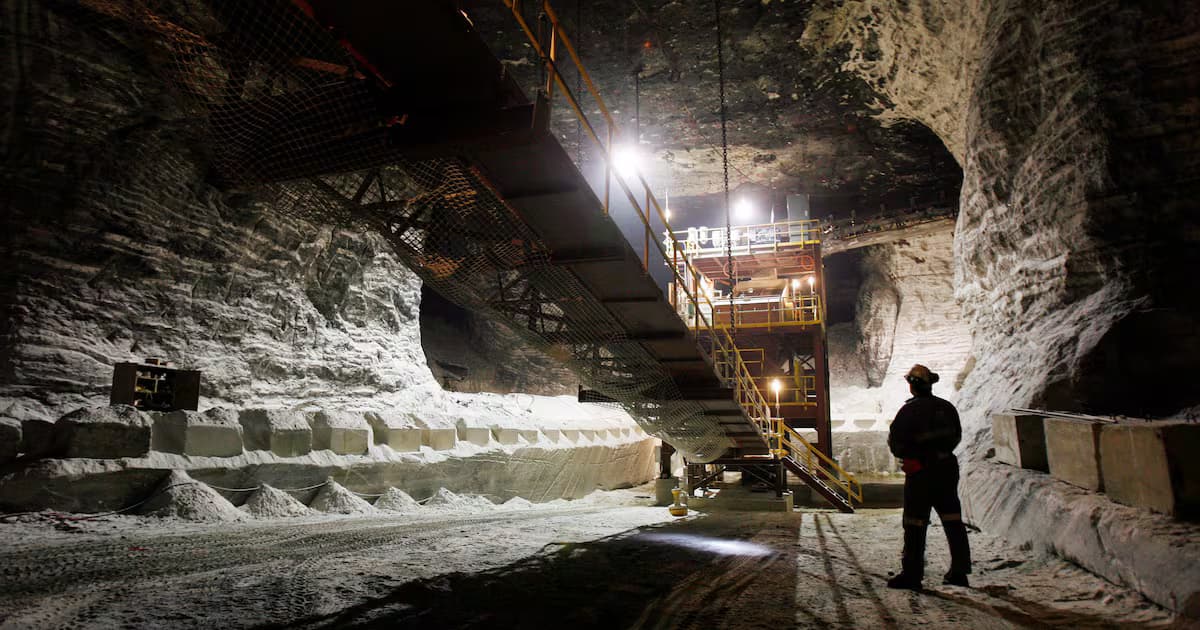
The Goderich mine, owned by Compass Minerals, produces roughly 7.25 million tonnes of salt annually and has capacity to reach about 9 million tonnes. Despite that output, large ships and empty trucks have been observed loading salt destined for U.S. markets while local distributors report shortages.
We remain committed to serving all our valued customers in Ontario and all markets that we serve.
Compass Minerals, in an email to CTV News
More than 100 empty trucks were reported lined outside the Goderich mine recently, waiting to pick up loads for delivery. The mine’s American ownership has prompted scrutiny from contractors and municipal officials about how product is allocated when local demand is high.
Municipal responses and rationing
London has announced operational adjustments to stretch its remaining salt, and Pickering’s city website warns that whatever remains must be used carefully to ensure supply lasts through winter. At the retail level, some Home Hardware stores are seeking new suppliers to keep consumer-sized bags on shelves.
Dave Gerow, president of Triple J Contracting, says municipalities that planned for average winter usage are already near exhaustion this January. His company supplies large public accounts and is altering routes and application rates to conserve salt.
If there's a municipality that only has a thousand tonnes in stock, because that was their average usage over their last 10 years, this year they might already be nearly out, and we're only in January.
Dave Gerow, Triple J Contracting
Supply-chain bottlenecks and rising costs
Distributors report longer hauls and delays as they chase inventory. Some trucks have travelled to the Port of Montreal to pick up shipments of salt arriving from as far away as Egypt, but a backlog at the port has left some drivers returning empty. Contractors say the per-ton price of salt has more than doubled this season.
Gerow describes the problem as a supply-chain issue rather than a raw-material shortage in Ontario. He warns that a long or intense storm period could quickly deplete municipal stockpiles, affecting road safety and service levels.
If we get a busy weekend, a multi-day winter storm or an ice storm, there's a high possibility we could run out of salt, and we're not alone.
Dave Gerow, Triple J Contracting
Government and industry comments
Requests for comment about shipments to the United States were sent to the premier's office and the provincial Ministry of Transportation. The premier's office forwarded queries to the ministry, which did not address the specific question about exports. A ministry spokesperson said the ministry's own salt quantity, used for provincial highways, remains sufficient.
Our own quantity of salt, that services Ontario highways, remains sufficient.
Spokesperson, Ontario Ministry of Transportation
Compass Minerals emphasised its commitments to all its markets, but contractors and some municipal officials say greater co-ordination is needed to prioritise local needs when supply is constrained.
What to expect this winter
Municipalities are already adjusting winter operations, applying salt more sparingly and relying more on mechanical clearing in some neighbourhoods. Distributors predict the supply-chain challenges could extend beyond this winter, with some forecasting shortages into next year unless distribution and procurement change.
For residents, that is likely to mean longer response times for some secondary roads and a continued focus by cities on prioritising main arteries, transit routes and emergency access.
Municipalities and contractors say they are watching stocks closely and exploring alternative suppliers and logistics solutions to keep roads safe while conserving a finite winter resource.
road saltOntariowintersupply chainmunicipal services