Trump shelves planned tariffs after saying he and NATO’s Rutte agreed on a Greenland, Arctic framework
At Davos, Trump announced a framework on Greenland and the wider Arctic and said he will not impose tariffs set for Feb. 1. He named negotiators and promised more details.
Copy link
By Torontoer Staff
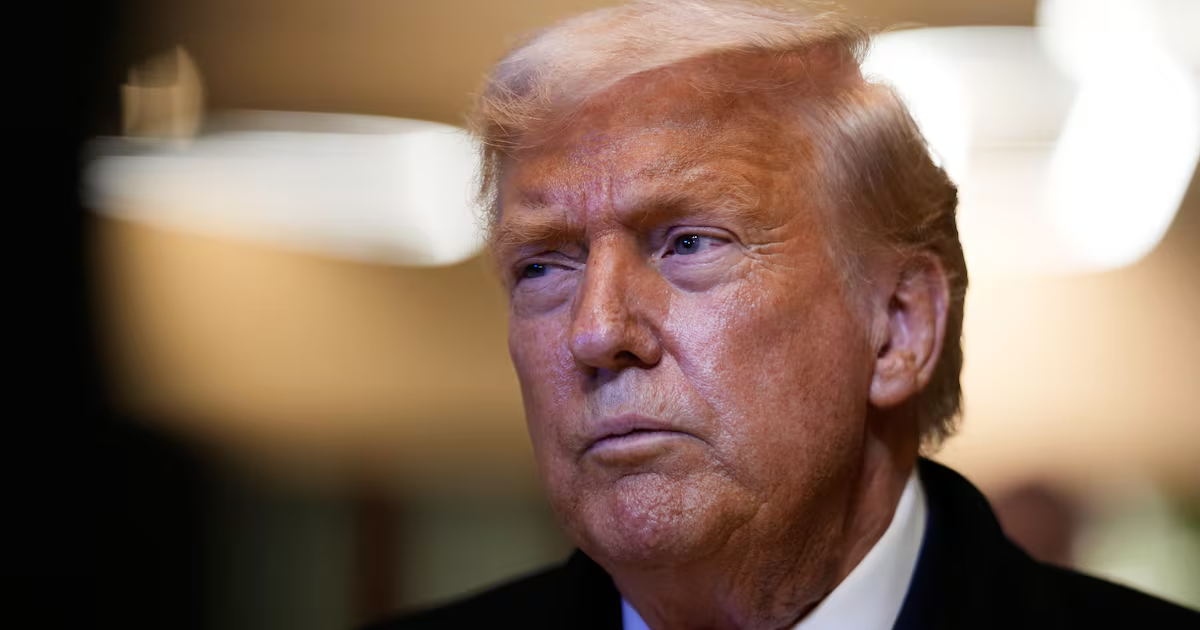
U.S. President Donald Trump announced on Wednesday that he will not impose tariffs that were scheduled to take effect on February 1, saying he and NATO Secretary‑General Mark Rutte have “formed the framework of a future deal with respect to Greenland and, in fact, the entire Arctic Region.” The statement appeared on Truth Social and followed a speech and a series of meetings at the World Economic Forum in Davos.
Trump framed the pause on tariffs as contingent on further talks and named a small team to lead negotiations. He offered little in the way of a public timetable, describing the deal’s timeframe as “infinite,” and said more information will be released as discussions progress.
What Trump said in Davos
Speaking on the main stage and to reporters on the sidelines, Trump repeated his long‑running argument that the United States needs control or influence over Greenland for strategic security reasons. He insisted the move is not about mining or rare earths, and said he does not plan to use force. He also criticised allies, singled out Canada and Denmark for what he called insufficient gratitude, and mocked other leaders during his address.
“Based upon this understanding, I will not be imposing the Tariffs that were scheduled to go into effect on February 1st,”
Donald Trump, Truth Social
Trump made several offhand remarks that drew attention, including an aside that “sometimes, you need a dictator.” He also warned that the United States would “remember” if Denmark refused to negotiate, a line he did not publicly expand on at the forum.
Who will handle the talks
- Vice‑President JD Vance
- Secretary of State Marco Rubio
- Special Envoy Steve Witkoff
- Other advisers to report directly to the president as needed
Trump said those officials will be responsible for negotiating the deal and will report directly to him. He gave no public details on mandates, legal mechanisms or whether any proposals have been put to Denmark or Greenland’s government.
International reaction and diplomatic fallout
Allies reacted quickly. Sweden’s foreign minister welcomed the withdrawal of the tariff threat as a positive step for nations backing Denmark and Greenland. European Parliament members paused work on ratifying parts of a U.S.‑EU trade deal after the earlier tariff threats, and EU leaders prepared an emergency meeting to discuss responses and the principle that Denmark and Greenland decide their own future.
“Good that Trump has now backed away from tariffs on those of us who have supported Denmark and Greenland,”
Maria Malmer Stenergard, Swedish foreign minister
NATO Secretary‑General Mark Rutte told reporters that U.S. allies would defend the United States if it were attacked. He stressed the need to keep focus on other security priorities, including supporting Ukraine, warning that disputes over Greenland should not distract from immediate threats.
“Let me tell you, they will,”
Mark Rutte, NATO Secretary‑General, on whether allies would defend the U.S.
Markets, logistics and local preparedness
Markets reacted to the Davos developments. U.S. stocks recovered some ground after initial drops, while the price of gold climbed to multi‑year highs as investors sought safe havens. Greenland’s government published new citizen guidance labeled for “crisis” scenarios, advising stockpiles of food and water and practical survival items, reflecting heightened local concern over political uncertainty.
Denmark has announced a significant upgrade to Greenland’s defences in recent weeks, and Copenhagen says implementation is underway. The Danish Defence Minister outlined a multi‑billion dollar plan including ships, drones and enhanced satellite capability.
Why Greenland matters
Greenland sits at a strategic crossroads in the Arctic and is part of the wider Arctic Region shared by eight countries: Canada, the United States (via Alaska), Greenland/Denmark, Norway, Sweden, Finland, Iceland and Russia. Interest in the island stems from its location, potential resources and military value in a region with growing geopolitical competition.
Trump has asserted strategic security reasons for pushing for Greenland, while dismissing mining as the driver. Allies and analysts say that any change in sovereignty would raise complex legal, diplomatic and security challenges under NATO and international law.
The president’s announcement to hold off on tariffs pauses an immediate economic escalation, but the wider political tension over Greenland and Arctic security remains unresolved. Leaders in Europe and North America will now watch the nominated negotiating team as it begins discussions, and decisions in the coming weeks will shape relations across the Atlantic.
TrumpGreenlandDavosArctictariffs