2025 ranked third-hottest year on record despite La Niña
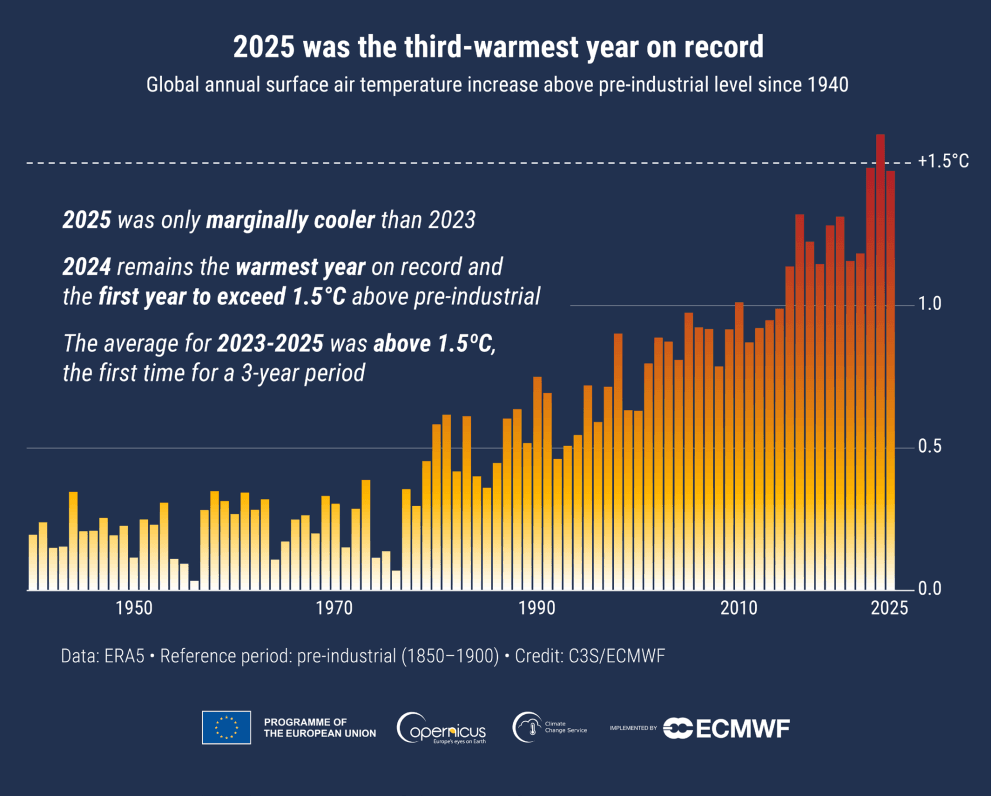
Global monitoring agencies say 2025 was the third warmest year in the instrumental record, with 1.44°C above pre-industrial levels and a continuation of an accelerating warming trend.
Copy link
By Torontoer Staff
Global climate and weather agencies reported this week that 2025 was the third warmest year on record, even though large-scale climate patterns expected to cool the planet were in place for much of the year. The World Meteorological Organisation put 2025 at about 1.44°C above pre-industrial temperatures, a notable rise for a year dominated by La Niña conditions.
The latest figures reinforce a continuing trend: the past 11 years are the warmest since instrumental records began, and the past three years occupy the top three positions on the leaderboard. Scientific groups in Europe and North America delivered broadly consistent analyses showing both a long-term upward trend and exceptional warmth in 2025 compared with previous La Niña years.
How 2025 fitted into recent temperature records
2024 remained the hottest year globally, boosted by a strong El Niño and a peak in the 11-year solar cycle. In contrast, 2025 saw El Niño fade and La Niña emerge, along with a small decline in solar output. Given those shifts, a cooler year would have been expected, but 2025 was unusually warm for a Niña year, exceeding the temperature of the previous La Niña year, 2022, by a wide margin.
Across the major datasets the three-year mean warming relative to pre-industrial levels sits between about 1.48°C and 1.50°C. That places recent years materially closer to international temperature limits set under the Paris Agreement than many previous assessments had suggested.
Drivers behind the unexpected heat
Scientists point to several factors that combined to make 2025 exceptionally warm despite La Niña. The dominant influence is continued growth in anthropogenic greenhouse-gas emissions, notably carbon dioxide. Emissions have not declined enough to offset the long-term warming influence of accumulated greenhouse gases in the atmosphere.
At the same time, reductions in atmospheric sulphate aerosols are removing a short-term cooling influence. Sulphates, produced by sources such as shipping and coal-fired power generation, reflect incoming solar radiation. Cleaner air policy and declines in certain pollution sources have lowered sulphate levels, which improves human health, but also reduces that masking effect on warming.
A separate concern is growing evidence that the climate system may be more sensitive to greenhouse forcing than some models estimated. A joint project by researchers at the University of Exeter and Britain’s Institute and Faculty of Actuaries published this week places sensitivity at the high end of mainstream ranges and warns global temperatures could exceed 2°C by mid-century if emissions do not fall rapidly.
Extreme impacts last year
Polar conditions were a major contributor to 2025’s record. February saw the lowest combined ice cover at both poles since satellite monitoring began in the late 1970s, and Antarctica recorded its hottest year on record. Those anomalies alter atmospheric and oceanic patterns and can amplify global temperatures.
Southern Europe suffered intense heat and wildfires in late July and early August. Fires in Spain and Portugal released almost 14 million tonnes of carbon to the atmosphere in the form of carbon dioxide and produced large amounts of soot. Soot darkens snow and ice and absorbs solar radiation, further increasing warming locally and regionally.
- 2025 global temperature anomaly, WMO estimate: ~1.44°C above pre-industrial
- Three-year mean warming: about 1.48–1.50°C
- Combined polar ice minimum: lowest on record since late 1970s satellite era
- Estimated carbon from 2025 Iberian wildfires: nearly 14 million tonnes
Outlook and policy implications
If recent warming rates continue, several independent calculations indicate the 1.5°C threshold enshrined in the Paris Agreement could be reached before the 2030s. Using the three-decade warming trend as a crude projection places the crossing near the end of this decade. That projection assumes current emissions pathways persist.
It’s not a question of not having the overshoot, but of figuring out how to manage it.
Carlo Buontempo, director, Copernicus Climate Change Service
Forecasts expect El Niño to return later in 2026. A renewed El Niño would likely push global temperatures higher again, making 2026 another strong candidate for the top of recent rankings. That prospect increases urgency for governments to accelerate emissions reductions and for planners to prepare for more frequent extreme events.
Policy responses face difficult trade-offs. Cutting sulphate pollution yields clear public-health benefits, but reduces a short-term cooling effect that had partially masked greenhouse warming. Long-term risk management therefore rests on rapid and sustained reductions in carbon emissions and increased resilience to climate extremes.
The 2025 assessments reinforce a simple conclusion for policymakers and planners: the background climate is warming faster than many expected a few years ago, and extreme years are becoming the new normal. How quickly governments act will determine how soon temperatures overshoot international targets and how large the social and economic costs will be.
climate changeenvironmentWorld Meteorological OrganizationEl Niñowildfires