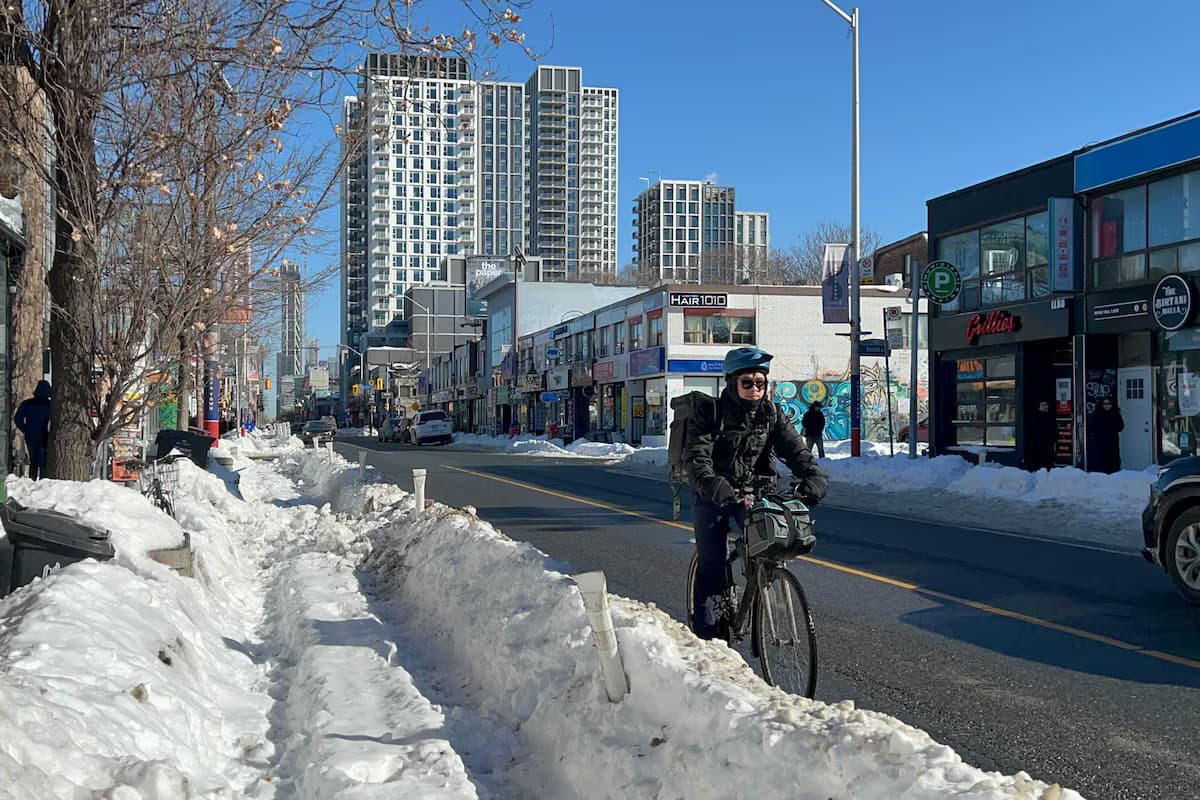
A Toronto councillor said the city cleared “spotless” bike lanes early in last week’s snowfall while residential streets, sidewalks and buses struggled. The comment prompted questions about whether the city prioritizes cyclists over other road users.
City policy and operational realities partly explain the perception. Under council-approved service levels, different parts of the transportation network are scheduled for plowing at different snowfall depths, and that schedule can make bike lanes appear to be cleared before many driving routes or some sidewalks.
How plow priority is set
The city uses fixed snowfall thresholds to determine when crews begin clearing each element of the network. Those thresholds are set through council service levels and reflect both safety and operational factors.
- Bike lanes and sidewalks: plow and clear when 2 centimetres accumulate
- Expressways: 2.5 centimetres
- Major roads: 5 centimetres
- Residential streets: 8 centimetres
Because bike lanes and sidewalks have lower thresholds, they are scheduled for service sooner than major and residential roads. The city says that reflects vulnerability: smaller snow amounts can create safety and accessibility hazards for pedestrians, cyclists and people using mobility devices.
Why bike lanes can look cleared first
City staff point to practical reasons why bike lanes sometimes appear to be plowed before other walking or driving routes. There are fewer kilometres of bike lanes than of roads, and they have fewer obstacles for plows, which makes them faster to service.
Sidewalk clearing is more complex and as a result may be plowed at a slower speed.
Laura McQuillan, city spokesperson
That speed difference can create visible contrasts, for example a clear curbside lane beside a sidewalk where ploughing has been slowed by parked cars, delivery drops or snow already shoveled onto the walkway.
Who still uses bike lanes in winter
City counts show winter cycling at about 20 per cent of peak summer volumes. On busy downtown routes such as Richmond and Adelaide Streets that translates to roughly 1,200 riders per day. By comparison, about 20,000 motorists use the same corridor daily, according to a 2024 Toronto Region Board of Trade report.
Even in winter, thousands of people rely on Toronto’s bike lanes to get around. Plowing bike lanes keeps them safe and accessible.
Laura McQuillan, city spokesperson
The city also highlights specific user groups such as food delivery riders, whose work depends on accessible curbside routes year-round.
Cyclists and volunteers report mixed results
Some cyclists and neighbourhood volunteers said the councillor’s claim that lanes were universally “spotless” did not match their experience. After last week’s storm, riders shared photos of snow-blocked bike lanes next to cleared streets and sidewalks.
Albert Koehl of the Toronto Community Bikeways Coalition said he and seven volunteers spent a Saturday clearing a three-kilometre stretch of Bloor Street between Royal York and Runnymede. Two days after the snowfall, parts remained impassable in places.
Within 24 hours are you able to ride a bike across the city? No. Politically it is clever to create this kind of wedge issue, but it is clearly inaccurate.
Albert Koehl, Toronto Community Bikeways Coalition
Volunteers reported a mix of fully plowed stretches and patches blocked by shoveled snow or incomplete service. Those local differences help explain why residents photographing the same street can reach different conclusions about overall city performance.
Political context and official response
Councillor Bradford posted a video arguing residential streets and sidewalks were neglected while bike lanes were “plowed early, salted, and spotless.” The video emphasised blocked cars, towed buses and residents struggling to move around their blocks.
Residential streets were buried, cars were stuck, buses were getting towed, and people were struggling just to get around their own blocks. Meanwhile, bike lanes across the city were plowed early, salted, and spotless.
Councillor Bradford
Mayor Olivia Chow said crews work around the clock during storms to clear roads, sidewalks and bike lanes. She dismissed the idea that cycling routes receive disproportionate focus.
Crews are out clearing everything, 24-7, if there is a snowstorm. We are out clearing roads, sidewalks, and yes, bike lanes.
Mayor Olivia Chow
What to take away
City policy means bike lanes and sidewalks are scheduled for service at lower snowfall depths than many driving routes, which can make them appear to be cleared first. Operational factors, local obstructions and inconsistent service across neighbourhoods produce the varied experiences residents reported.
Officials say the approach prioritises safety and accessibility for people walking and cycling, while cyclists and volunteers say visibility of plowing results varies street by street. The debate highlights the challenge of communicating operational rules and meeting differing expectations in the immediate aftermath of storms.