Armed Forces model a hypothetical U.S. invasion, outline insurgency-style response
The Canadian Armed Forces modelled a conceptual U.S. invasion and potential Canadian response, including insurgency tactics. Officials say the scenario is theoretical and an actual U.S. attack is unlikely.
Copy link
By Torontoer Staff
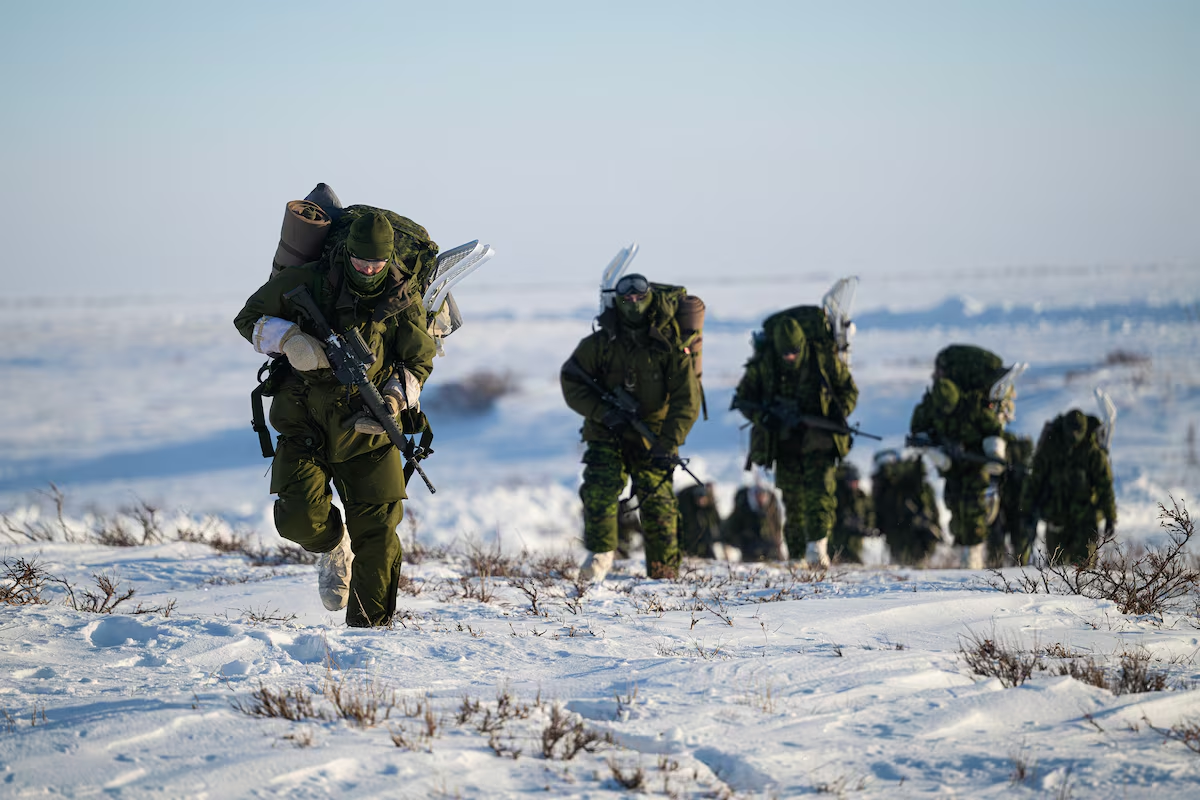
The Canadian Armed Forces modelled a hypothetical U.S. invasion and how Canada might resist, including unconventional tactics such as ambushes, sabotage, drone strikes and hit-and-run attacks, two senior government officials told the Globe and Mail. The study is a conceptual framework, not an operational plan, and the officials said an American attack remains unlikely.
Officials said the modelling, believed to be the first time in a century Canadian planners have mapped a U.S. assault, looks at how a vastly superior conventional force could be blunted by irregular warfare and civilian resistance if invasion were ordered.
What the model assumes
Planners modelled an attack coming from the south, with American forces expected to overcome Canada’s strategic positions at land and sea within days to a week. Given Canada’s smaller military and limited heavy equipment compared with the United States, the model prioritises unconventional methods for inflicting casualties and disrupting occupying forces.
The tactics described draw on examples from Afghanistan. One official said the model includes hit-and-run attacks similar to those used by the mujahedeen against Soviet forces in 1979 to 1989, and tactics later employed by the Taliban against coalition forces. The objective in the scenarios is not to defeat U.S. forces conventionally, but to make occupation costly and difficult.
Why planners considered the scenario
Officials framed the work as part of broader threat analysis. The military has also modelled missile strikes from other peer competitors, and is participating with the United States on a proposed continental missile-defence architecture referred to as Golden Dome. Sources say the modelling anticipates a breakdown in joint defence cooperation, such as a rupture in NORAD’s shared skies policy, as a signal that an attack might be imminent.
The scenario drew renewed attention amid diplomatic friction over Greenland and public comments from U.S. officials and ex-advisers about Canada’s posture in the Arctic. Nonetheless, government and defence sources emphasise the study is conceptual and that bilateral military relations remain largely cooperative.
What Canada could do
Conscription is not on the table, officials said. Defence leadership has already proposed a large volunteer reserve to broaden options in a crisis. Chief of the Defence Staff Jennie Carignan has signalled an intent to expand reservist numbers significantly, with planners discussing how volunteers might be armed or tasked to conduct disruptions if an occupying force appeared.
Retired officers consulted for the public debate said insurgency-style tactics would be among the few available tools to blunt an invasion, and that assets such as small drones and anti-vehicle weapons could be decisive in denying freedom of movement to armoured formations.
You know if you come after Canada, you are going to have the world coming after you, even more than Greenland. People do care about what happens to Canada, unlike Venezuela.
Retired major-general David Fraser
Fraser argued allied support would be likely, with countries such as Britain, Germany and Japan potentially contributing forces or logistics. Other retired senior officers were more sceptical about an American attack, while stressing Canada must still strengthen homeland defence and its presence in the Arctic.
It is fanciful to think the Americans would actually invade Canada, but we could not withstand a conventional invasion. They would have great difficulty occupying a country the size of Canada.
Retired lieutenant-general Mike Day
Experts on deterrence and homeland defence
Analysts say the modelling serves two purposes: to explore worst-case contingencies and to identify capability gaps that matter in peacetime. Building credible homeland-defence capabilities, they argue, is a deterrent even if the specific scenario modelled is unlikely.
The better Canada can embrace this approach to homeland defence, the less likely all of these horrible scenarios that nobody wants will ever come to pass.
Aisha Ahmad, University of Toronto political scientist
Gaëlle Rivard Piché of the Conference of Defence Associations said the messaging matters. She said Canada should clearly signal to its neighbour that it can be a capable, credible ally and that it can defend its own territory rapidly.
What to watch
- Progress on the volunteer reserve expansion and investments in Arctic infrastructure and surveillance
- Canada’s participation in continental missile-defence planning, including the so-called Golden Dome project
- Diplomatic developments with the United States that affect NORAD and shared defence arrangements
Officials and experts emphasise that the modelling is not evidence of imminent conflict. It is analytical work intended to help policymakers prioritise defence investments, readiness and alliances so Canada can deter threats and respond if circumstances change.
For now, the study has prompted public discussion about how Canada should balance continental partnership with independent capability building, and how to defend a vast country against a range of possible threats.
defenceCanada-U.S. relationsmilitaryhomeland securityNORAD