At Davos, Trudeau set a new purpose for Canada: protect economic sovereignty and build middle-power coalitions
At Davos, Prime Minister Justin Trudeau framed a national purpose: bluntly name geopolitical realities, reduce economic leverage that enables coercion, and rally middle powers and business to act.
Copy link
By Torontoer Staff
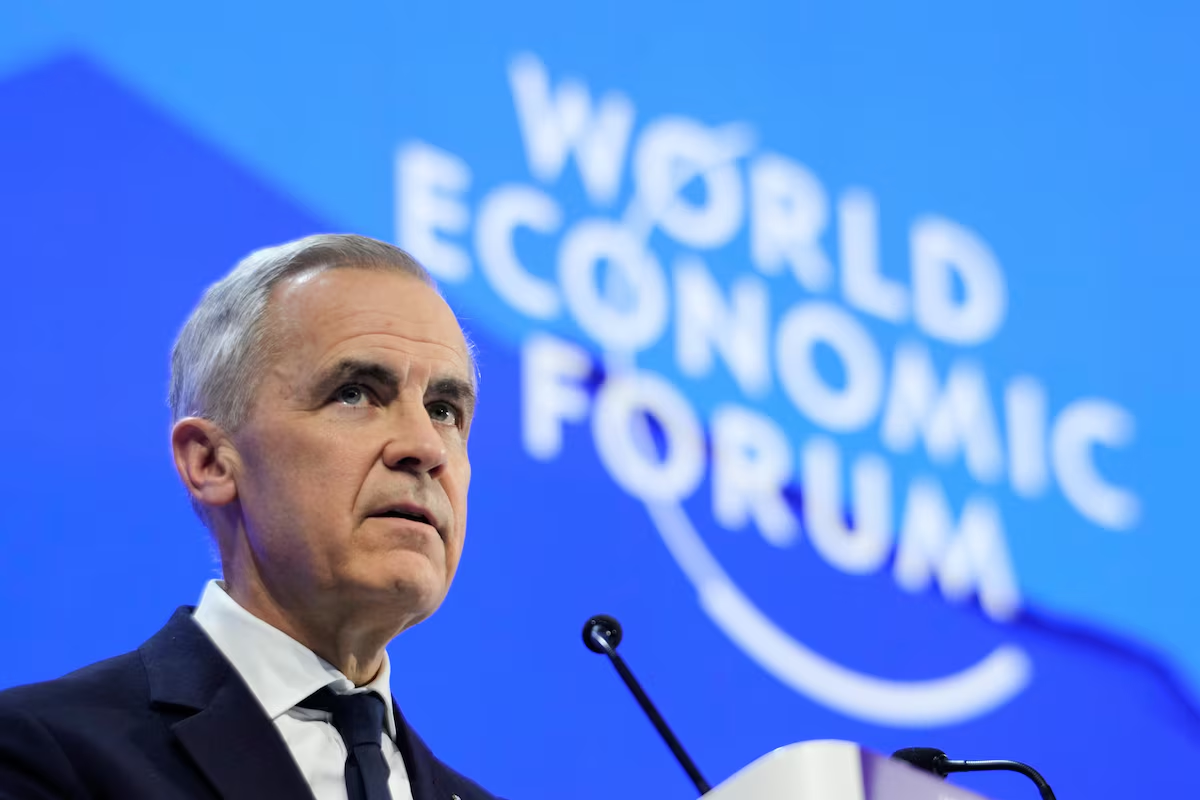
At the World Economic Forum in Davos, Prime Minister Justin Trudeau laid out a concise national purpose: secure Canada’s economic sovereignty and help other middle powers resist economic coercion. He urged Canadians, business leaders and allies to recognise a shifting global order and to build practical coalitions that defend shared rules and values.
Trudeau’s speech combined a blunt diagnosis of the present with specific policy direction. He described the erosion of the international rules-based order, warned against retreating into protectionism and asked Canadian business to play an active role beyond profit and compliance.
Naming the problem
The Prime Minister opened by rejecting comforting illusions about global integration. He used the phrase "the end of the pleasant fiction," invoking a literary image to say that the institutions and agreements that once guaranteed predictable trade and cooperation are now under strain. In his words, the world faces a reality where economic ties can be weaponised by powerful states against those with less leverage.
He quoted a long-standing realism about power: "That the strong do what they can, and the weak suffer what they must," and framed Canada’s response as practical and values-driven rather than idealistic. The task, he said, is to reduce the levers that enable coercion and to bind like-minded middle powers into functioning coalitions.
A world of fortresses will be poorer, more fragile, and less sustainable.
Prime Minister Justin Trudeau
Policy, trade and coalition-building
Trudeau presented coalition-building as a pragmatic, incremental project: link trade frameworks, coordinate on security measures, and pool economic resilience. He set out an ambition to knit together existing agreements so they operate at scale, citing the idea of creating a larger trading zone by aligning the Trans-Pacific Partnership and European Union frameworks.
The government’s recent diplomatic and trade activity underpins that strategy. In the past six months Ottawa has signed a string of trade and security arrangements and pursued bilateral deals with countries including China and Qatar, seeking to diversify markets and harden economic ties that cannot be easily severed.
What Trudeau asked of Canadian business
The speech repositioned business as a national security partner. Trudeau said that corporate leaders must look beyond balance sheets and consider the strategic consequences of where they invest, how supply chains are structured and how much leverage foreign actors can gain over critical sectors.
- Diversify supply chains away from single points of failure
- Prioritise investments that strengthen domestic and allied economic resilience
- Work with government on standards and agreements that reduce vulnerability to coercion
- Adopt corporate policies that reflect human rights, sustainability and national security concerns
The government framed these measures as both defensive and competitive: firms that shore up resilience also build long-term market advantages in an uncertain world.
Historical perspective and middle-power strategy
Trudeau placed the moment in historical context, drawing a line from the Victorian era and the upheavals that followed to today’s systemic strains. He suggested Canada cannot afford passivity, recalling past episodes when the country found itself at the mercy of larger geopolitical forces.
The remedy he proposed is not grandstanding or isolation. It is a middle-power strategy that leverages Canada’s strengths: multilateral relationships, moral authority on human rights and sustainable development, and the ability to build issue-based coalitions with partners who share enough common ground to act effectively.
Reducing the economic leverage that enables coercion is central to defending our sovereignty and our values.
Prime Minister Justin Trudeau
Practical implications for Canadians
For policymakers the speech signals a continued push for trade diversification, investment screening, and coordination with allies on economic security. For business it means greater scrutiny of where risks lie and closer collaboration with government. For voters it is a prompt to expect foreign policy to be judged in domestic terms, including jobs, supply chains and critical infrastructure.
Trudeau’s message is actionable: name the reality, build the institutions and coalitions that reflect it, and mobilise public and private actors to reduce vulnerabilities. That combination of clarity and practical steps is intended to turn a strategic diagnosis into measurable change.
The Davos speech reframes Canadian statecraft around economic sovereignty and coalition-building. If the government and business accept the assignment, the coming months will test whether those words translate into policy and commercial choices that make Canada harder to coerce and better positioned to shape the rules that will govern tomorrow’s global economy.
CanadaDavosJustin Trudeautradeforeign policy