Canada builds CHORD: 512 radio dishes rising in B.C. to probe the cosmos
A 512-dish radio telescope is taking shape near Penticton. CHORD will map hydrogen across the universe and hunt fast radio bursts with high precision.
Copy link
By Torontoer Staff
Construction is underway on CHORD, the Canadian Hydrogen Observatory and Radio-transient Detector, a 512-dish radio telescope being installed in the Okanagan Valley near Penticton, B.C. The array aims to map hydrogen across cosmic time and to detect fast, fleeting radio bursts from far beyond the Milky Way, all on a $23-million budget.
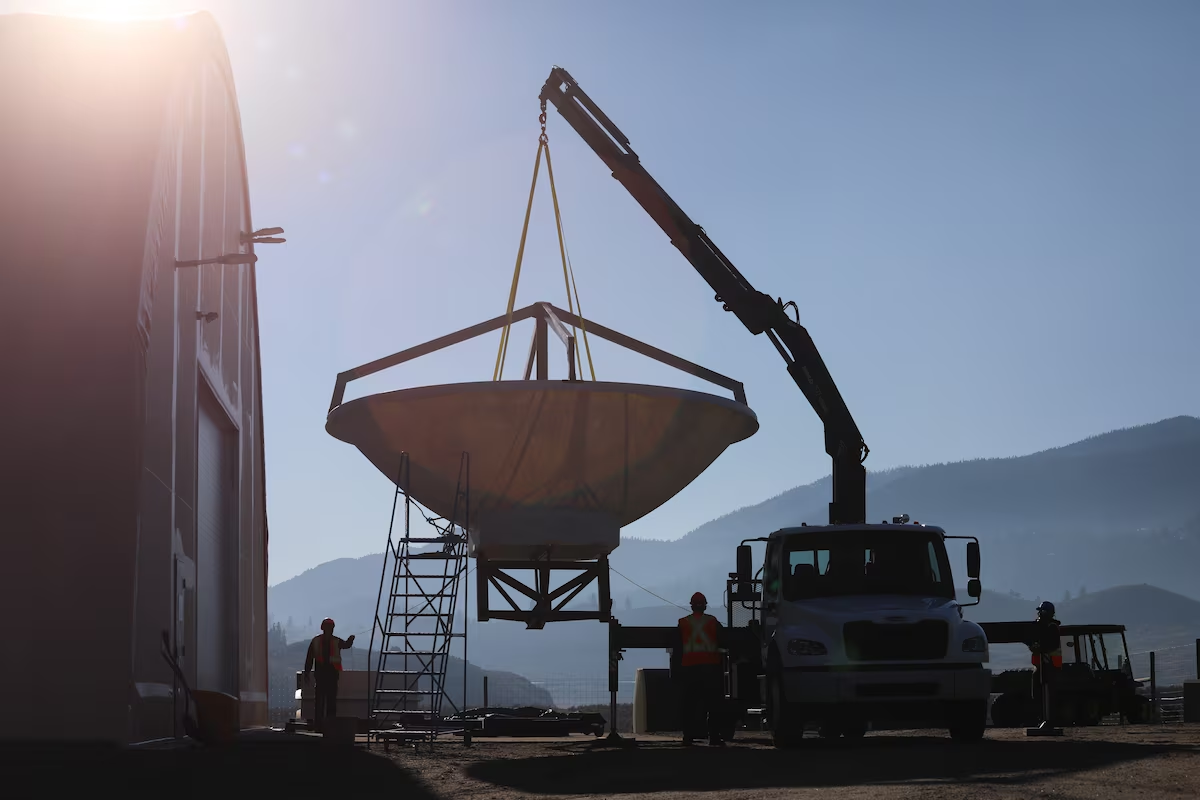
Project scientists say the design emphasises repeatability and cost control, so many identical, six-metre dishes can be mass produced on site and combined to act like a single, much larger receiver.
Design and production: a practical approach
CHORD’s dishes are small compared with single-dish observatories, but their number gives the array a collecting area equivalent to two soccer fields. The project relies on nearly identical components to make the array’s performance highly predictable and to keep costs down. As of January, 37 dishes were in place, with a target of 512 by next year.
The whole intent is to design something that can be rapidly scaled up, there’s nothing to stop us from just continuing.
Kendrick Smith, project scientist, Perimeter Institute
Rising steel prices after the pandemic prompted a redesign that substitutes fibreglass moulded on site for many metal parts. The technique borrows from recreational boat building: lightweight, repeatable layups produce dishes with the precision needed for radio astronomy while trimming material costs.
What CHORD will do
CHORD has two main scientific goals: map the large-scale distribution of hydrogen to track the universe’s expansion history, and detect and localize fast radio bursts, brief flashes of radio energy from extragalactic sources.
By measuring the imprint of baryon acoustic oscillations, the relic sound waves from the early universe, CHORD can act as a metre stick for cosmology. That can help constrain how the expansion rate changes over billions of years, offering new data about the balance between dark matter and dark energy.
- Map neutral hydrogen across large cosmic distances
- Measure baryon acoustic oscillations to track expansion
- Detect and precisely localize fast radio bursts to probe intergalactic matter
- Serve as a pathfinder for scalable, computation-driven telescope design
In my view it’s a coming of age. We’re creating something end to end and we’re thinking big about it.
Matt Dobbs, project director, McGill University
Data, computing and the role of CHIME
CHORD follows the computational model pioneered by CHIME, another Canadian instrument that uses large metal troughs instead of dishes. CHIME has proven the effectiveness of collecting large volumes of data then relying on advanced processing to find signals. CHORD takes that idea further by using many dishes and wider frequency coverage to improve sensitivity and localisation.
To handle the torrent of data, CHORD uses 156 graphics processing units and custom software to reduce raw streams to the signals astronomers need. The project team describes the instrument as a machine that converts astrophysical problems into computer science challenges.
Site, collaboration and local impact
CHORD is being built at the Dominion Radio Astrophysical Observatory. The location, a sheltered valley south of Penticton, is protected from most local radio interference by surrounding hills, which helps preserve the sensitivity of the receivers.
Production has created local jobs and a small, specialised manufacturing line that can turn out dishes rapidly. Project staff say the observatory is busier than at any time in its history as teams lay up, test and deploy antennas.
The core array in B.C. will be complemented by 128 dishes at two remote stations in the United States. Together those stations will form a continental triangle, improving angular resolution and enabling precise localisation of transient sources.
Early milestones and outlook
Before the new year the team combined signals from three dishes to observe Cassiopeia A, producing CHORD’s first fringes, a basic test that shows the dishes are working together. The test was celebrated on site with a cake decorated with the interference pattern.
If CHORD meets its goals, scientists expect results within a few years: improved maps of hydrogen, a richer sample of well-localized fast radio bursts, and new constraints on cosmological models. The project also aims to demonstrate a cost-effective model for building powerful arrays, with most investment in digital infrastructure rather than large structures.
Canada funded CHORD as a single instrument, so success matters for the country’s research profile. The team calls the project a chance to gain hands-on experience designing and operating a next-generation radio observatory on Canadian soil.
CHORD will not only expand the tools available to cosmologists and transient astronomers, it will test a scalable approach to building telescopes that could be doubled in size or upgraded as computing costs fall. The next few years will determine whether this pragmatic, repeatable model becomes a template for future large-scale science in Canada.
CHORDradio astronomyCHIMEOkanaganPentictonfast radio burstscosmologyDominion Radio Astrophysical ObservatoryCanada science