Canadian officer in U.S. 11th Airborne would not be sent to Minnesota without Ottawa’s approval
Brig.-Gen. Robert McBride, a Canadian serving as deputy commander of the U.S. 11th Airborne Division, would not be subject to U.S. deployment orders in Minnesota without permission from Canada, National Defence says.
Copy link
By Torontoer Staff
A Canadian officer serving as second-in-command of the U.S. Army’s 11th Airborne Division would not be deployed to Minnesota under U.S. orders without approval from the Government of Canada, National Defence told Canadian media. Brigadier-General Robert McBride holds the deputy commanding general of operations post, a role occupied by a Canadian since 2014 under an exchange arrangement.
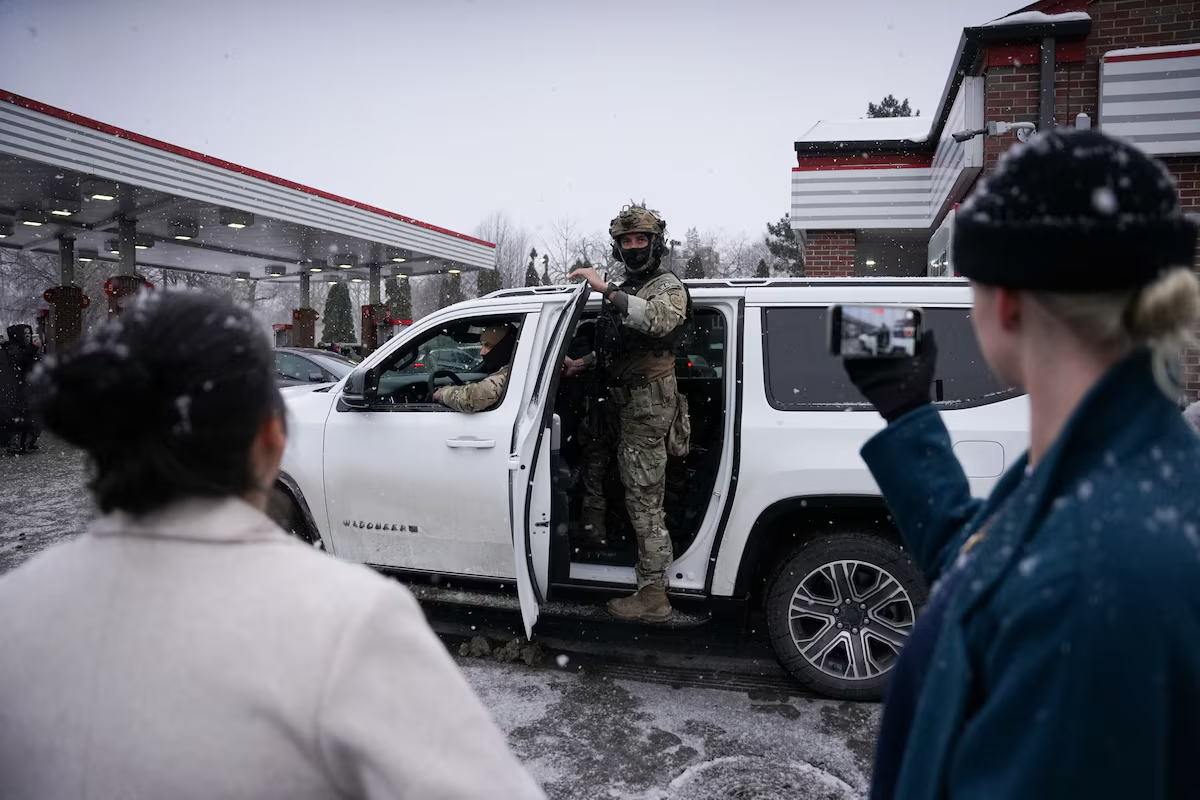
The clarification follows U.S. reports that President Donald Trump issued prepare-to-deploy orders for two infantry battalions of the Alaska-based 11th Airborne Division amid large protests in the Twin Cities over an immigration enforcement operation and the recent fatal shooting of Renee Nicole Macklin Good by an Immigration and Customs Enforcement agent.
What National Defence said
Kened Sadiku, a National Defence spokesperson, told The Globe and Mail that Brig.-Gen. McBride would not be subject to the U.S. President’s orders. "There are currently no active-duty members involved in operations in Minnesota, nor would they be allowed to be without approval by the Government of Canada. At this time, no such request has been made," he said.
How the exchange posting works
McBride’s role is part of a Canadian Armed Forces exchange program that places Canadian officers in U.S. commands. The posting requires a recommendation from the Chief of the Defence Staff and authorization from the Minister of National Defence. While exchange officers work within partner forces, their participation in operations outside routine duties depends on approval from their home government.
It is a pretty far stretch that any Canadian government would approve the deployment of an exchange officer on a domestic operation. For years, we had officers and non-commissioned officers in the British Army and none of them, zero, went to Northern Ireland.
Retired Major-General Denis Thompson
Context: why Minnesota drew military prepare-to-deploy orders
U.S. media reported that the Army placed roughly 1,500 active-duty personnel in Alaska, including two infantry battalions from the 11th Airborne Division, prepared for possible deployment if unrest in Minneapolis and St. Paul escalated. The move came after demonstrations against immigration enforcement actions and the death of 37-year-old Renee Nicole Macklin Good in an encounter with an ICE agent.
The Pentagon has previously moved forces for domestic contingencies. In the summer, about 700 Marines were sent to Los Angeles to guard federal properties amid protests related to immigration enforcement, though their activities were limited to protective duties.
Legal and political constraints on cross-border involvement
Exchange officers operate under bilateral terms and national law. In Canada, deploying personnel to participate in another country’s domestic security or law enforcement operations would require explicit government approval. National Defence indicated no such request had been received from the United States.
- Exchange postings require Chief of the Defence Staff recommendation and ministerial sign-off.
- Canadian approval would be necessary before an exchange officer could take part in domestic operations in another country.
- Past practice shows reluctance to allow exchange personnel to join foreign domestic security tasks, as noted by retired senior officers.
McBride’s record
Brigadier-General Robert McBride is a career Canadian officer with operational experience in Bosnia, Kosovo, Sierra Leone, Afghanistan and Iraq. His decorations include the Meritorious Service Medal, a Chief of Defence Staff Commendation and appointment to the Order of Military Merit, reflecting his service in combat and coalition operations.
Local reaction and wider implications
Minneapolis Mayor Jacob Frey warned that any deployment of military forces into the city would increase tensions. The Trump administration has also threatened to invoke the Insurrection Act, a rarely used law that can allow U.S. military forces to perform law enforcement duties domestically.
Analysts say using military forces in domestic disturbances raises legal, political and public-opinion risks for both the host country and any foreign personnel who might be involved. Canada’s requirement for ministerial approval helps ensure that decisions about Canadian exchange officers reflect national policy and legal constraints.
For now, National Defence’s statement closes the question of Brig.-Gen. McBride’s immediate involvement. Ottawa would need to receive and approve any formal U.S. request before a Canadian officer in the exchange program could take part in U.S. domestic operations.
CanadaMilitaryUS-Canada relationsMinnesotaBrigadier-General Robert McBride