Carney abandons conciliatory approach to Trump, adopts tougher trade posture
After resolving a tariff dispute with China and denouncing economic coercion at Davos, Prime Minister Mark Carney is pursuing a harder line ahead of USMCA talks.
Copy link
By Torontoer Staff
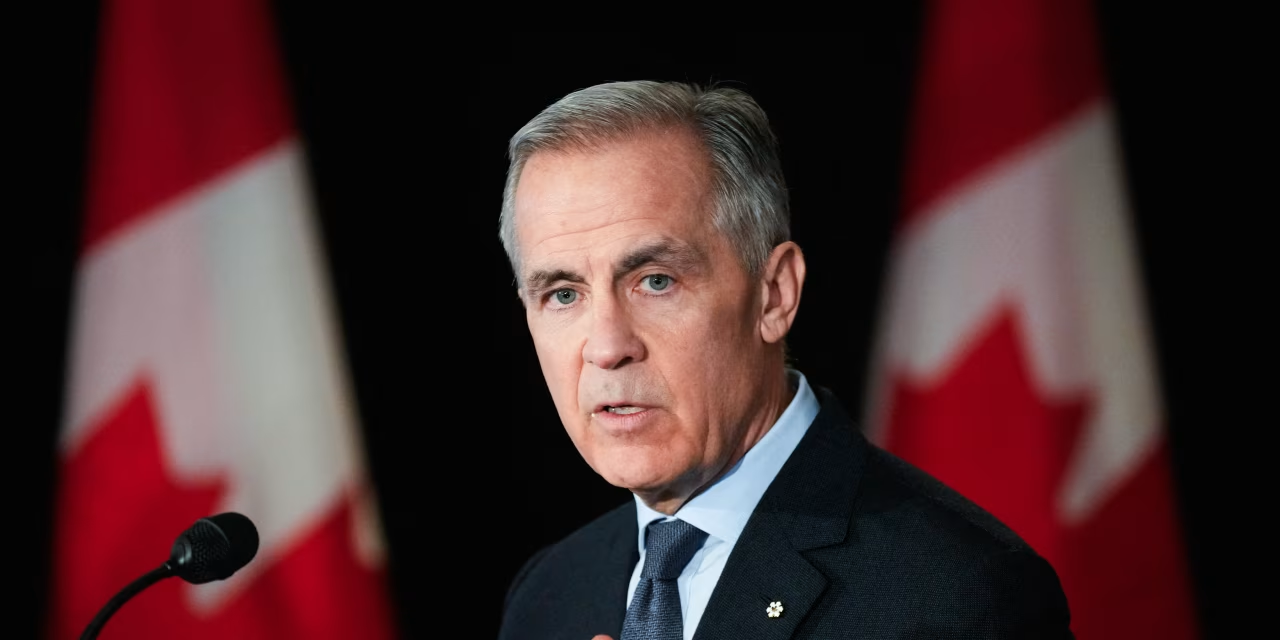
Prime Minister Mark Carney has shifted from a conciliatory approach toward U.S. President Donald Trump to a firmer posture, following a trade settlement with China and a high-profile speech at the World Economic Forum in Davos. Political analysts say the move is aimed at building leverage ahead of renegotiations of the U.S.-Mexico-Canada Agreement, or USMCA.
The change carries risk. Canada remains heavily exposed to U.S. trade policy and faces existing tariffs and uncertainty that already weigh on businesses and households.
Why the shift now
Carney entered office trying to cultivate a cooperative relationship with Trump through measures such as tighter border security, stepped-up anti-fentanyl efforts, increases in military spending and dropping a proposed digital tax on U.S. tech companies. Analysts say those gestures produced little traction in Washington, prompting a tougher strategy.
Carney "has tried to be nice, but he hasn’t gotten too far. Carney is now turning up the heat to get more attention."
Christopher Sands, director of Canadian studies, Johns Hopkins University
Observers identify two practical motives for the pivot. First, projecting strength can create bargaining chips before USMCA negotiations, in the way other countries have used trade measures to gain leverage. Second, the tougher tone may prime the government for a snap election by framing stability and economic sovereignty as a campaign theme.
"It’s time to take the gloves off and play hardball."
Fen Hampson, international politics professor, Carleton University
"In the world Carney is describing, stability becomes an asset."
David Coletto, president, Abacus Data
International moves and reactions
The China agreement Carney announced addresses a tariff dispute affecting Canadian agricultural products and speculative issues around China-made electric vehicles. Carney has emphasised that the deal was not an opening to comprehensive free-trade agreements with China, telling reporters he "has no intention to pursue free-trade agreements" with China or other non-market economies.
Carney has also pursued deeper ties with Europe and Gulf states. In Qatar he secured investment pledges for Canadian clean-energy projects, artificial intelligence ventures and the defence sector. Canada gained access to a European Union defence fund intended to reduce dependence on the U.S.
- Resolved tariff dispute with China affecting agricultural and food products and electric vehicles
- Investment pledges from Qatar for clean energy, AI and defence projects
- Access secured to a European Union defence fund
The moves have drawn a sharp reaction from the Trump administration. On Truth Social, Trump warned he would impose 100 percent tariffs on all Canadian imports should Ottawa strike a comprehensive deal with Beijing. He also posted that "China is successfully and completely taking over the once Great Country of Canada."
Domestic politics and risks
Carney leads a minority Liberal government. That heightens the stakes of both foreign and domestic manoeuvres: a miscalculation could intensify economic pressure from Washington or provide ammunition for opposition parties.
"We have had enough words. Now, we need results."
Pierre Poilievre, Conservative Party leader
Trade lawyers and business groups express concern that escalating tensions could make USMCA renegotiations more difficult. "I want to be optimistic that USMCA will remain largely intact after talks this year, but I don’t think Carney can keep going like this because it will be impossible to renegotiate," said Mark Warner, a Toronto trade lawyer who practises in both Canada and the U.S.
What comes next
Carney plans further diplomatic engagement, including a visit to Australia in March. He has called for smaller powers such as Canada and Australia to coordinate responses to economic coercion by larger states, an argument that Australian Prime Minister Anthony Albanese has publicly supported.
Analysts say the near-term test will be how Ottawa manages USMCA talks and whether the tougher posture yields meaningful concessions without triggering new tariffs or broader economic fallout. Domestic political timing also matters: analysts see the Davos message as potentially laying the groundwork for a campaign that centres on stability and economic sovereignty.
For now, Carney has balanced a public rejection of broad trade deals with non-market economies and a series of targeted international moves designed to diversify Canada’s options. Whether that approach buys leverage or raises the cost of access to the U.S. market will be a defining question for Canada’s economy this year.
Mark CarneyUSMCACanada-US relationstradeDavos