Carney: Holocaust Remembrance Day must prompt Canadians to confront past complicity
At the National Holocaust Memorial, Prime Minister Mark Carney urged Canadians to remember how silence and policy contributed to the Holocaust and to act against rising antisemitism.
Copy link
By Torontoer Staff
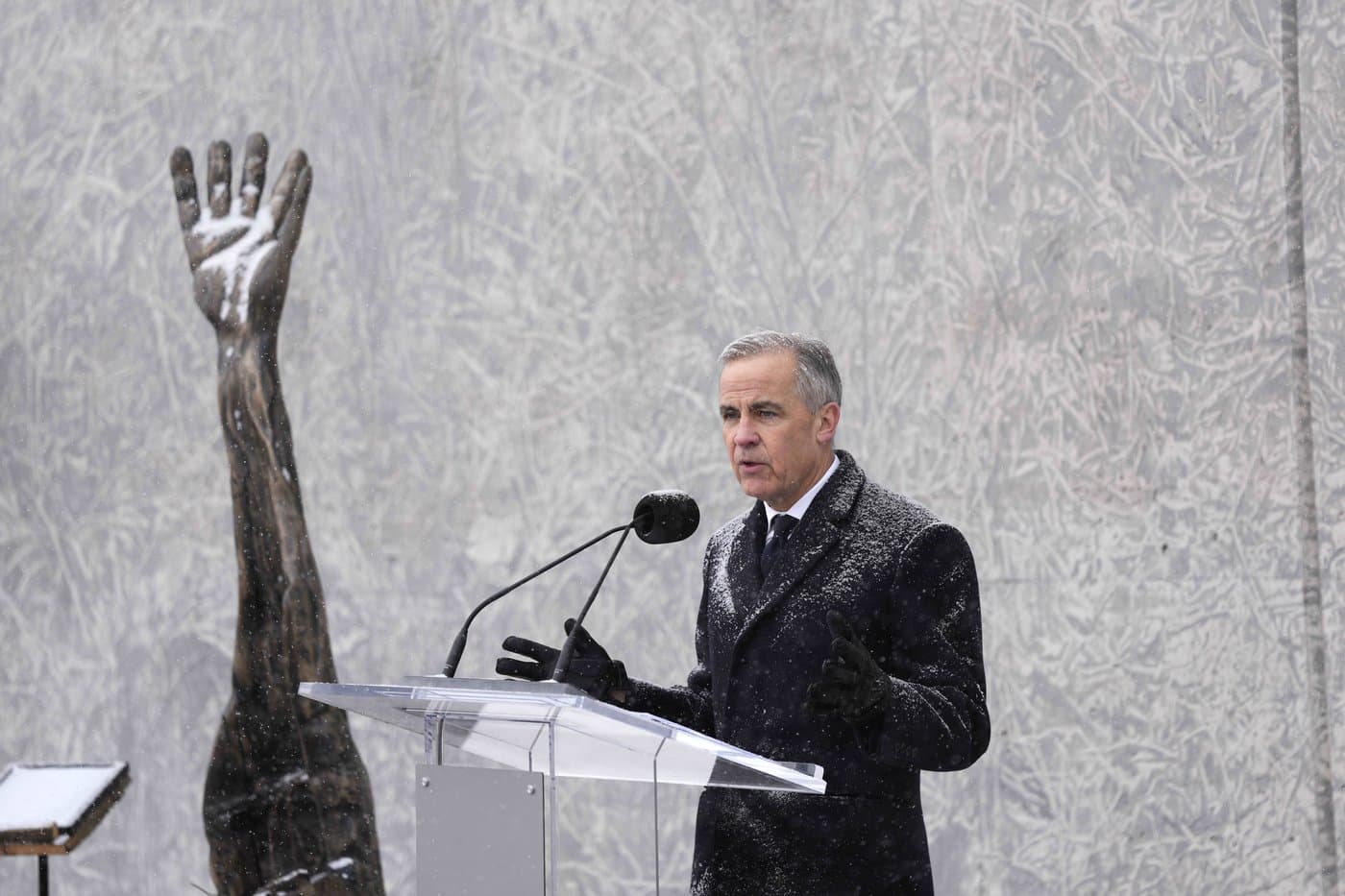
Prime Minister Mark Carney told a Holocaust Remembrance Day ceremony in Ottawa that Canadians must confront the consequences of ignorance and hatred, and acknowledge the country’s wartime complicity in allowing Nazi persecution to proceed largely unchecked.
Speaking at the National Holocaust Memorial, Carney said remembering the Holocaust is essential to preventing repetition and to supporting survivors and their families who continue to live with the aftermath.
The liberation of Auschwitz-Birkenau exposed the scale of Nazi crimes to the world and became symbols of the horrors of the Holocaust, the guilt of the enablers and the resilience of the survivors.
Prime Minister Mark Carney
Carney insisted that silence and indifference were not neutral. "Today, we acknowledge that looking away is not a passive act, but an act of betrayal," he said, calling on Canadians to reflect on policies and attitudes that left many refugees without refuge.
Canada’s wartime record and the meaning of remembrance
Holocaust Remembrance Day, established by the United Nations in 2005, honours the roughly six million Jewish people murdered under the Nazi regime and other victims of Nazi persecution. Carney highlighted that Canadian immigration policy at the time reflected widespread antisemitism and contributed to the small number of Jewish refugees admitted here.
The Canadian Museum for Human Rights has said Canada accepted the smallest number of Jewish refugees of any Allied nation during the Second World War. After the war, about 40,000 Holocaust survivors settled in Canada, according to federal figures.
Rising antisemitism in Canada today
Carney linked historical failings to present-day challenges, noting a sharp rise in reports of anti-Jewish hate in recent years. Police and Jewish community organisations have documented an increase in incidents ranging from vandalism to violent attacks, including firebombings targeting Jewish schools and synagogues.
Advocacy groups are urging government action. B’nai Brith Canada this week called for a federal commission on antisemitism, saying a growing number of people are blaming all Jews for the actions of the state of Israel and that anti-Israel sentiment can morph into antisemitism.
Parliamentary response: Bill C-9 and legal measures
Carney drew attention to work in Parliament on Bill C-9, which would create two new Criminal Code offences: intimidating someone to make them afraid to access a religious or cultural institution, and intentionally obstructing someone attempting lawful access to those places.
"We know these laws are tragically necessary, but they’re far from enough," Carney said, adding that he is working with Conservative Leader Pierre Poilievre on the legislation. He argued laws can deter and punish acts of hate, but cannot by themselves prevent prejudice from taking root.
Today’s antisemitism, regretfully, is more top-down than bottom-up. It is spread through university faculties, and other educational institutions that teach people to fear and hate Israel.
Conservative Leader Pierre Poilievre
Poilievre said anti-Israel sentiment often transforms into antisemitism and urged Canadians to protect the right of Jewish people to practise and express their faith openly. He framed safety and acceptance as the measure of whether the country has honoured the Holocaust pledge of "never again."
Voices of survivors and advocates
Survivors and community organisations say remembrance must include education, support services and public policy. They point to intergenerational trauma among survivors and the continued need for security at religious and cultural institutions.
- Support survivor services and community security funding.
- Push for educational curricula that teach the history and warning signs of genocide.
- Back legal measures that protect safe access to places of worship and cultural gathering.
- Report and document incidents of hate so patterns can be addressed.
What comes next
Carney and other speakers framed Holocaust Remembrance Day as a call to active memory: to learn the facts of the past, support survivors, and pursue policies that reduce hate and protect vulnerable communities. They emphasised that remembrance is a civic responsibility, not only a ceremonial one.
As Parliament considers Bill C-9 and community groups press for broader responses, officials and advocates say work will need to combine legal, educational and social measures to address both the symptoms and roots of antisemitism in Canada.
This report draws on remarks made at the National Holocaust Memorial in Ottawa and on statements from community groups and federal officials. Reporting originally by The Canadian Press.
Holocaust RemembranceantisemitismMark CarneyBill C-9National Holocaust MemorialCanada