Carney warns the rules-based order is fading as Ottawa models a hypothetical U.S. invasion
Mark Carney told Davos delegates the postwar rules-based order is eroding. Separately, the Canadian Armed Forces modelled a theoretical U.S. attack and Ottawa says its commitment to NATO stands.
Copy link
By Torontoer Staff
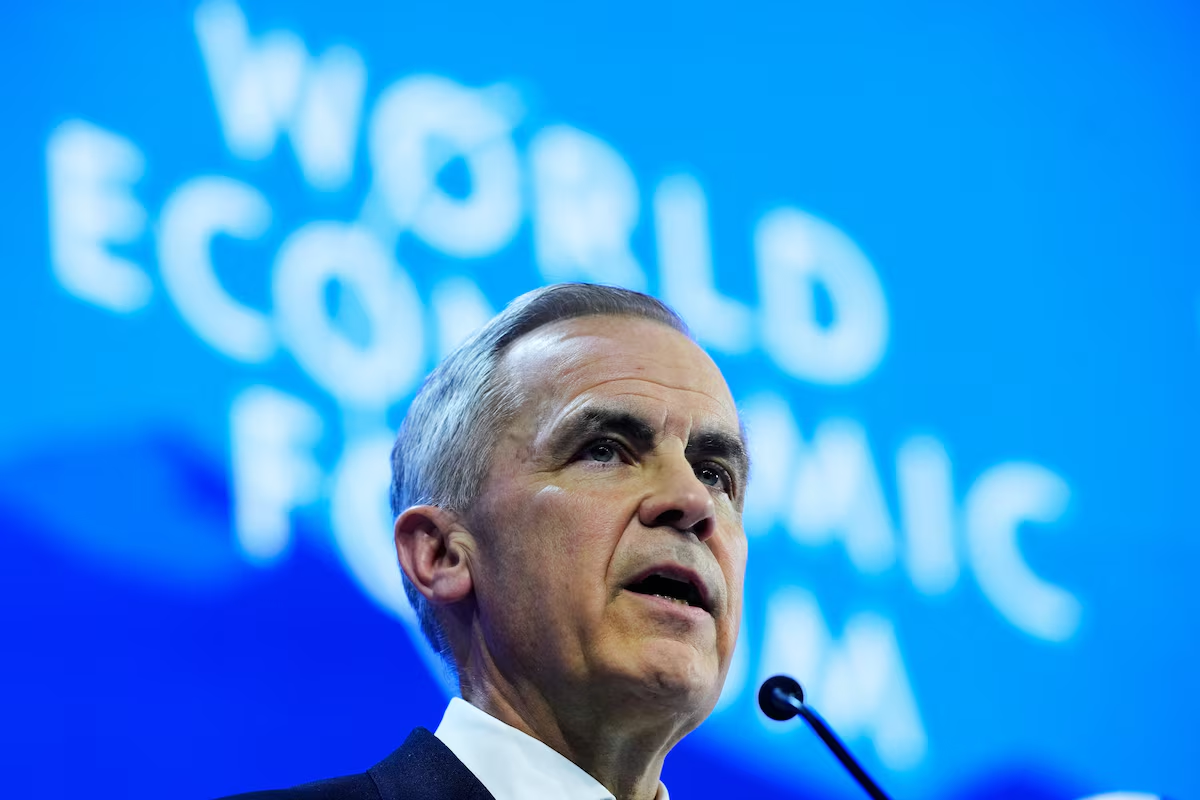
Mark Carney told delegates at the World Economic Forum in Davos that middle powers must stop treating the postwar rules-based international order as if it still functions and instead build real coalitions to protect their interests. His remarks, which invoked the late Czech writer Václav Havel, come amid renewed debate over Greenland after comments by U.S. President Donald Trump.
Separately, reporting by The Globe and Mail says the Canadian Armed Forces modelled a hypothetical U.S. military invasion of Canada and sketched responses that draw on tactics used in recent conflicts. Officials described the work as a conceptual model rather than an operational plan.
Carney calls out the fiction of a functioning rules-based order
Carney argued that for decades many middle powers relied on American power to deliver open sea lanes, a stable financial system and collective security. That arrangement, he said, no longer guarantees protection, and countries should stop pretending the old system works as advertised.
"The rules-based order is fading. Stop invoking the rules-based international order as though it still functions as advertised. Call the system what it is: a period of intensifying great power rivalry where the most powerful pursue their interests using economic integration as a weapon of coercion."
Mark Carney, World Economic Forum
Carney urged nations to condemn economic coercion even when it is practised by a powerful ally, an apparent reference to Washington. He named the United States only once in the speech when he referenced "American hegemony," but his broader critique targeted the uneven reality of global power today.
As an example of middle powers cooperating, Carney said Canada stands with Greenland and Denmark on Arctic sovereignty and reiterated support for NATO’s collective defence clause, Article 5.
Ottawa, Greenland and the limits of commitment
Carney’s remarks follow a week of headlines about Greenland after a reported threat by President Trump to impose tariffs on some European allies while seeking strategic advantages in the Arctic. The future of Greenland and the strain on Western alliances have dominated discussions in Davos.
Foreign Affairs Minister Anita Anand, speaking in Davos, declined to say whether Canada would deploy troops to Greenland if asked. She pointed to the regular participation of Canadian forces in NATO exercises and said deployment decisions rest with the minister of national defence and the chief of the defence staff.
"Regarding future deployments and future exercises, those are decisions that the minister of national defence makes, together with the chief of defence staff."
Anita Anand, Foreign Affairs Minister
The Canadian Armed Forces model a hypothetical U.S. invasion
The Globe and Mail reports that the Canadian military created a model of a theoretical American assault and sketched Canadian responses. Officials described the exercise as conceptual and exploratory, not a step-by-step operational plan.
According to two unnamed senior government sources, the simulated Canadian response draws on tactics used against Russia and against later coalition forces in Afghanistan. It is believed to be the first time in about a century that the Canadian Armed Forces modelled an American assault on Canadian territory.
Government sources and experts quoted by the Globe said it is unlikely any U.S. administration would order such an invasion. The modelling, they said, is part of contingency planning and threat assessment rather than evidence of imminent risk.
What else is developing
- Hootsuite pursued business with U.S. Immigration and Customs Enforcement, five years after staff opposition forced the company to halt services to the agency.
- Former federal justice minister Jody Wilson‑Raybould confirmed she has begun breast-cancer treatment following surgery.
- Former prime minister Justin Trudeau spoke at Davos and was accompanied by singer Katy Perry.
- Quebec’s finance minister warned that Ontario’s Crown Royal whisky ban could affect operations and jobs in Quebec.
- Transport Canada plans workforce reductions that may affect up to 1,500 employees.
- Homicides have fallen sharply in several major Canadian cities, a trend experts say should shape policy debates on sentencing and public safety.
- The House of Commons returns on Jan. 26. The Senate reconvenes on Feb. 3.
- Four of five NDP leadership candidates will join a virtual debate on Palestine organized by Canadians for Justice and Peace in the Middle East.
Commentary featured in the original report argues that Canada must push back against threats to allied solidarity in the Arctic and that Ottawa needs clearer plans to cope with a more uncertain international environment.
Carney’s message at Davos and the military’s recent modelling underscore a shift in how Canadian officials are framing risk: less faith in automatic protections and more focus on coalition-building, deterrence and contingency planning. Those adjustments will shape debates in Ottawa about defence spending, alliances and how Canada projects security in the North and beyond.
Mark CarneyDavosCanadian Armed ForcesGreenlandNATO