Claude Code Is Changing How People Work with AI
Anthropic’s Claude Code has gone viral among developers and non-coders, accelerating software work and prompting fresh questions about jobs, productivity and what comes next.
Copy link
By Torontoer Staff
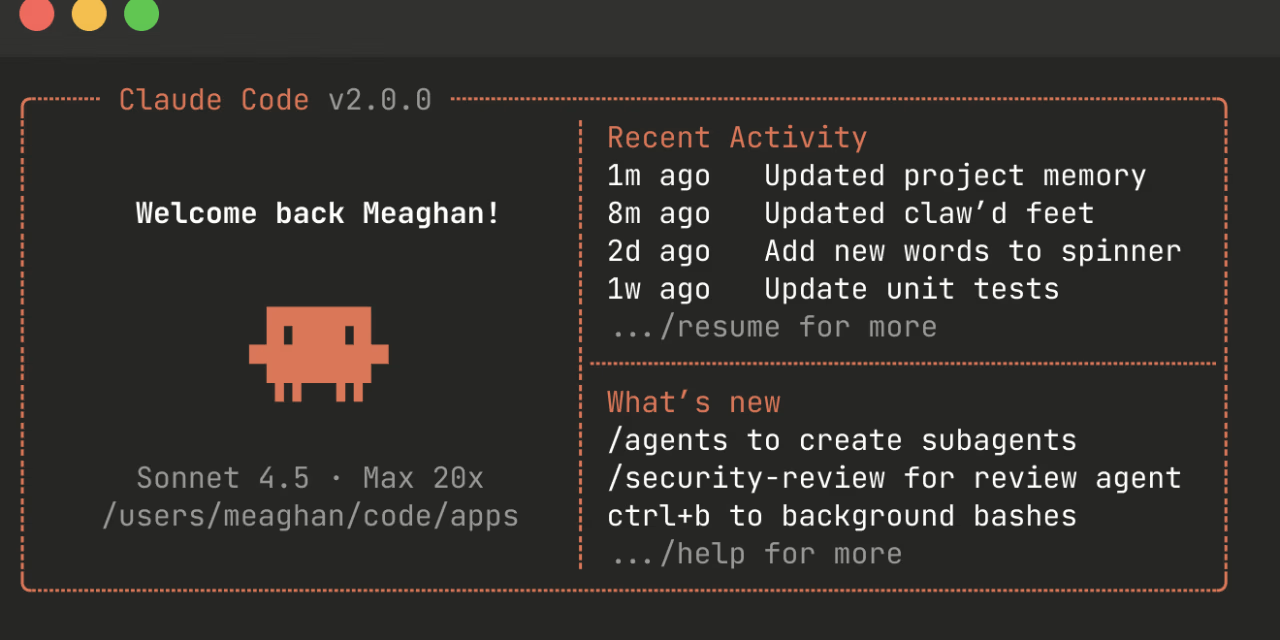
Anthropic’s Claude Code has become a viral moment in AI, drawing developers, executives and hobbyists to a desktop coding tool built on the Claude Opus 4.5 model. Users report dramatic productivity gains, and the tool’s ability to operate with access to files, a browser and apps is shifting expectations about what AI can do for everyday work.
The reaction has been intense enough that some people say they have been “Claude-pilled”: handing projects to the model and watching it produce solutions that once required months or years of human effort. That response is prompting both excitement and unease across teams and industries.
What sets Claude Code apart
Claude Code combines a powerful generative model with tooling that lets the AI act more autonomously than typical chatbots. Instead of only answering prompts, it can browse the web, access user files and trigger other applications, which allows it to complete multi-step tasks without constant human direction.
That mix of advanced language understanding and systems access gives users a different experience from prior code-focused models, which were often likened to junior developers. People who have used Claude Code describe it as closer to a collaborator that can design, debug and stitch systems together on its own.
How people are using it
Engineers have used the tool to finish complex projects in days instead of months. Non-engineers are trying tasks they never learned to code, such as analysing data sets, recovering files, building websites or automating email workflows. The tool’s desktop interface encourages experimentation beyond traditional developer environments.
- Automating expense reports and data analysis
- Recovering or repairing corrupted files
- Rapid website and app prototyping
- Parsing medical imaging results and other specialised data
- Monitoring projects and even simple home setups, such as using a webcam to watch plants grow
I spent 10 hours a day on my vacation building new software, and each run gave me an endorphin rush akin to playing a Vegas slot machine.
Malte Ubl, chief technology officer at Vercel
Productivity, hiring and labour implications
Some business leaders say Claude Code is multiplying their productivity and altering hiring plans. One founder who had planned to recruit engineers paused hiring after the tool made his team several times more productive. For small teams and startups, that can reduce costs and speed time to market.
At the same time, experienced practitioners report a personal shift when tasks they built careers on are completed by AI in a single pass. ‘‘It’s amazing, and it’s also scary,’’ said Andrew Duca, chief executive of Awaken Tax, describing the feeling of seeing long-developed skills replicated by the software.
Market context and rivals
Anthropic has positioned Claude as a business-focused alternative to other leading models. OpenAI and Anthropic remain the most visible startups in generative AI, with different product and customer emphases. Anthropic’s emphasis on coding mastery and tooling has helped it gain traction among enterprise customers, according to industry trackers.
Claude’s web audience and desktop traffic have climbed recently, signalling growing interest among professionals. That interest has continued even as other large companies, including Google, compete with their own advanced models and tool suites.
Design choices and user experience
Anthropic’s Claude Code team has adjusted the product for broader use. After many non-coders began testing the command-line style app, the team shipped a graphical variation called Cowork to provide a friendlier interface. They report building the initial Cowork version using Claude Code itself, illustrating how the tool shortens development cycles.
It’s just so different than the AI that came before.
Boris Cherny, head of Claude Code
What comes next
The main question for many observers is how far tooling-style AI will spread beyond software engineering. Engineers are a small portion of the labour force, and broader adoption could reshape many white-collar roles. ‘‘The bigger story here is going to be when this goes beyond software engineering,’’ said David Hsu, chief executive of Retool.
For now, Claude Code offers a glimpse of that future. It is already changing workflows, prompting companies to reassess hiring plans and encouraging individuals to experiment with projects they previously would have outsourced or not attempted at all. The balance between amplified productivity and displaced expertise will shape how organisations and workers adopt the technology.
Anthropic’s momentum comes as the company prepares for a public listing and continues to refine its models and tooling. Observers and users will be watching how the firm scales commercial adoption, handles safety and integrates controls for broader workplace use.
Claude Code’s viral moment has made clear that advanced, tool-enabled AI is no longer an abstract possibility. It is now a practical option for many everyday tasks, and that reality is already changing how work gets done.
AIAnthropicClaude Codeproductivitytechnology