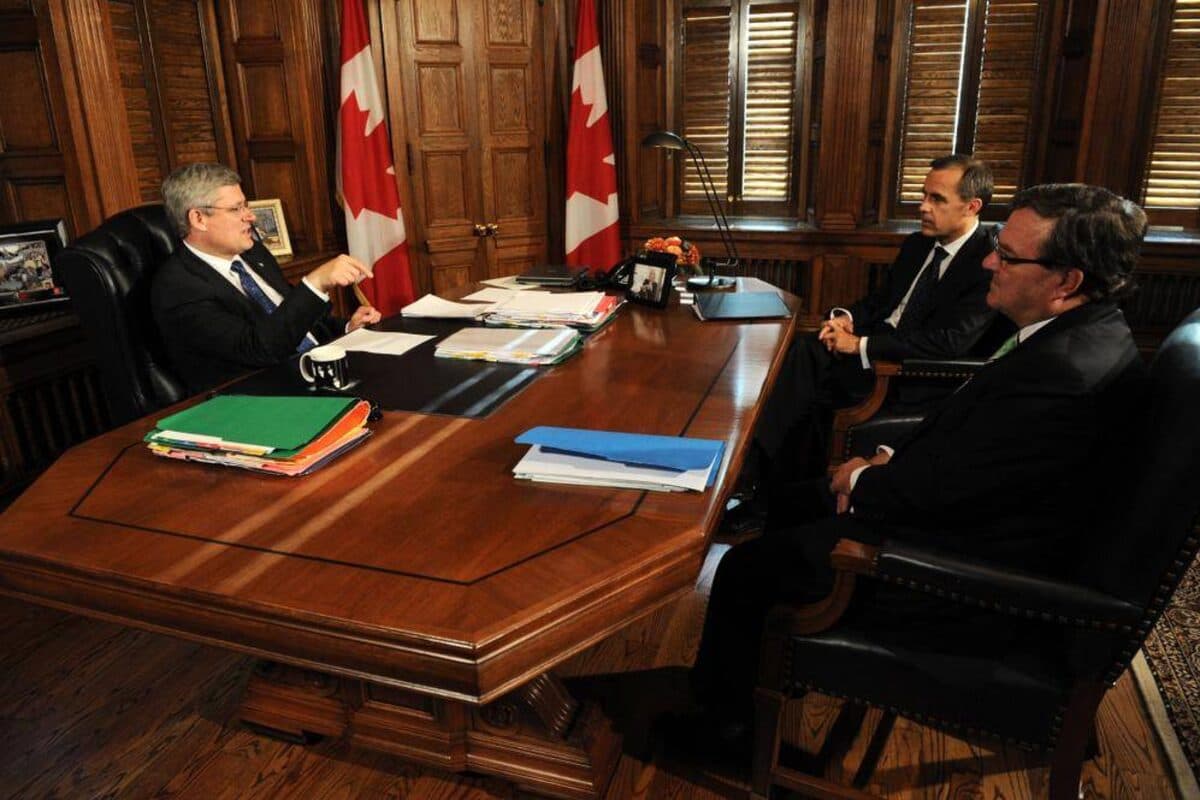
The Conservative Party spent the week balancing commemoration with strategy as it marked 20 years since Stephen Harper first led it to government. The events followed a three-day national convention in Calgary, where leader Pierre Poilievre secured broad support in a leadership review but faces questions about whether his approach can win the next federal election.
The anniversary programming highlighted contrasts between Harper-era conservatism and Poilievre’s populist style, and prompted party veterans and younger members to consider how to expand the party’s reach without abandoning core messages.
A party at a crossroads
When Harper won in 2006, Canada’s political landscape looked different. The political right had recently unified, the Liberal Party was weakened by internal divisions, and the New Democrats under Jack Layton were on the rise. Harper won a minority government with 36 per cent of the vote, and then adapted the party’s approach to win three governments in total.
By contrast, Poilievre’s Conservatives captured 41 per cent of the popular vote in the most recent election but fell short of forming government. The party leadership convention in Calgary reaffirmed Poilievre’s mandate, but delegates and former ministers used the anniversary events to debate strategy and outreach.
Voices from the party: repair, broaden, persuade
Former cabinet minister Jason Kenney said winning will require rebuilding relationships with traditional allies, including provincial Conservative leaders and business figures who have been alienated by Poilievre’s tone and tactics. Kenney said the party must retain its populist economic messaging, while demonstrating more statesmanship on the international stage.
Pretending that Trump doesn’t exist is not a strategy for dealing with an 800-pound gorilla who body-slams this country every week.
Jason Kenney
Kenney argued that acknowledging geopolitical realities, including the influence of U.S. politics, would signal a readiness for government rather than perpetual opposition posture. Tony Clement, another former cabinet minister, pointed to Harper’s post-2004 adjustments as an example of how a leader can learn and recalibrate to win.
He had to really do some soul-searching. ‘Am I the right leader for this generation of conservatives?’ He came to the conclusion he was. He made some adjustments to his campaign and his campaign style in terms of how he presented Conservative policies, and that became a winning combination for 2006. I think Pierre is learning.
Tony Clement
Generational dynamics and grassroots energy
Poilievre repeatedly addressed younger voters at the convention, framing his message around household economics and resilience. He spoke directly to young families and single parents in his remarks, emphasising persistence and practical concerns.
I’ll never give up, because the young couple scrimping to start a family, and the single mother fighting each day to feed her kids, they never give up.
Pierre Poilievre
Younger delegates say the party’s appeal extends beyond one personality. Mirco Peters, a 22-year-old delegate, credited the energy of younger MPs for drawing him in and framed the party’s shortfall as a team problem rather than an individual failure.
When you fall short, it’s not just one player, it’s not just the captain or the coach, it’s the whole team. I think we all fell short, and we need to find what caused that.
Mirco Peters, delegate
That reflects a tension within modern conservatism. Many in the party have no memory of the pre-merger battles between the Progressive Conservatives and the Canadian Alliance. Still, residual divisions influence relations between federal and provincial Conservatives, as seen in scheduling conflicts and public distancing by some provincial leaders.
Strategy moving forward
Several long-time party operatives say the party must understand why people voted for the Liberals last time. Ian Brodie, who has worked in senior party roles, said Conservatives need to step into the shoes of those voters and address their priorities, rather than simply rebutting them.
The Harper anniversary provides a framing moment. Brodie said it helps remind members that the party was built to be competitive and to win, not only to air internal debates. That dual focus — deepening grassroots energy while polishing messages for broader electorates — will dominate planning in the months ahead.
- Repair relationships with provincial Conservatives and business leaders
- Retain kitchen-table economic messages while showing greater statesmanship
- Engage younger voters through rising MPs and grassroots organising
- Study why swing voters chose the Liberals and adapt outreach accordingly
The anniversary events underscored that the party’s identity and its electoral prospects are being contested on multiple fronts. Veterans urged pragmatic adjustments based on past lessons, while younger members called for unity and a team effort to translate energy into votes.
How the Conservative Party synthesises those views will shape its trajectory between conventions and the next election cycle. The immediate task is practical, not symbolic: broaden appeal, repair bridges, and convert a reaffirmed leadership into a winning strategy.