EU promises 'unflinching' response to Trump's Greenland threats
Ursula von der Leyen said the EU will respond "unflinching, united and proportional" after Trump threatened 10% tariffs on goods from eight European countries over Greenland.
Copy link
By Torontoer Staff
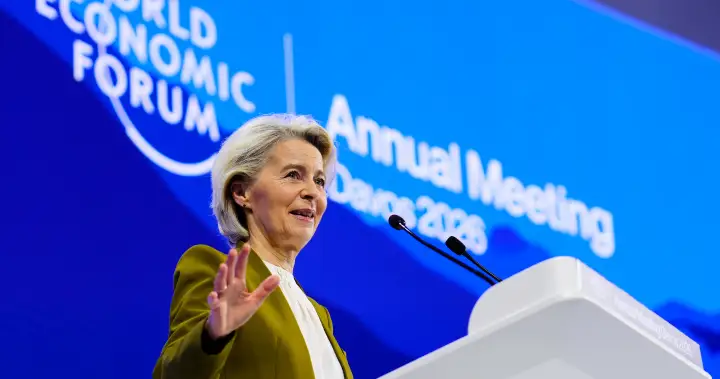
Europe's top official signalled a firm reaction to U.S. President Donald Trump's recent threats over Greenland, saying the European Union will respond "unflinching, united and proportional." The comments came from European Commission President Ursula von der Leyen at the World Economic Forum in Davos, after Trump said he would impose a 10 per cent import tax starting in February on goods from eight European countries.
Von der Leyen paired the warning with an explicit defence of Greenland and Denmark, calling Greenland's sovereignty "non-negotiable," and said the EU would pursue closer security cooperation with Arctic partners including the U.K., Canada, Norway and Iceland.
Von der Leyen's message in Davos
Speaking at a forum that draws leaders and business figures from around the world, von der Leyen framed the tariffs as a strategic error between long-standing allies. She warned that tit-for-tat measures would weaken collective efforts to keep adversaries out of the Arctic strategic landscape.
Our response will be unflinching, united and proportional.
Ursula von der Leyen
Von der Leyen also said the EU was ready to work with the United States on Arctic security, while at the same time preparing to deepen security ties with regional partners. That approach signals an intent to pursue both diplomatic engagement and coordinated deterrence.
What Trump has said and done
Trump announced a planned 10 per cent tariff on imports from eight European countries after public opposition by those countries to U.S. proposals concerning Greenland, a semiautonomous territory of Denmark. He also posted on Truth Social an artificial intelligence-generated image showing him and other U.S. officials planting a U.S. flag on Greenland.
Trump shared a message he said was from Dutch prime minister Mark Rutte, describing it as evidence of a willingness to "find a way forward." In an interview cited by U.S. media, Trump linked his posture toward Greenland to diplomacy and personal grievances, and he declined to rule out force when asked directly whether he would use it to acquire the territory, responding, "No comment."
How the EU is preparing to respond
EU member states are assembling for an emergency summit to weigh immediate and longer-term responses. Officials have raised the prospect of using the bloc's so-called "trade bazooka," a shorthand reference to tariffs, countermeasures and other trade tools, while keeping diplomatic channels open.
- Coordinated tariffs or trade restrictions targeting sectors important to the United States
- Legal action through the World Trade Organization or other bodies
- Strengthened security partnerships with Arctic and NATO allies
- Joint diplomatic pressure and statements reaffirming Greenland's sovereignty
Von der Leyen's mention of closer security partnerships with Canada and other regional states signals that any response will include defence and strategic planning, not only economic measures.
Public and diplomatic fallout
The rhetoric has prompted public demonstrations in Denmark and in Nuuk, Greenland's capital, and stirred concern in NATO and among Arctic nations about regional security. European officials say escalatory language from a close ally complicates cooperation on broader security challenges in the Arctic.
Leaders at Davos and capitals across Europe are balancing a push for unity and deterrence with an acknowledgment that continued engagement with the United States remains important for broader transatlantic security objectives.
For now, the situation remains fluid: an emergency EU meeting is set for later this week, and member states will use it to decide whether to activate trade countermeasures, pursue legal routes, or intensify security cooperation in the Arctic region.
The dispute underscores how strategic competition in the Arctic is intersecting with trade and diplomacy, and how allies are recalibrating responses when long-standing partnerships are tested.
EUGreenlandDonald TrumpUrsula von der LeyenDavostariffsArctic security