Ford renews attack on Canada-China EV deal, cites jobs and security concerns
Premier Doug Ford condemned a federal agreement to lower tariffs on Chinese electric vehicles, saying it undermines Ontario jobs and raises security risks while benefiting prairie exporters.
Copy link
By Torontoer Staff
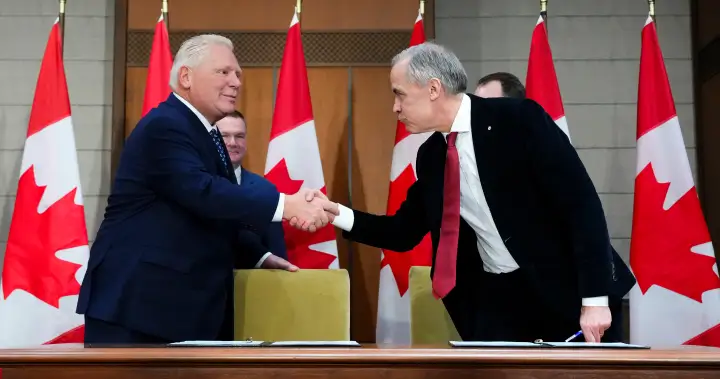
Premier Doug Ford spent Monday publicly criticising the federal government’s trade agreement with China that will allow up to 49,000 Chinese-made electric vehicles into Canada at a reduced tariff rate. Ford called the pact a "terrible deal," argued it favours foreign "spy vehicles" over Ontario jobs, and said he was left out of discussions before the announcement.
The deal reduces duties on some Chinese EVs in exchange for Beijing lowering punitive tariffs on Canadian canola and other farm products. Ford voiced frustration about the lack of direct communication from Prime Minister Mark Carney and said the move further exposed a rift between Ontario and the prairie provinces over competing economic priorities.
What the trade agreement says
After months of negotiation, Ottawa agreed to allow up to 49,000 Chinese electric vehicles to enter Canada at a most favoured nation tariff rate of 6.1 per cent. The arrangement includes an affordability target: by 2030, half of those imported EVs must cost less than $35,000.
In return, Canada expects China to cut duties on canola seed from 84 per cent to 15 per cent by March 1. Other measures remove Chinese "anti-discrimination" tariffs on canola meal, lobsters, crabs and peas through at least the end of the year. The deal did not address the 100 per cent tariff on canola oil, and the 25 per cent tariff on Canadian pork remains unchanged.
- Up to 49,000 Chinese EVs allowed into Canada at a 6.1% tariff
- By 2030, half of those imports must be priced under $35,000
- Canola seed tariff to be reduced from 84% to 15% by March 1
- Canola meal, lobster, crab and peas freed from certain tariffs through year end
- No change to 100% canola oil tariff or 25% pork tariff
Ford’s objections: jobs, security and communication
Ford said the agreement undermines Ontario’s EV manufacturing strategy and will hurt well-paid provincial jobs. He argued the province should have been consulted directly before details were finalised and complained he learned about the deal only hours before the public announcement.
I’m disappointed because we had such a great relationship, and I look forward to continuing the great relationship, but it’s all about communication, collaboration and partnership. At least I know where I stand, though.
Premier Doug Ford
Ford also raised national security concerns, warning that some Chinese-made vehicles could be used for surveillance. He said his office received a heads-up from Minister of Internal Trade Dominic LeBlanc, not from the prime minister directly, and that he had not spoken to Mark Carney about the agreement as of Monday.
I thought we had a good enough relationship that he’d give me a quick text or a little bit of communication. That never happened.
Premier Doug Ford
Provincial split and political fallout
The deal highlights a split between provincial interests. Saskatchewan, which has pushed for relief from steep Chinese duties on canola and pork, was represented on the federal trade mission. Saskatchewan Premier Scott Moe was invited to join the trip to China, while Ford said Ontario was left on the sidelines.
Ford had sought a 100 per cent tariff on Chinese-made EVs to protect Ontario’s nascent EV supply chain. Federal officials, by contrast, emphasised the benefits to Canadian exporters and measures intended to improve EV affordability for consumers.
Federal response and next steps
Prime Minister Mark Carney framed the agreement as progress in a difficult trade relationship. He described the outcome as a new partnership and said the reciprocal tariff changes will help Canadian exporters regain access to Chinese markets.
This is enormous progress. A new partnership, a new era.
Prime Minister Mark Carney
The agreement sets a March 1 deadline for the initial change to canola seed duties and spells out the timeline for EV imports and affordability targets. Implementation details and potential follow-up reviews, including on security implications, have not been fully disclosed.
What this means for Ontario drivers and farmers
Consumers could see more affordable EV options over time if the price targets are met. For Ontario’s auto sector, the prospect of increased competition from lower-cost imports raises questions about how the province will preserve and attract manufacturing jobs tied to vehicle electrification.
For farmers and exporters in provinces like Saskatchewan, the tariff reductions offer immediate relief for commodities that have been hit by retaliatory measures. The uneven distribution of benefits across provinces helps explain the sharp political reaction.
The federal government will need to balance those competing economic priorities while addressing the security concerns raised by some provincial leaders. For now, the deal has deepened a political divide and set the stage for further debate about Canada’s trade and industrial strategy.
Doug Fordtrade dealChinaelectric vehiclescanola