Global markets fall after Trump threatens tariffs on eight NATO allies over Greenland
Stocks tumbled and safe-haven metals jumped after President Trump threatened tariffs on eight NATO members amid a dispute over Greenland.
Copy link
By Torontoer Staff
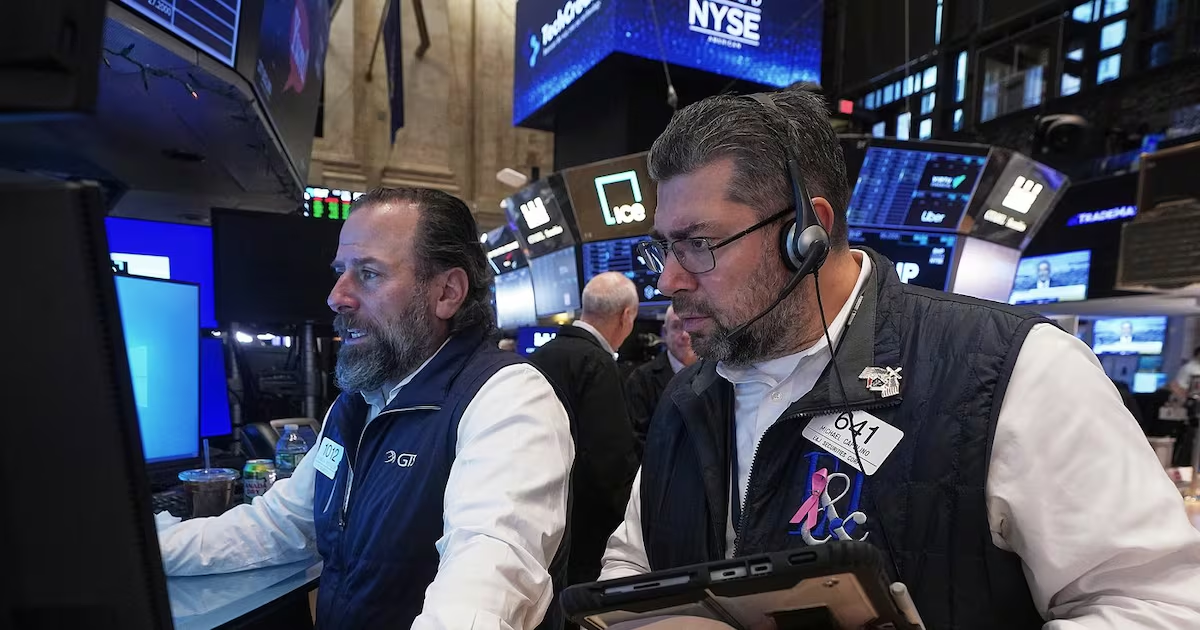
Global markets slid on Tuesday after President Donald Trump threatened to impose new tariffs on eight NATO members in response to their opposition to his proposal to acquire Greenland. U.S. futures pointed to sharp losses as investors moved toward safe havens.
Futures for the S&P 500 fell 1.8 per cent, Dow futures dropped 1.6 per cent, and the Nasdaq was down about 1.8 per cent. European benchmarks in Paris, Frankfurt and London each lost more than 1 per cent, extending a recent run of declines.
Market moves and safe-haven flows
Investors responded to the tariff threat by buying gold and silver. Metals rallied sharply as traders sought protection from escalating geopolitical tensions. Oil prices were modestly higher, while bond yields and other indicators showed increased demand for safe assets.
Analysts described the tariff announcement as an immediate overhang for markets at major gatherings this week, including the World Economic Forum in Davos.
Geopolitical events will remain in focus today, particularly any talks that may take place in Davos.
Michael Brown, senior research strategist at Pepperstone
What the U.S. announced
President Trump said a 10 per cent import tax would take effect in February on goods from Denmark, Norway, Sweden, France, Germany, the United Kingdom, the Netherlands and Finland. He framed the move as a response to their opposition to his desire to bring Greenland into U.S. control.
Trump also referenced a personal dispute over the Nobel Peace Prize in communications with Norway’s prime minister, language that further heightened diplomatic tensions between Washington and several of its closest allies.
European reaction and possible countermeasures
European leaders responded with criticism and diplomatic activity. EU officials and national capitals discussed potential responses, including retaliatory tariffs and invoking the European Union’s anti-coercion instrument for the first time to counter economic pressure.
Market indexes in Europe moved lower at midday, with France’s CAC 40 down around 1.2 per cent, Germany’s DAX off about 1.5 per cent, and Britain’s FTSE 100 down roughly 1.3 per cent.
U.S. officials and market commentary
U.S. Treasury Secretary Scott Bessent, speaking on the sidelines of the World Economic Forum in Davos, said American ties with Europe remain strong and urged trading partners to 'take a deep breath' while tensions over the tariff threats play out.
Some analysts expect the threats to weigh on sentiment in the short term but to ease as negotiations and diplomacy proceed. "Our view is just like over the last year the bark will be worse than the bite on this issue and tariff threats as negotiations take place and tensions ultimately calm down between Trump and EU leaders," wrote Dan Ives of Wedbush Securities.
Global market context
Asian markets largely followed the global trend. Tokyo’s Nikkei fell about 1.1 per cent after Japan’s prime minister called a snap election. Hong Kong’s Hang Seng declined about 0.3 per cent, while mainland China’s Shanghai Composite was largely unchanged. South Korea and Australia posted modest losses, while Taiwan gained slightly.
Investors are also watching central bank calendars. The U.S. Federal Reserve will meet in two weeks and is widely expected to hold its benchmark interest rate steady as it balances a cooling labour market with inflation above its two per cent target. The Bank of Japan has a policy board meeting ending later in the week.
Commodities and other indicators
Gold and silver rose sharply amid the rush for safe assets. U.S. benchmark crude oil gained to about $59.86 per barrel, while Brent crude traded near $64.45 a barrel, reflecting a modest uptick in energy markets.
What to watch this week
- Corporate earnings reports for major U.S. companies, which could influence market direction
- U.S. inflation data that the Federal Reserve monitors for policy decisions
- Diplomatic developments between the U.S. and European allies, including any formal trade actions or retaliatory measures
Markets will likely remain sensitive to developments in Davos and to any formal steps by the EU or individual countries in response to the tariff threats. Investors could see greater volatility until diplomatic channels clarify whether the threats will become policy or remain leverage in talks.
This story was informed by reporting from The Associated Press and market data. Torontoer will update coverage as officials and markets respond.
marketsfinancetariffsTrumpNATOGreenlandglobal-economy