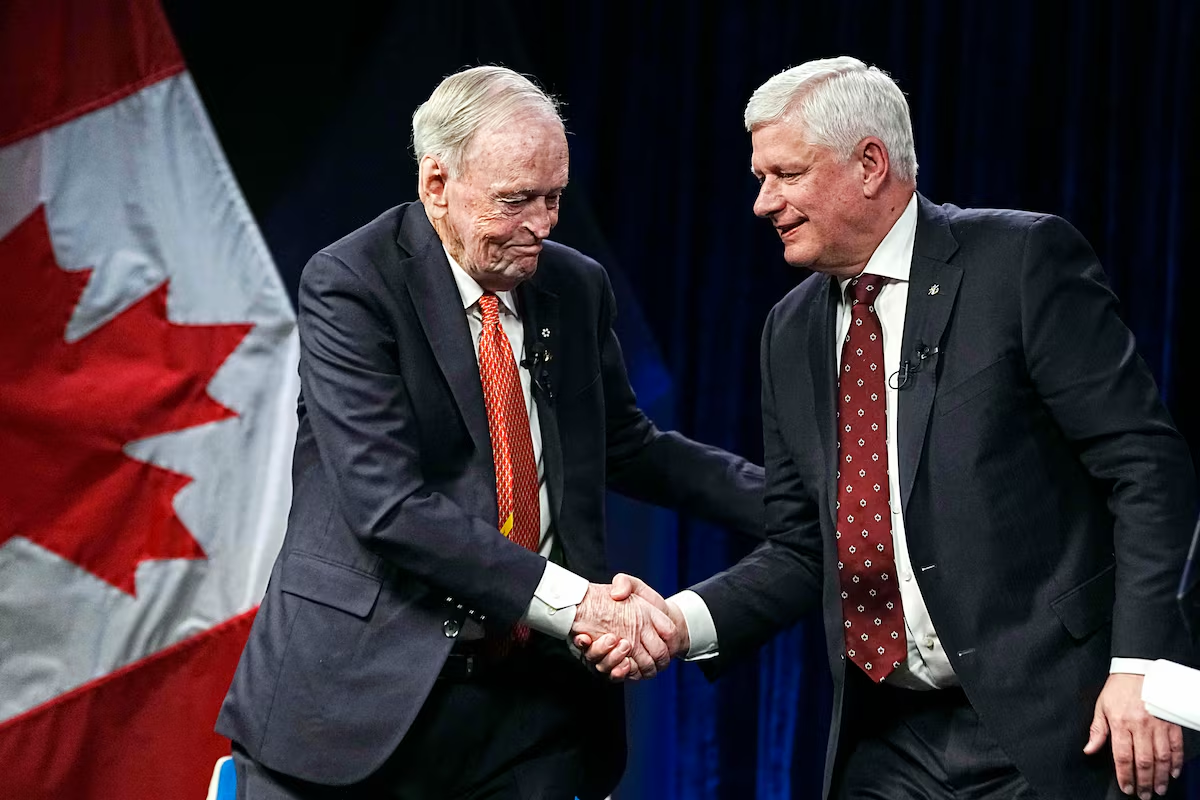
Former prime ministers Stephen Harper and Jean Chrétien used a public event in Ottawa to press a simple argument: Canada should stick together and act to reduce reliance on the United States. The pair spoke at a Royal Canadian Geographical Society ceremony where Mr. Harper received a gold medal for his work on Arctic sovereignty and national parks.
Their comments focused on practical steps for preserving economic and territorial independence as U.S. policy under President Donald Trump has taken a more transactional and nationalist tone. Both men drew on history and recent geopolitical shifts to make the case for unity and a sharper Canadian strategy in the North.
A call for national unity
Mr. Harper framed unity as a strategic necessity, not merely patriotic feeling. He said Canadians should be proud and work to remain cohesive while making policy choices that protect national interests. He warned that the federal government must emphasise unity and avoid ideological tangents if it wants to hold the country together.
Our pride does not have to be not liking Donald Trump. We should be proud as a people and as a nation. There is no reason why this country should not be as nationalistic as anyone else. We have a lot to be proud of. It is a tremendous country.
Stephen Harper
Mr. Chrétien echoed the need for cohesion and took a longer view of global shifts. He argued that the Trump presidency may mark a decline in American predominance, and he presented that change as an opportunity for Canada to define its own path.
I think it is probably the beginning of the end of the American empire and it has to come. But we are in a very good position. We are the best educated people in the world.
Jean Chrétien
Focus on the Arctic and sovereignty
Both former prime ministers have a record of promoting Canada’s role in the Arctic and used the event to stress urgent policy work in the region. They said rising activity from the United States, Russia and China makes Canadian surveillance and defence capability a priority.
Mr. Harper noted that Canada must be able to monitor and, if necessary, defend its lands, seas and airspace independently. Mr. Chrétien was blunt in asserting Canadian ownership of the North and framed defence of the region as non-negotiable.
It is clearly Canadian. Now, some people look at Canada and they would like to take it over from us. But we will stand on guard, don’t worry.
Jean Chrétien
Trade diversification and economic resilience
Trade policy featured prominently. Both speakers described U.S. trade moves as a risk to Canadian prosperity and urged diversification away from single-market dependence. Their prescription was straightforward: pursue other markets and craft domestic policies that reduce exposure to sudden shifts in U.S. economic policy.
They noted Canada has endured external threats before and can adapt. The emphasis was on practical governance: sound federal management, targeted economic strategy and investment in capabilities that support sovereignty and growth.
National identity, immigration and public memory
Mr. Chrétien used the platform to push back against what he described as excessive focus on historical grievances. He highlighted immigration as a strength and said Canada remains a beacon for people fleeing poverty and repression. His comments urged leaders to look forward and build on the country’s strengths.
Both men also acknowledged internal political pressures. The Parti Québécois has promised a new sovereignty referendum if it wins the next provincial election, and some movements in Alberta have pushed for independence. The two former prime ministers tied those debates back to the larger point about leadership that prioritises unity.
Practical takeaways for policymakers and citizens
- Prioritise trade diversification to reduce economic vulnerability to U.S. policy changes
- Invest in Arctic surveillance, infrastructure and defence capabilities
- Promote national unity through federal leadership focused on pragmatic policy
- Frame immigration and diversity as strengths for long-term resilience
Mr. Harper was in Ottawa to mark 20 years since his 2006 swearing-in as prime minister, with his official portrait scheduled for unveiling. The discussion with Mr. Chrétien mixed institutional memory with policy prescriptions aimed at preparing Canada for a more uncertain global environment.
Their message was consistent: Canada can weather external pressure if it acts cohesively, commits to sovereignty in the North and broadens its economic partnerships. That argument framed both the medal presentation and the wider conversation about the country’s future.