How Gaza’s shifting yellow line is shaping daily life after the ceasefire
The ceasefire boundary known as the yellow line has become a moving safety zone, restricting movement, access to land and livelihoods across much of Gaza.
Copy link
By Torontoer Staff
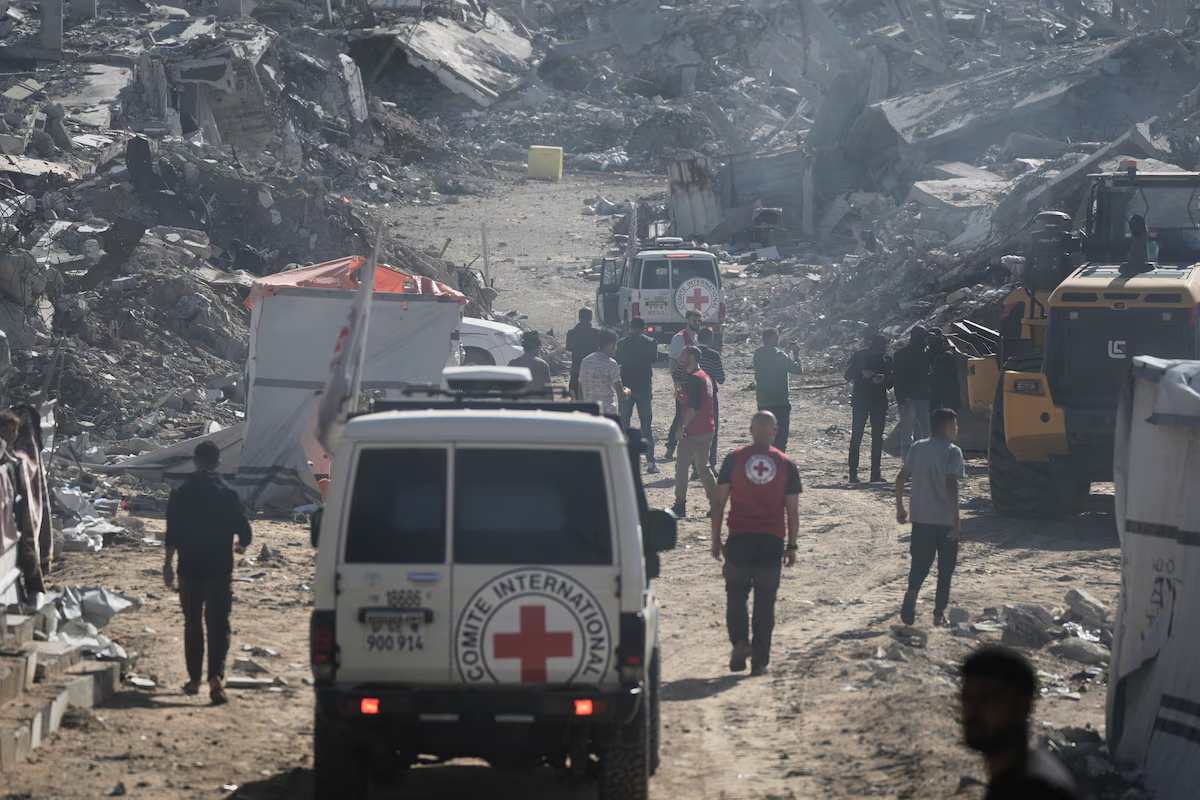
The yellow line that marks the ceasefire boundary in Gaza has become a daily reality for residents, not an abstract map. Set out as the limit of Israeli military positions after the October truce, the line now determines where people can live, farm and move, and it has been associated with continuing low-level violence.
Since the ceasefire took effect on Oct. 10, the Palestinian Health Ministry says 447 Palestinians have been killed. At least 77 of those deaths occurred near the yellow line, including 62 people who were attempting to cross it.
What the yellow line is and how it is enforced
The yellow line began as a conceptual ceasefire boundary. The Israeli army later placed large yellow concrete blocks to make it visible on the ground. Its depth varies by area, absorbing between roughly 50 and 58 per cent of Gaza’s land by designating wide swaths as high-risk zones.
In practice the line cuts from northern Gaza through central neighbourhoods to the outskirts of Rafah in the south. In some places the controlled zone extends about two kilometres from the line, in others it pushes as far as seven kilometres. Israeli forces are present in eastern parts of Gaza City neighbourhoods such as Shuja’iyya, Al-Tuffah and Al-Zeitoun, and in northern towns including Beit Hanoun and Beit Lahia, as well as areas of Rafah and eastern Khan Younis.
How the boundary shapes daily life
For people living near the yellow line, everyday decisions are now security calculations. Residents say movement is restricted, homes and farms inside the cordoned areas are off limits, and anyone approaching the line risks gunfire, drones, artillery or tank fire. Farmers who once relied on land now cut back or abandon fields, and many households depend on aid.
There is no normal movement here. Every step needs a risk assessment. We watch the sky more than we watch the road.
Osama Abu Saeed, 30, resident near the yellow line
Residents describe the yellow line as mobile. They say its location appears to change without official notification, and they learn of advances when gunfire moves closer or when yellow barrels are dropped by drones to mark new limits. That volatility increases the danger of accidentally crossing into a restricted area.
Getting close to the house or staying there became extremely dangerous. The shelling did not stop and the constant drones, artillery fire and direct gunfire forced us to leave again.
Hazem Al-Awawda, 25, displaced resident
Economic and social consequences
The eastern zones now under Israeli control include hundreds of small family farms held over generations. With access to fields cut off or too dangerous, many farmers have lost their main source of income. Displacement has increased demand on crowded shelters and humanitarian services in safer parts of Gaza.
- Restricted access to homes and agricultural land
- Deaths and injuries near the boundary, including people attempting to cross
- Displacement into tent camps and overcrowded neighbourhoods
- Loss of income for small-scale farmers and local businesses
- Ongoing psychological stress from constant surveillance and threat
The political and humanitarian context
The ceasefire was brokered by the United States in October as the first phase of a plan that U.S. officials say includes measures for a longer-term pause and reconstruction oversight. As phase two begins, U.S. President Donald Trump announced two oversight boards for rebuilding, including a proposed international 'Board of Peace' that some world figures have agreed in principle to join.
Despite diplomatic moves and reconstruction proposals, residents say the reality on the ground has not stabilised for many. The yellow line remains a practical barrier between people and their homes, livelihoods and sense of normalcy.
What residents want
Displaced families and farmers emphasise that statistics do not capture personal loss. They ask for recognition of daily hardship and practical measures that restore safe access to land and homes, along with consistent protection so people can rebuild.
We just want people to understand that we are not numbers, we are human beings. We have homes, land and the right to live in peace. The Yellow Line is not just a line on a map. It has become a barrier between us and our lives.
Hazem Al-Awawda
Until the lines on the ground become stable and security is guaranteed, residents who live near the yellow line will continue to base daily life on shifting boundaries and constant risk assessment.
GazaceasefirehumanitarianMiddle Eastconflict