Japanese automakers keep Ontario presence as U.S. firms scale back
A Trillium Network report finds Honda and Toyota have largely maintained production and investment in Ontario while the Detroit Three have cut assembly and jobs.
Copy link
By Torontoer Staff
A new report from the Trillium Network for Advanced Manufacturing finds Ontario’s auto industry has contracted sharply over the past decade, but Japanese manufacturers have held a steady footprint while the Detroit Three have scaled back operations. Production fell to 1.2 million vehicles in 2025 from 2.3 million in 2016, driven largely by reduced output at Ford, General Motors and Stellantis plants.
The report highlights that by 2025 only Honda and Toyota were assembling more than 400,000 vehicles a year in Ontario, together accounting for 77 per cent of Canadian production. Assembly-plant employment fell to 23,700 in 2024 from 32,700 in 2015, not counting tariff-related job losses in 2025.
Production trends and factory closures
Ontario’s decline reflects a mix of corporate decisions, retooling and plant closures. Ford’s Oakville factory has been closed for retooling since 2024. Stellantis halted retooling at its Brampton plant, which closed in 2024. General Motors closed its BrightDrop electric delivery van plant in Ingersoll in October, cutting 1,150 jobs, and recently laid off 700 workers at its Oshawa Silverado factory.
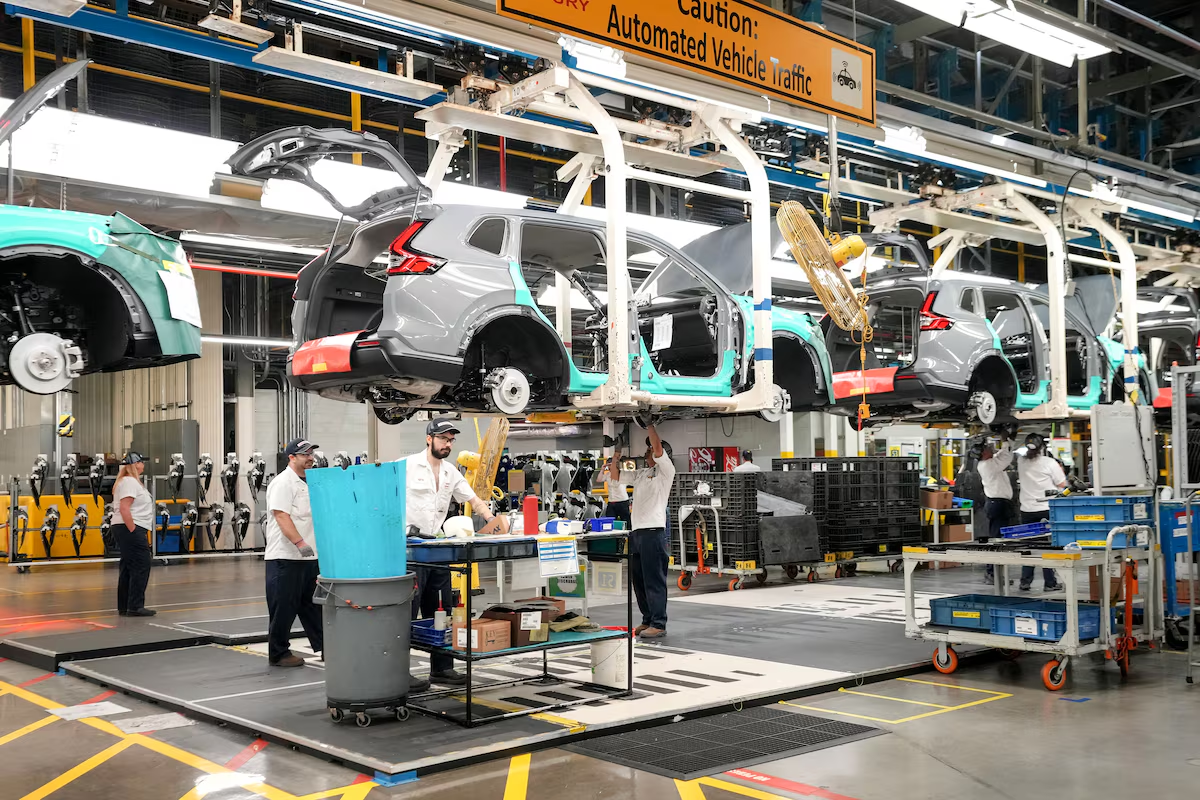
By contrast, production at Honda and Toyota facilities has remained comparatively stable aside from pandemic-related slowdowns. Toyota assembles RAV4 hybrid models and the Lexus RX at plants in Cambridge and Woodstock. Honda builds the Civic and CR-V in Alliston.
Why Honda and Toyota have kept capacity
Brendan Sweeney, managing director of the Trillium Network, attributes the difference to planning horizons and how companies view plants in their global networks. He says the Japanese manufacturers prioritise long-term investment and see Ontario plants as integral to their manufacturing networks, rather than treating them primarily as short-term profit centres.
They are not as worried about quarterly results. They are not as worried about kowtowing to an American president because they are not American companies. They tend to have these long-term horizons for a return on investment compared to the U.S.-based automakers.
Brendan Sweeney, Trillium Network for Advanced Manufacturing
That stability has coincided with a strategic shift toward higher-priced models with more advanced technology, the report notes. Producing hybrids and luxury models has helped sustain investment at the Toyota and Honda plants in the province.
Tariffs, Chinese EVs and policy uncertainty
U.S. President Donald Trump imposed a 25 per cent tariff on the non-U.S. content of Canadian-made cars, a policy that has increased costs for automakers and prompted some production shifts. Toyota has said those tariffs have made manufacturing in Ontario ‘‘unsustainable.’’ Honda has taken steps to reroute some production to avoid the tariffs.
The federal government’s decision to allow an annual quota of 49,000 Chinese electric vehicles further complicates the picture. The quota was agreed to as part of a trade-off involving canola and other agricultural issues, and the industry expects additional competitive pressure from lower-cost EV imports.
The sector is watching two policy moments closely: the federal government’s auto strategy due in February, and the scheduled July review of the U.S.-Mexico-Canada trade agreement. Automakers and analysts say outcomes in both processes will influence investment decisions and the future scale of manufacturing in Ontario.
Trillium Network recommendations
The Trillium report offers a set of policy options designed to reward production and investment in Canada and to encourage automakers to use Canadian technology and talent. The network argues for targeted incentives and measures to level the playing field for manufacturers that build here.
- Tariff breaks or remissions for vehicles and components produced in Canada
- Production credits tied to domestic assembly or component manufacturing
- Consumer rebates for Canadian-made cars
- Incentives for automakers to integrate Canadian technology and suppliers
Sweeney said Canada has used similar measures in past decades and could consider policies that make market access slightly harder for companies that do not produce vehicles in the country. He frames such steps as a way to protect jobs and factories and to encourage long-term investment.
We haven’t really had an approach that says, 'Listen, if you don’t make cars here and you want to bring them over here, it’s going to be a little harder to access our market.'
Brendan Sweeney, Trillium Network for Advanced Manufacturing
Automakers have also flagged the cost pressures created by tariffs. GM has said the measures could cost the company about US$4 billion in a given year, adding to the financial strain on U.S.-based producers with North American operations.
What comes next for Ontario’s auto sector
The Trillium Network frames the immediate future as one of policy choices and market shifts. If federal incentives materialise and trade frictions ease, some manufacturers may find a business case to maintain or expand Ontario production. If tariffs, import quotas and global competition persist without compensating measures, more capacity and jobs could be at risk.
For now, Honda and Toyota remain the stabilising presence in Ontario’s auto ecosystem, while Ford, GM and Stellantis continue to make adjustments to their Canadian footprints. The federal auto strategy and the USMCA review will be watched closely by industry leaders and policy makers alike.
The Trillium Network’s report recommends active policy to favour domestic production and investment, arguing that without a coordinated approach Ontario’s manufacturing base will struggle to regain the scale it held a decade ago.
automotiveOntarioHondaToyotatrade policy