Lutnick calls Carney’s Davos speech 'political noise' as Greenland, Trump and Zelenskyy dominate talks
U.S. Commerce Secretary Howard Lutnick dismissed Mark Carney’s Davos remarks as “political noise” as leaders debated Greenland, Trump’s new Board of Peace and Ukraine at the World Economic Forum.
Copy link
By Torontoer Staff
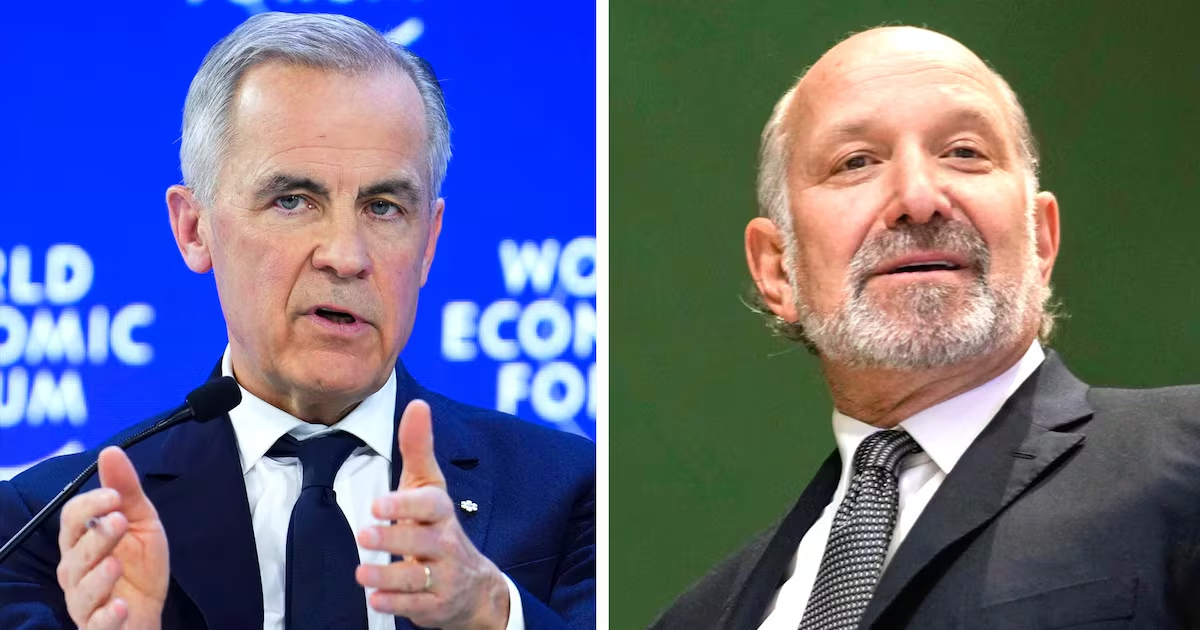
U.S. Commerce Secretary Howard Lutnick publicly dismissed Prime Minister Mark Carney’s speech at the World Economic Forum in Davos as “political noise,” injecting fresh tension into a week already dominated by diplomacy and security questions. Carney, who returned to Canada to address a cabinet planning forum in Quebec City, used his domestic remarks to frame Canada as a global example of pluralism and democratic resilience.
Davos remained crowded with competing initiatives and controversies: uncertainty over the terms of a newly announced U.S. framework for Greenland, U.S. President Donald Trump’s launch of a so-called Board of Peace, and high-profile talks involving Ukrainian President Volodymyr Zelenskyy and Russian interlocutors. The forum highlighted the diplomatic juggling act between trade, security and values.
Carney frames Canada as a beacon
Delivering his first domestic remarks after a widely reviewed address in Davos, Prime Minister Carney told Canadians the country cannot solve all global problems, but can “be a beacon, an example to a world that’s at sea.” He urged defense of rights and pluralism at a time he said democratic norms are under pressure.
We can show that another way is possible. That the arc of history isn’t destined to be warped towards authoritarianism and exclusion, it can still bend towards progress and justice.
Prime Minister Mark Carney
Carney’s Quebec City speech tailored the themes of his Davos address for a Canadian audience and kicked off a two-day cabinet planning forum ahead of Parliament’s return. Internationally, his Davos message drew continued attention from European leaders and commentators who cited his warning about shifts in the global order.
U.S. response: Lutnick calls the speech 'political noise'
Appearing on Bloomberg TV, U.S. Commerce Secretary Howard Lutnick criticised Carney’s Davos speech and questioned Canada’s recent trade deal with China, calling the remarks “political noise.” Lutnick suggested Ottawa’s China agreement could complicate renegotiations of the Canada-U.S.-Mexico trade pact that are due for review this year.
Canada has the second-best deal in the world, and he’s complaining, making political noise.
Howard Lutnick, U.S. Commerce Secretary
The exchange underlines persistent friction between Ottawa and Washington over trade and influence, and it came as other Davos conversations probed how middle powers should respond to economic coercion from larger states.
Greenland uncertainty and Inuit responses
Following President Trump’s announcement of a U.S. framework regarding Greenland at Davos, the island’s leadership said details remain unclear. Greenland’s Chairman Jens-Frederik Nielsen told reporters in Nuuk he did not yet know what parts of the deal are concrete, and he emphasised respect for territorial integrity and sovereignty.
We cannot cross the red lines.
Jens-Frederik Nielsen, Chairman of the Government of Greenland
Greenlandic politicians and Inuit leaders stressed consultation and self-determination. Juno Berthelsen, a member of Greenland’s parliament, said Greenlanders want to decide their future and must be included in any agreement. Similar messages came from Nunatsiavut President Johannes Lampe in Labrador, who called outside control an assault on Inuit self-determination.
Trump’s Board of Peace and Davos diplomacy
President Trump used Davos to launch a so-called Board of Peace, presenting it as an initiative to address Gaza and other conflicts. The White House billed a charter ceremony, though no public draft or complete membership list was released. Several traditional U.S. allies expressed reservations about the board’s mandate and potential overlap with the United Nations.
Trump called the body “something very, very unique for the world,” and supporters including U.S. Secretary of State Marco Rubio described it as action oriented. Still, other leaders and diplomats emphasised the need for clarity on how the board would operate and whether it would complement the UN or compete with it.
Russia, Ukraine and other Davos highlights
Ukrainian President Volodymyr Zelenskyy used Davos to press for sustained European support, warning leaders that words alone will not build a new world order. He held a private meeting with President Trump and was due to participate in panels on Ukraine’s recovery.
Elsewhere, Russian President Vladimir Putin met Palestinian President Mahmoud Abbas to discuss Gaza and offered the potential allocation of frozen assets to reconstruction efforts. China’s foreign ministry disputed President Trump’s claims about wind power use, noting China’s large domestic wind capacity and exports of renewable equipment.
- Elon Musk appeared in a newly scheduled Davos session with BlackRock CEO Laurence Fink.
- Markets reacted to diplomatic shifts, with Asian shares mostly higher after Trump walked back tariffs related to Greenland.
- NATO Secretary General Mark Rutte urged allies to keep focus on supporting Ukraine.
The week at Davos blended high-level rhetoric with immediate diplomatic manoeuvring. Trade, security and the management of global institutions remained recurring themes as leaders sought to translate announcements into concrete agreements.
The outcomes from Davos will likely be measured in coming weeks by whether frameworks announced at the forum turn into detailed plans and whether middle powers such as Canada can shape cooperative responses to pressure from larger states.
Mark CarneyWorld Economic ForumDavosGreenlandDonald TrumpUkraine