Macron and European leaders softened tone in private texts Trump published
Donald Trump posted private messages from Emmanuel Macron and Mark Rutte about Greenland and other issues. The texts show a more conciliatory tone behind public criticism.
Copy link
By Torontoer Staff
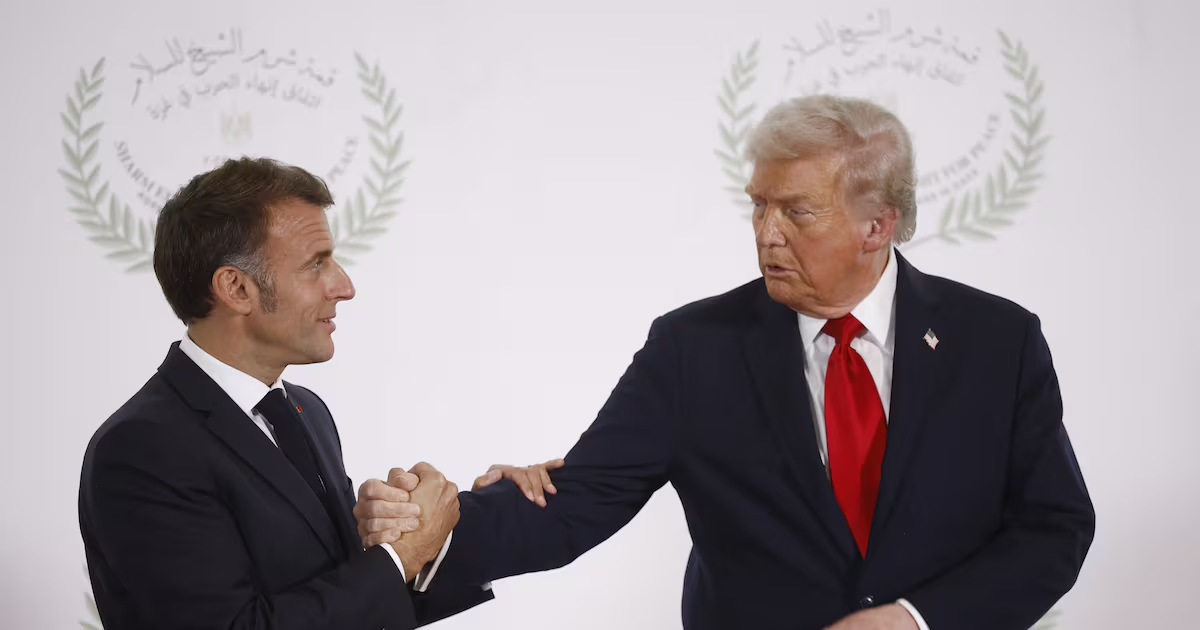
President Donald Trump on Tuesday published private texts he says he received from French President Emmanuel Macron and Dutch Prime Minister Mark Rutte, releasing into public view messages that European leaders had largely framed more forcefully in public. Macron’s note began, "My friend," and Temple his public criticisms of the president’s comments about Greenland with a softer, more conciliatory private tone, Macron’s office confirmed the message was genuine.
The texts provide a rare look at how allied leaders are managing a diplomatic spat. Public statements from Paris and elsewhere have been direct and blunt about the idea of the United States seeking to acquire Greenland from Denmark. In private, Macron and Rutte emphasised cooperation on other policy areas and urged continued engagement.
What the messages said
Trump published two portions of Macron’s message. In the first, Macron writes in English that France and the United States are in agreement on Syria and could make progress on Iran: "We are totally in line on Syria. We can do great things on Iran." He then addresses Greenland directly, writing, "I do not understand what you are doing on Greenland," before pivoting back to a tone of partnership: "Let us try to build great things."
Macron signed the note, "Emmanuel," according to the text Trump posted.
We are totally in line on Syria. We can do great things on Iran. I do not understand what you are doing on Greenland, Let us try to build great things.
Portion of message from Emmanuel Macron, published by Donald Trump
Trump also posted a short message from Dutch Prime Minister Mark Rutte, which the Netherlands confirmed as authentic. The note reads, "I am committed to finding a way forward on Greenland. Can't wait to see you. Yours, Mark." Rutte has declined to discuss Greenland in public, but his private message, as posted by Trump, emphasises finding a diplomatic path.
I am committed to finding a way forward on Greenland. Can't wait to see you. Yours, Mark.
Portion of message from Mark Rutte, published by Donald Trump
Private tone versus public criticism
European leaders have been outspoken in public about the implications of any U.S. move to acquire Greenland, framing the issue as one that touches on sovereignty and the integrity of NATO allies. The messages published by Trump show a different register: less blunt, more focused on areas of agreement and on preserving channels for negotiation.
An official close to Macron told reporters the text reflects the French president’s consistent position in public and in private. The official, speaking anonymously in line with French presidential practice, reiterated that France considers respect for state sovereignty and territorial integrity non-negotiable when it comes to Greenland.
Broader diplomatic context
Macron’s message also offered a glimpse of other ideas he has discussed privately with Trump. According to the portions Trump posted, Macron suggested inviting representatives from both Ukraine and Russia to a meeting in Paris, and said the meeting could include "the Danish, the Syrians" and G7 partners. He proposed a dinner in Paris on Thursday before the president returned to the United States.
That idea has not been aired publicly by Macron, and it highlights the tension leaders face between signalling firmness to domestic audiences and keeping diplomatic options open. Hosting Russian and Ukrainian delegates in the same forum would be delicate, given France’s declared support for Ukraine amid the conflict with Russia.
Why Trump made the messages public
Publishing private messages breaks long-standing diplomatic norms that let leaders speak differently in private and in public. Trump has repeatedly shown a preference for airing communications directly, bypassing traditional channels. The effect is to expose the softer, more conciliatory language leaders sometimes use with one another, and to shape public perception of those relationships.
European officials appear cautious in response. Rutte avoided public comment on Greenland when pressed by reporters, saying he could not discuss certain matters in public. Macron’s office confirmed the authenticity of the message Trump posted but emphasised France’s public stance on sovereignty.
What comes next
Officials from the United States, France and Denmark are likely to continue private discussions while balancing firm public statements. The immediate diplomatic consequences will depend on whether the United States pursues concrete steps toward acquisition or limits its actions to signalling interest. For allies, the priority will be protecting long-term commitments to NATO and to partner sovereignty.
Publishing private exchanges has already altered the tone of the debate, by bringing internal calculations into public view. That is likely to make future private outreach more complicated, and it may force leaders to calibrate their language knowing it could be broadcast.
The messages underscore a familiar diplomatic reality: public confrontation can coexist with private efforts to preserve cooperation, but exposure of those private overtures reshapes the political landscape and narrows room for discreet negotiation.
diplomacyinternationalGreenlandMacronTrump