María Corina Machado presents Nobel medal to Trump after White House meeting
Venezuelan opposition leader María Corina Machado left her Nobel Peace Prize medal with Donald Trump at the White House. The Nobel Institute says the prize cannot be transferred.
Copy link
By Torontoer Staff
Venezuelan opposition leader María Corina Machado presented her Nobel Peace Prize medal to former U.S. president Donald Trump during a White House visit, and Trump confirmed on social media that she left the medal for him to keep. The Nobel Institute has said Nobel prizes cannot be given away, making the gesture symbolic rather than official.
Machado sought the meeting to press the case for a transition in Venezuela, but she offered few specifics afterward. The encounter highlights a diplomatic balancing act: an opposition figure publicly thanking Trump, while U.S. policy appears to leave room to deal with interim authorities who served under Nicolás Maduro.
What happened at the White House
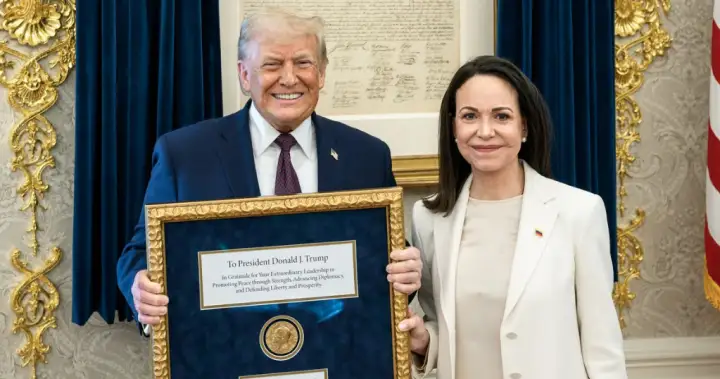
Machado spent roughly two and a half hours at the White House. After the closed-door meeting, she told reporters that she had presented Trump with her Nobel medal as recognition for what she described as his commitment to Venezuelan freedom. The White House posted a photo of the two in the Oval Office, with Trump holding the medal in a large frame.
I presented the president of the United States the medal, the Nobel Peace Prize, as a recognition for his unique commitment with our freedom.
María Corina Machado
Trump posted on social media that the presentation was an honour and thanked Machado for the gesture. The framed text in the Oval Office photo read, "Presented as a personal symbol of gratitude on behalf of the Venezuelan people in recognition of President Trump’s principled and decisive action to secure a free Venezuela."
She is a wonderful woman who has been through so much. María presented me with her Nobel Peace Prize for the work I have done. Such a wonderful gesture of mutual respect.
Donald J. Trump
Symbolism, legality and the Nobel Institute
The Nobel Institute clarified that Nobel prizes cannot be legally transferred by the laureate in a way that changes ownership of the award. That makes Machado’s action symbolic. For Machado, the gesture appears aimed at signalling gratitude and securing political attention. For Trump, the photograph offered a highly visible endorsement from a globally recognised dissident figure.
The encounter also underscored contradictions in U.S. policy. Trump has at times questioned Machado’s ability to lead Venezuela, saying she lacked sufficient support inside the country. At the same time, the administration has engaged with interim authorities who served under Maduro, complicating the opposition’s message about a clear path to democratic transition.
Responses in Washington and Caracas
The meeting led to mixed reactions among U.S. lawmakers. White House press secretary Karoline Leavitt called Machado "a remarkable and brave voice," but said the meeting did not signal a change in the administration’s overall assessment of her. Machado then met with a bipartisan group of senators in a closed-door session.
Senator Chris Murphy said Machado warned that if there is no real progress toward a power transition or elections in the next several months, concerns should grow. Republican Senator Bernie Moreno praised Machado and described Trump’s removal of Maduro as a major achievement for the region.
In Caracas, interim authorities led by Delcy Rodríguez remain in charge of day-to-day operations despite international pressure. Rodríguez has promoted resuming diplomatic ties and opening Venezuela’s oil industry to foreign investment. U.S. forces have also moved to gain control of sanctioned Venezuelan oil shipments, part of a broader effort to leverage the country’s resources during the transition.
Machado’s background and recent trajectory
Machado, an industrial engineer and co-founder of the civic group Súmate, has been a long-standing critic of the chavista governments that began with Hugo Chávez. She first entered national politics in 2004 with a recall referendum effort. Over the past two decades she has become one of the most visible faces of Venezuela’s opposition, though she has also faced legal and political reprisals.
She was not present in Norway when the Nobel Committee awarded her the Peace Prize. Her daughter accepted the prize on her behalf. Machado spent nearly a year in hiding in Venezuela before she reappeared in public abroad, and she has been building international support for a transition process back home.
- María Corina Machado presented her Nobel medal to Donald Trump at the White House, a symbolic gesture.
- The Nobel Institute says Nobel prizes cannot be transferred, so the presentation has no legal effect.
- Machado met with bipartisan senators and urged progress toward elections or a transition.
- U.S. policy appears to balance engagement with interim authorities and support for a democratic transition.
- Machado has led opposition efforts for two decades and received the Nobel Peace Prize in absentia.
After leaving the White House, Machado greeted supporters near the gates and told them, "We can count on President Trump." Those words will matter only if they lead to clear, concrete steps toward elections or a transition in Venezuela.
The medal presentation offered a powerful image, but it did not resolve the central question facing Venezuelan opposition figures: what concrete timeline and mechanisms will produce a change in power. The meeting gave Machado publicity and a public show of appreciation, yet substantive commitments from Washington remain limited.
VenezuelaMaría Corina MachadoDonald TrumpNobel Prizeinternational affairs