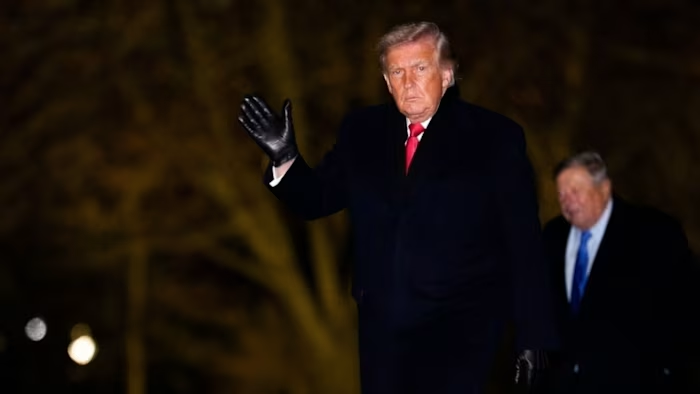
Markets slip as Trump says ‘no going back’ on Greenland plan, fuelling transatlantic tensions
US stocks and the dollar fell after Donald Trump insisted there was “no going back” on the push for Greenland, prompting criticism from European leaders and concern at Davos.
Copy link
By Torontoer Staff
US equities and the dollar slid after President Donald Trump said there was “no going back” on his campaign to take control of Greenland, even as he offered talks to resolve the dispute. The remarks escalated a diplomatic row with European capitals and added to investor anxiety ahead of the World Economic Forum in Davos.
On Tuesday the S&P 500 dropped 2.1 per cent, its worst single-day decline since October. The dollar fell 0.9 per cent against a basket of six currencies and long-term US government bond prices moved lower, reflecting concern about trade tensions and geopolitical risk.
Market reaction and financial indicators
The sell-off was broad based. Technology stocks led declines, sending the Nasdaq Composite down 2.4 per cent, while consumer discretionary, financial and industrial sectors also suffered significant losses. Investors treated the diplomatic dispute as a potential trigger for tariffs and wider economic friction.
Treasury yields rose as bond prices fell. The yield on the 30-year US Treasury advanced to about 4.92 per cent, up 0.08 percentage points. Traders cited a mix of worries, including the Greenland row, earlier weakness in Japanese government bonds, and a general flight from risk assets.
How the dispute escalated
The confrontation centres on Trump’s declared interest in acquiring Greenland, a self-governing territory of Denmark. He warned of tariffs on eight European states that recently sent military personnel to Greenland, a move that has prompted threats of retaliatory tariffs from Brussels and stalled cooperation talks.
European leaders responded sharply. French President Emmanuel Macron criticised the tone of the US approach, and the European Parliament’s main parties agreed to suspend ratification of last year’s EU-US trade deal. The dispute has become a focus at Davos, where leaders and ministers will discuss next steps.
There can be no going back.
Donald Trump
Political fallout and Davos dynamics
The dispute has complicated the transatlantic agenda at the World Economic Forum. Trump said he had agreed to convene a meeting of involved parties in Davos. US Treasury officials urged calm, asking trading partners to “take a deep breath and let things play out,” while reaffirming US commitment to NATO.
If the president presses ahead that would risk a dangerous downward spiral, we will respond in an unflinching, united and proportional way.
Ursula von der Leyen
The president also posted what appeared to be an AI-generated image showing an American flag on Greenland, and hinted at tougher measures. He criticised European leaders on his Truth Social platform and threatened punitive tariffs in response to perceived slights or security decisions.
What this means for markets and policy
Markets can respond quickly to diplomatic tensions that could affect trade and supply chains. The immediate impact has been price volatility and a reassessment of policy risk, including the prospect of tit-for-tat tariffs that would hit exporters and certain sectors disproportionately.
I do not understand what you are doing on Greenland,
Emmanuel Macron
- S&P 500 fell 2.1 per cent, Nasdaq fell 2.4 per cent.
- Dollar dropped about 0.9 per cent versus a six-currency basket.
- 30-year Treasury yield rose to roughly 4.92 per cent.
- European Parliament paused ratification of the EU-US trade deal.
- Tariff threats and diplomatic recriminations could prompt targeted market disruptions.
For businesses and consumers, the near-term concern is uncertainty. Exporters face the prospect of retaliatory levies, while investors may rotate toward safe-haven assets if tensions widen. Policy responses in Brussels and other capitals will be key to market direction in the coming days.
What to watch next
Look for outcomes from the planned Davos meeting and any formal tariff announcements from Washington or Brussels. Pay attention to statements from NATO officials, and to moves in bond markets as a barometer of risk sentiment. Corporate earnings and central bank commentary will also affect how markets absorb this geopolitical shock.
The Greenland dispute has added a fresh geopolitical wrinkle to an already uncertain market backdrop. How leaders manage rhetoric and follow-through on tariffs will determine whether this episode becomes a brief market scare or a longer drag on growth and trade.
TrumpGreenlandMarketsDavosEU-US relations