Most Americans prefer Canada and Greenland to remain independent, survey finds
A Research Co. poll finds 66% of U.S. adults want Canada to stay independent, while 17% support annexation. Greenland drew slightly more support for U.S. control.
Copy link
By Torontoer Staff
A new public opinion poll shows most Americans want Canada and Greenland to keep their current status rather than become U.S. territories or states. The online survey of 1,002 adults, conducted Jan. 13 to 15, found clear majorities favouring independence for both countries.
Sixty-six per cent of respondents said they want Canada to remain an independent nation, while 56 per cent said Greenland should keep its status as an autonomous territory of Denmark. Only 17 per cent supported making Canada a U.S. territory or state, and 23 per cent backed the same outcome for Greenland.
Survey findings in detail
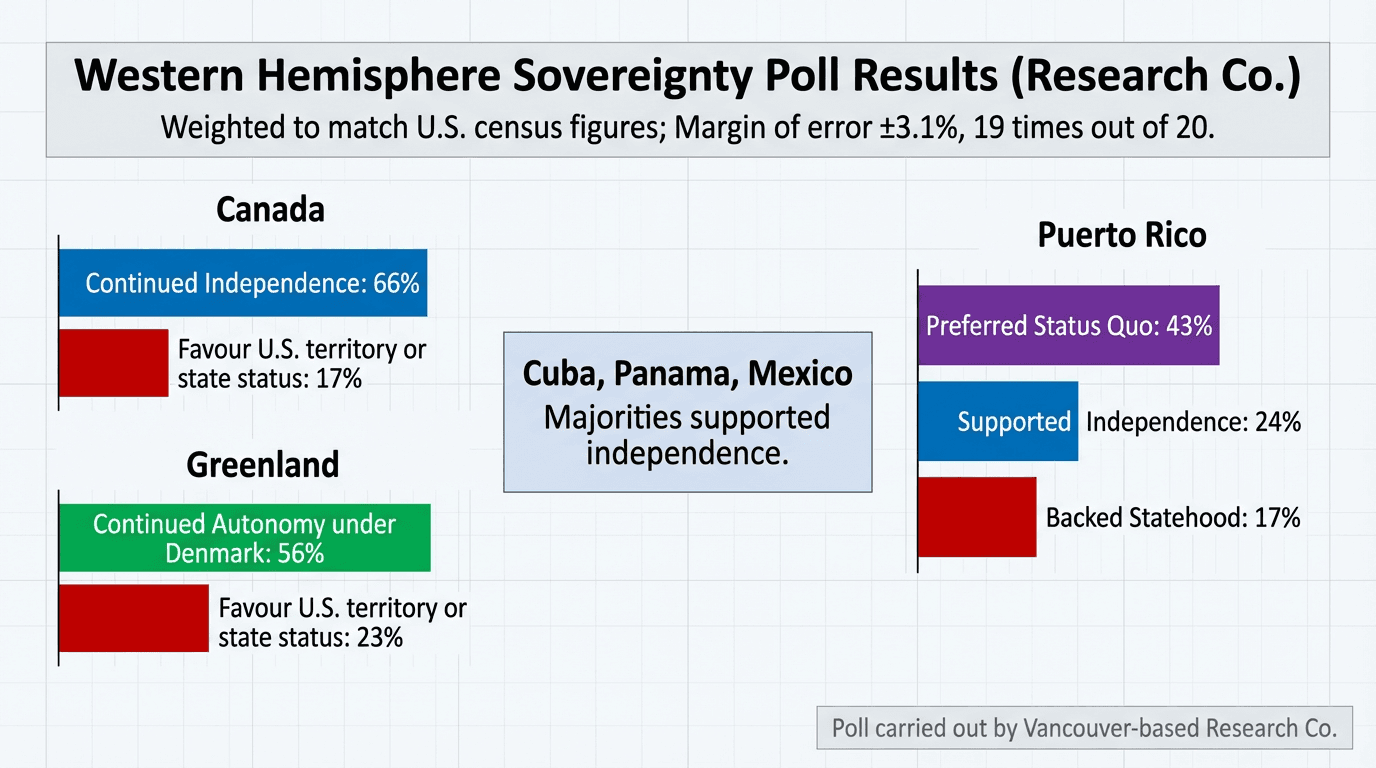
The poll was carried out by Vancouver-based Research Co. and weighted to match U.S. census figures for age, gender and region. The margin of error is plus or minus 3.1 percentage points, 19 times out of 20. Researchers asked respondents about the sovereignty of several countries and territories in the Western Hemisphere.
- Canada: 66% want continued independence, 17% favour U.S. territory or state status.
- Greenland: 56% want continued autonomy under Denmark, 23% favour U.S. territory or state status.
- Cuba, Panama, Mexico: majorities supported independence.
- Puerto Rico: 43% preferred the status quo, 24% supported independence, 17% backed statehood.
Partisan differences and political context
Support for changing the status quo was higher among Republicans and among voters who backed Donald Trump in 2024, but even among those groups majorities did not favour annexation. Research Co. found 36 per cent of Trump supporters said they wanted Greenland to become a U.S. state or territory.
We were curious to see how Americans felt about the expansionist push that their president has initiated. There is really no group that is clamouring to make the countries and territories that we asked about either U.S. territories or American states.
Mario Canseco, Research Co. president
President Donald Trump has pursued an expansionist agenda during his second term, publicly expressing interest in making Canada the U.S.’s 51st state and in asserting control over Greenland. Both Canada and Denmark, along with Greenlandic authorities, have pushed back against those proposals. All three remain NATO allies.
Methodology and limitations
The poll relied on an online sample of 1,002 U.S. adults and was statistically weighted to reflect census demographics. As with any online survey, results reflect respondents’ views at the time of polling and carry the stated margin of error. Small differences between subgroups should be read with caution.
The survey’s framing and the list of places included can shape responses. Questions about sovereignty and territory interact with respondents’ knowledge of international law, history and current geopolitics, which the poll did not measure in depth.
What the results suggest
Taken together, the findings indicate limited public appetite in the United States for territorial expansion into Canada or Greenland. Even among politically sympathetic groups, support falls short of a majority, signalling that annexation proposals face low popular backing.
For Canada and Denmark, the poll offers a public confirmation of broader diplomatic resistance to U.S. proposals about sovereignty. Policy debates about territory remain shaped by government positions, international law and strategic considerations rather than by a dominant shift in public opinion.
The Research Co. poll provides a snapshot of U.S. attitudes early in 2026. Future surveys would be needed to track whether opinions change as political discussions or geopolitical events evolve.
Canadapublic opinionsurveyGreenlandinternational relations