Nova Scotia rejects claims it is undermining Canada in U.S. softwood lumber dispute
Nova Scotia says requests from Quebec, Alberta and Ontario for detailed stumpage survey data are a ‘‘fishing expedition’’ and asks the U.S. to reject them.
Copy link
By Torontoer Staff
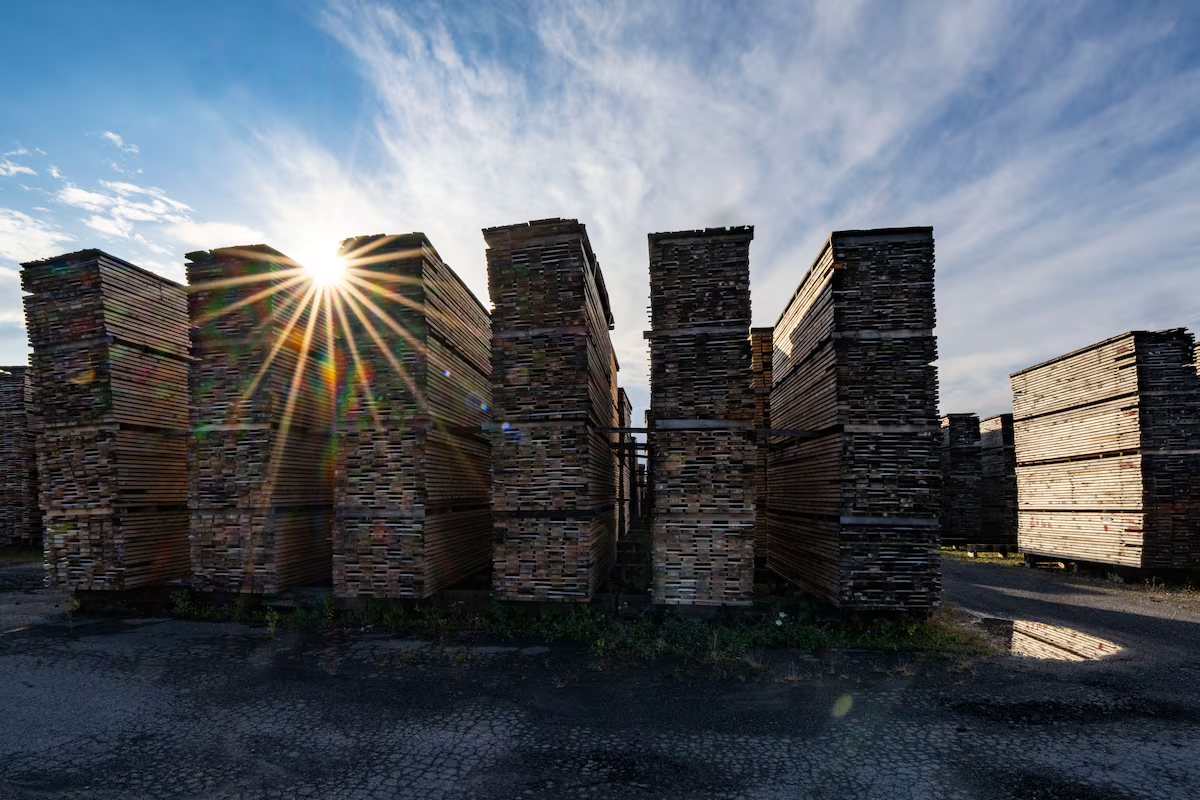
Nova Scotia has pushed back against accusations from Quebec, Alberta and Ontario that it is being secretive and damaging Canada’s position in a long-running softwood lumber dispute with the United States. The province’s lawyers asked the U.S. Department of Commerce to reject requests for detailed disclosure of the proprietary surveys Nova Scotia uses to set timber-harvesting fees.
The clash centres on how provinces calculate stumpage, the fee charged for the right to harvest timber. Nova Scotia argues its survey-based approach is proprietary and adequate for the Commerce Department’s needs, while the three other provinces want the U.S. to probe Nova Scotia’s methodology more deeply.
What Nova Scotia told the U.S. Commerce Department
Lawyers for the Nova Scotia government wrote to Commerce Secretary Howard Lutnick last week, calling the provinces’ requests a ‘‘fishing expedition’’ meant to ‘‘cast aspersions.’' The letter says Nova Scotia’s public disclosures are sufficient for interested parties to understand submissions, and that forcing full access to proprietary survey data would undermine the province’s ability to set stumpage rates.
The government of Nova Scotia categorically rejects the provincial governments’ insinuation that the government of Nova Scotia is trying to intentionally disadvantage the Canadian softwood lumber industry.
Nova Scotia government lawyers
The province also framed its co-operation with the Commerce Department as part of maintaining a constructive relationship with an important trading partner in the United States, saying it participates out of respect for bilateral trade processes.
Why Quebec, Alberta and Ontario want more detail
Quebec, Alberta and Ontario have jointly asked the Commerce Department to scrutinize Nova Scotia’s private woodlot surveys, arguing those surveys may produce stumpage benchmarks that are not comparable to systems in other provinces. Their filings urged the U.S. to consider abandoning Nova Scotia’s surveys as a benchmark if the methodology cannot be closely examined.
The three provinces say a deeper look is needed because the Commerce Department uses confidential Nova Scotia information as a benchmark to assess whether stumpage fees in Quebec, Alberta and Ontario are artificially low and therefore amount to unfair subsidies.
How the U.S. uses provincial data in its case
The Commerce Department compares provincial stumpage systems with U.S. benchmarks to determine countervailing and anti-dumping duties. For British Columbia, the U.S. conducts a separate comparison with Washington State. Nova Scotia’s confidential data is one of the inputs the U.S. relies on when assessing whether Canadian producers receive subsidized access to timber.
U.S. duties on Canadian softwood now total about 45.16 per cent for many producers, including 35.16 per cent in anti-dumping and countervailing duties plus a 10 per cent tariff. The measures include recent tariffs announced by the U.S. administration under national-security provisions.
Industry context and provincial differences
Forest tenure varies across Canada. Most Canadian timberland is Crown land, with stumpage fees set by provincial governments. Nova Scotia is an outlier: about 70 per cent of its forested land is private, while roughly 30 per cent is Crown land. That mix has led Nova Scotia to rely on private-woodlot surveys to inform its Crown stumpage rates.
By volume, British Columbia is Canada’s largest lumber exporter to the U.S., followed by Quebec, Alberta, Ontario and New Brunswick. Nova Scotia is among the smaller provincial exporters, but its methodology is relevant because the Commerce Department uses it as a comparative benchmark.
Canadian industrial policy promotes domestic production, and therefore exports, by charging below-market prices for standing timber on Crown land.
U.S. Lumber Coalition
What this means for the sector
The dispute adds another layer of uncertainty for Canadian forest companies that are already facing steep U.S. duties. The federal government is responding with a new Canadian Forest Sector Transformation Task Force, aimed at boosting domestic demand for Canadian wood products and reducing reliance on U.S. markets.
- Total U.S. import measures on many Canadian producers are about 45.16 per cent.
- The 2006 Canada-U.S. softwood agreement expired in 2015 and has not been replaced.
- Ottawa has launched a task force to promote mass timber and modular construction in Canada.
If Commerce presses Nova Scotia for more disclosure or discounts its survey benchmarks, the decision could influence duty calculations for other provinces and affect how stumpage systems are evaluated going forward.
Next steps and timeline
The Commerce Department will consider submissions from all parties before deciding whether to grant the provinces’ requests for additional information or to continue relying on Nova Scotia’s confidential data. Meanwhile, Ottawa and provincial governments will continue to engage on both trade defence and domestic measures to strengthen the forest sector.
The softwood dispute has been active since the 1980s and has intensified in recent years. Any change in how stumpage benchmarks are treated could have ripple effects across trade negotiations and industry competitiveness.
For now, Nova Scotia is standing by its process, the other provinces are seeking greater scrutiny, and the Commerce Department will decide how much weight to give proprietary survey data in its ongoing softwood reviews.
softwood lumberNova ScotiatradeforestryCanada-US relations