Prime minister at Davos: full speech and Canada’s plan for a changing world order
At Davos the prime minister called the rules-based order broken and set out a strategy of values-based realism: build resilience at home, deepen partnerships, and act with middle powers.
Copy link
By Torontoer Staff
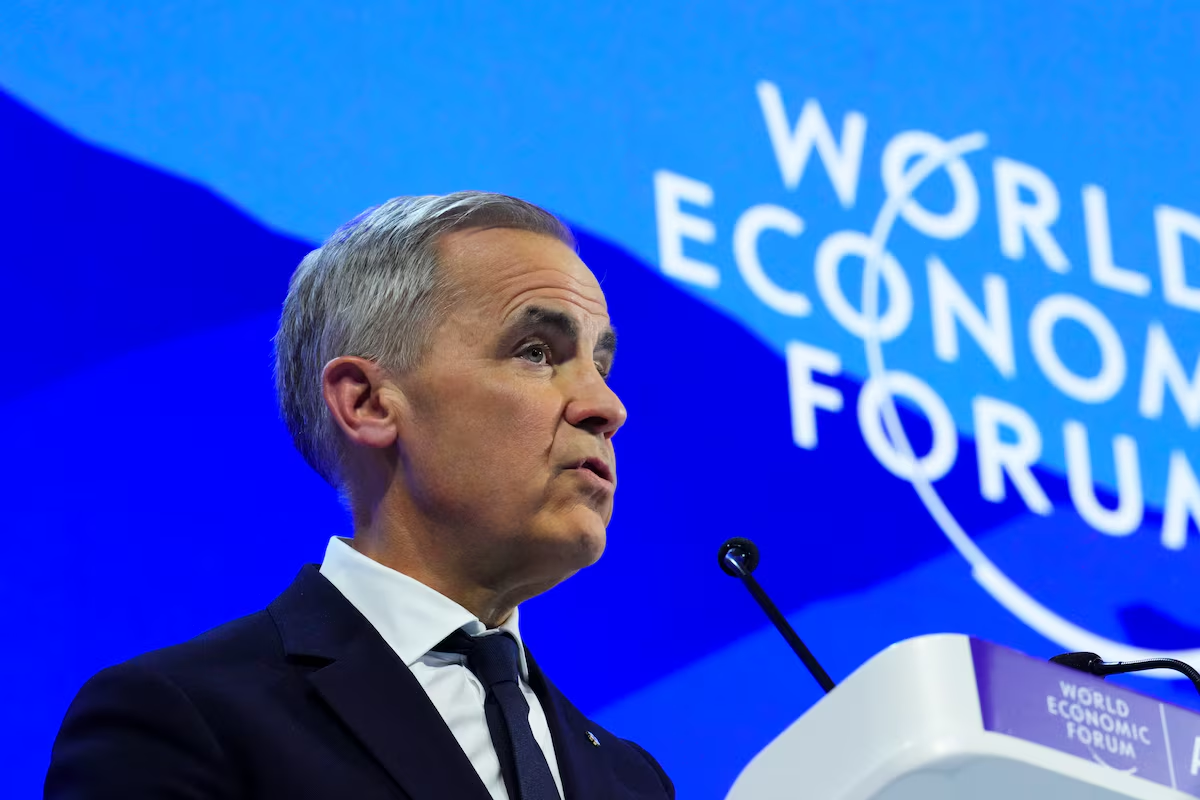
At the World Economic Forum in Davos, the prime minister declared that the rules-based international order is rupturing and laid out how Canada will respond. He argued the era of predictable institutions is over and that middle powers must choose between passive accommodation and active cooperation.
The speech mixed political diagnosis with policy steps. It framed the current moment as one of great-power rivalry, described the limits of multilateral institutions, and presented a strategy the government calls values-based realism, pairing principled positions with pragmatic, strategic action.
The problem, in plain terms
The prime minister said the old bargain that underpinned global governance has frayed. Over recent decades, crises in finance, health and energy revealed risks in deep integration. More recently, he said, economic ties have been weaponized: tariffs used as leverage, financial plumbing used for coercion, supply chains exposed as vulnerabilities.
He invoked Václav Havel’s greengrocer analogy to make his point about collective self-deception. Governments and firms, he said, have often performed rituals that signalled compliance with the rules-based order, even when those rules were applied unevenly. When the performance stops, the illusion cracks.
The power of the less powerful begins with honesty.
Prime minister, Davos speech
What Canada plans domestically
The government tied international strategy to domestic strength. Since taking office, it said, it has moved to cut taxes on income, capital gains and business investment, removed federal barriers to interprovincial trade, and begun fast-tracking roughly a trillion dollars in investment across energy, artificial intelligence, critical minerals and new trade corridors.
Defence was a central focus. The government pledged to double defence spending by the end of the decade, with investments aimed at building domestic industry as well as military capability. Specific priorities mentioned include over-the-horizon radar, submarines, aircraft and increased troop presence to secure northern and western flanks.
How Canada will act abroad
The speech emphasised diversification of international ties and flexible coalitions tailored to specific issues. The government highlighted recent strategic moves: a comprehensive partnership with the European Union that includes defence procurement cooperation, a string of trade and security deals across four continents, and newly concluded strategic partnerships with China and Qatar.
Trade negotiations were described as active and wide ranging. The government said it is negotiating free trade agreements with India, ASEAN, Thailand, the Philippines and Mercosur, while also working to build a bridge between the Trans-Pacific Partnership and the European Union to create a larger trading bloc.
- Strategic partnerships with the EU, China and Qatar
- Negotiations on free trade with India, ASEAN states, Thailand, the Philippines and Mercosur
- Plurilateral efforts to link the CPTPP and the EU
- Buyer’s clubs for critical minerals anchored in the G7
- Cooperation with democracies on AI standards
On security issues the prime minister positioned Canada as an active contributor. He restated support for Ukraine, described Canada as a core member of the Coalition of the Willing, and emphasised per-capita contributions to defence. He also reiterated backing for NATO’s Article 5 and expressed support for Greenland and Denmark on Arctic sovereignty, opposing tariffs that target Greenland.
A different posture for middle powers
The central argument was practical: middle powers cannot match great powers on hard power alone, but they can combine legitimacy, integrity and shared rules to produce influence. The speech urged countries to stop paying lip service to a rules-based order that no longer functions as advertised, and instead build institutions and agreements that actually deliver.
That means applying consistent standards to allies and rivals, reducing vulnerability by diversifying supply chains and energy sources, and pooling investments in resilience where collective action is cheaper than every country building its own fortress.
We are taking the sign out of the window.
Prime minister, Davos speech
What to watch next
The speech sets a framework rather than a timetable. Expect the government to highlight new defence contracts that create domestic industrial capacity, more bilateral and plurilateral trade and security arrangements, and initiatives on critical minerals and AI governance. How those moves translate into concrete policy, and how partners respond, will determine whether the strategy reinforces Canadian resilience or simply shifts dependencies.
The prime minister framed Canada’s approach as values-based realism: explicit about principles such as sovereignty and human rights, and pragmatic about the limits of existing institutions. He invited middle powers to act together, arguing that from the current fracture it is possible to build systems that are stronger and more just.
The speech closes with a clear line: the old order is not returning, so Canada will focus on building domestic strength, deepening strategic partnerships and creating issue-specific coalitions. That strategy will be the measure of whether middle powers can shape the next phase of global governance.
Davosforeign policyCanadadefencetrade