Quebec refocuses its international strategy as global politics shift
Quebec is reorienting its parallel foreign policy under International Relations Minister Christopher Skeete, expanding U.S. ties and new partnerships as global uncertainty grows.
Copy link
By Torontoer Staff
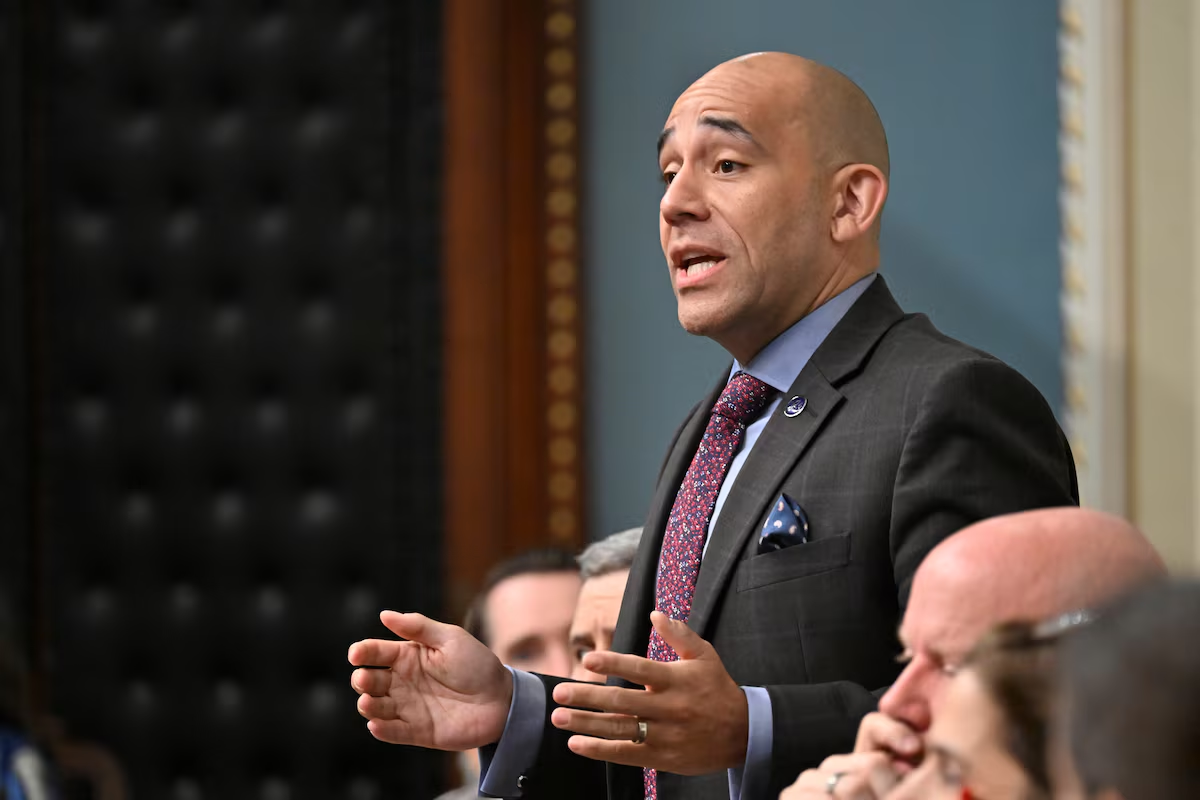
Quebec is recalibrating its international strategy under International Relations Minister Christopher Skeete as global politics and trade relations grow more volatile. The provincial government is leaning on a long-established but little-known diplomacy apparatus to protect economic and cultural interests abroad.
Quebec runs a network of 62 offices overseas, including trade and cultural delegations and parapublic agencies. That footprint, roughly equal to the rest of Canada combined by one estimate, gives Quebec a degree of direct access on the world stage that most provinces do not have.
A distinct foreign policy, rooted in provincial jurisdiction
Quebec’s international presence dates to the 1960s and is governed by the Gérin-Lajoie doctrine. The doctrine emphasises the external application of Quebec’s internal jurisdiction, allowing Quebec to conduct diplomacy on matters tied to provincial responsibilities such as education, culture and natural resources. Over time that approach became institutionalised, moving from provocation to ordinary practice in Ottawa and abroad.
Historic flash points shaped the policy. Visits and interventions in the 1960s and 1990s, including Charles de Gaulle’s 1967 speech and a secret 1995 emissary to Paris, provoked federal pushback. Those tensions have diminished as Quebec’s overseas operations became standard parts of its governance.
A sizeable footprint and state-like trappings
Quebec’s offices abroad perform a mix of cultural diplomacy, trade promotion and political outreach. Some delegate-general residences and downtown offices resemble missions more than trade bureaus, and the province maintains a visible presence within international fora such as the Canadian delegation to UNESCO.
It’s more organized, it’s better financed, it’s more systemic. It’s rooted in culture.
Christopher Skeete
Those investments in people and premises have made Quebec’s network more effective at promoting francophone culture and provincial interests, and at building bilateral relationships with cities, states and nations.
Pivoting to the United States and new partners
Trade with the United States has eclipsed historical ties with France in commercial terms, and Quebec has responded by expanding its U.S. presence. The province now operates nine offices across major American markets, from Los Angeles to Miami. Those on-the-ground teams allowed Quebec to engage U.S. state legislatures directly during recent trade disputes.
We saw it coming. We boosted our staff in the Washington D.C. office before the election of Trump, we maintained relationships with people in the MAGA movement, we knew Trump was going to win before he did.
Christopher Skeete
At the same time, Quebec has sought new international partners to reduce reliance on a single market. Recent initiatives include a collaboration between Quebec shipbuilder Davie and a Finnish yard on an Arctic icebreaker, and a December agreement with the United Kingdom on critical minerals such as titanium for defence supply chains.
- Increased staffing in Washington to improve state-level outreach
- Davie and Finnish shipyard cooperation on an icebreaker project
- Agreement with the UK on critical minerals for defence
Relations with Ottawa and political risks
Quebec’s diplomacy now often lines up with federal priorities, particularly on U.S. relations. Former delegates and officials say a pragmatic approach under the current federal leadership has created a period of cooperation that differs from the more confrontational eras of past decades.
That truce could be temporary. A future provincial government that prioritises sovereignty and a new referendum would likely reintroduce friction with Ottawa and revive old disputes over jurisdiction and recognition.
I can’t for the life of me sum up the energy to care about that, given everything else that’s going on. I’d rather be at Davos yesterday, promoting Quebec. I’d rather be in Japan next week.
Christopher Skeete
For now, Quebec’s approach combines the practicalities of trade promotion with cultural diplomacy and targeted political outreach. The strategy aims to protect provincial interests while navigating an international environment marked by shifting alliances.
Quebec’s parallel foreign policy remains quietly influential. It is grounded in provincial jurisdiction, staffed for access in key markets, and positioned to adapt as global politics continue to evolve.
Quebecforeign policyChristopher Skeeteinternational relationsCanada