Quebec soldier accused of plotting to seize cottages, court records say
Court documents allege Master Corporal Marc‑Aurèle Chabot led a group of current and former soldiers planning to occupy cottages and scout infrastructure. He faces three terrorism-related charges.
Copy link
By Torontoer Staff
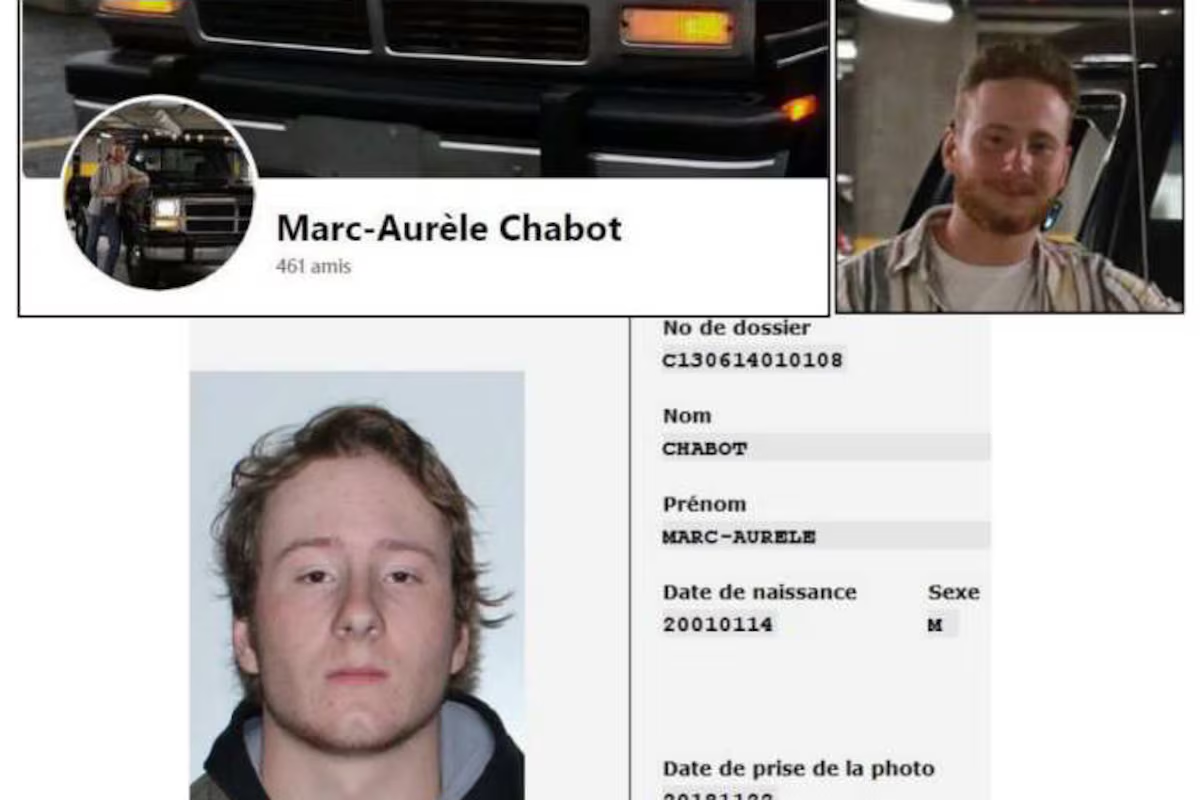
Master Corporal Marc‑Aurèle Chabot, a member of the Canadian Armed Forces, is accused in court documents of leading a group of current and former soldiers who planned to seize cottages and other sites by force in the event of a societal collapse. The allegations were disclosed after a publication ban was lifted, and none have been proven in court.
Police say Chabot and associates conducted tactical exercises in central Quebec and eastern Ontario, scouted industrial sites and a water‑filtration plant, and discussed explosives and defensive preparations. He faces three terrorism-related charges, along with weapons and other offences against three co-accused.
Charges outlined in unsealed documents
The RCMP charged Chabot last year and federal prosecutors added new counts in November. The men originally faced accusations of facilitating a terrorist activity. The new indictment accuses Chabot of instructing others to carry out activities for a terrorist group, and all three men face counts of using property, including firearms and smoke grenades, for terrorist purposes.
Three men from the Quebec City area are named in the documents: Master Corporal Marc‑Aurèle Chabot, Raphaël Lagacé, a former cadets instructor, and Simon Angers‑Audet, an ex‑reservist. A fourth suspect, Corporal Matthew Forbes, faces weapons charges but was not accused of terrorism.
How the investigation developed
The RCMP began surveillance in March 2023 after an alert from the Canadian Security Intelligence Service. Investigators filed affidavits to obtain 111 warrants to access financial and postal records, geolocate phones and deploy tracking devices. Nearly 14,000 pages of those documents were unsealed following a media application.
The documents identify a group called Hide and Stalk, H&S, made up of current and former soldiers who shared anti‑government views. Police say the group used multiple social media and messaging platforms, discussed erasing data and moving to encrypted channels, and engaged in tactical drills in remote locations.
An informant’s cooperation
Investigators expanded the probe to New Brunswick after monitoring a former army sapper, Bryan Foglia. The affidavit says Foglia visited a Fredericton RCMP detachment on May 24, 2023, and told officers he was ‘‘ready to collaborate’’. He later agreed to cooperate, provided a USB key of photos and access to his cellphone, and became a co‑operative witness.
Foglia is ready to collaborate.
affidavit excerpt
Foglia told investigators he declined requests to teach explosive‑handling techniques. The documents say he attended H&S training weekends and posted photos that included gestures investigators associate with white supremacist symbolism.
Alleged plans and targets
According to the affidavits, Chabot discussed expectations of an imminent crisis, describing scenarios that ranged from economic collapse to foreign attack, and even a ‘‘zombie invasion.’’ The documents say he planned to shelter at a hunting ground called ZEC Batiscan‑Neilson, and that the group had identified specific cottages they intended to occupy.
Chabot has said he didn’t care about dying to realize his plan.
RCMP affidavit
Investigators also allege the group conducted reconnaissance at a water‑filtration plant, industrial sites and communication towers they deemed ‘‘places of interest.’’ The affidavits describe discussions that included anti‑Semitic jokes and disparaging comments about women, and note the use of firearms, smoke grenades and other military equipment during training.
Surveillance, seizures and arrests
RCMP investigators conducted months of covert surveillance, including aerial monitoring, to observe training sessions where men wore military gear and carried out drills. The probe intensified after a separate incident in January 2024 when a former girlfriend of Raphaël Lagacé called 9‑1‑1 reporting he was suicidal. Local police seized about 50 firearms from Lagacé without a warrant as a preventive step.
The RCMP executed searches days later, seizing phones and other materials from the four men. Chabot and three others were arrested in July 2023. The Crown has since added terrorism‑related counts against Chabot and other charges remain before the courts.
Legal status and next steps
None of the allegations in the affidavits have been tested at trial. The material presently in the public record stems from warrant applications and investigative statements. Publication restrictions previously in place limited reporting on additional testimony and details.
Prosecutions for terrorism offences require the Crown to prove intent and participation beyond a reasonable doubt. Court proceedings will determine which elements of the RCMP’s case can be admitted as evidence and whether charges will proceed to trial.
The unfolding case has prompted scrutiny of how current and former military personnel communicate and train outside formal structures, and how security agencies track individuals who express extremist views. The RCMP and federal prosecutors continue to handle the investigation and related court processes.
A publication ban was lifted, allowing further details to be reported. Defence counsel, prosecutors and the RCMP did not immediately respond to requests for comment on the unsealed material.
The case remains before the courts. Hearings and legal filings will determine the timetable for any trial and the admissibility of evidence disclosed so far.
terrorismRCMPCSISQuebecmilitary