SpaceX buys xAI in record deal, valuing combined company at $1.25 trillion
Elon Musk has merged SpaceX and xAI in a record-setting acquisition that values the combined company at US$1.25 trillion as SpaceX moves toward a planned IPO.
Copy link
By Torontoer Staff
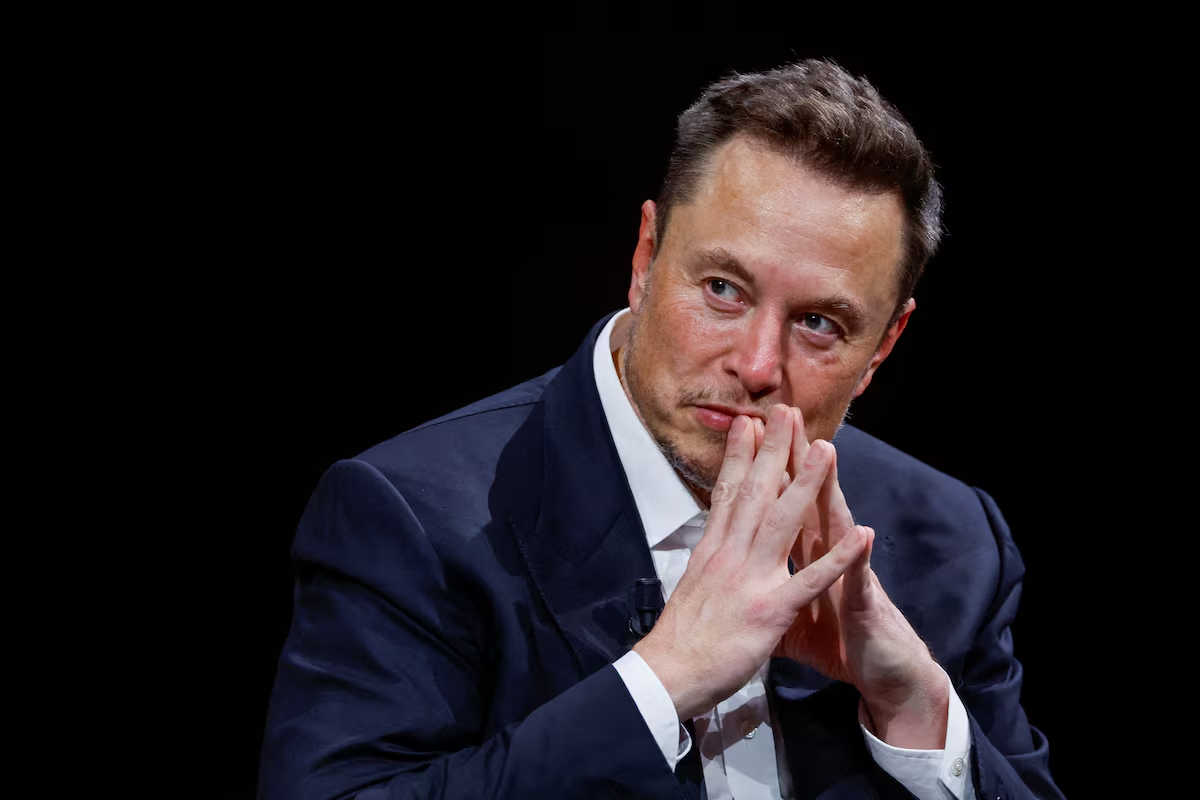
Elon Musk announced that SpaceX has acquired his artificial-intelligence startup xAI in a deal that values the combined business at roughly US$1.25 trillion. The transaction unites SpaceX’s rocket and satellite operations with xAI’s Grok chatbot technology as the space company prepares for a potential public offering.
The agreement, first reported by Reuters last week, marks the largest M&A deal on record by a wide margin and consolidates several of Musk’s technology bets into a single, integrated platform ahead of a likely SpaceX IPO.
Deal details and valuation
People familiar with the deal said the transaction values SpaceX at US$1 trillion and xAI at US$250 billion. xAI shareholders will receive 0.1433 shares of SpaceX for each xAI share. Some xAI executives may elect to take cash instead of SpaceX stock, at approximately US$75.46 per xAI share. Another person familiar with the matter said the combined company is expected to price shares at about US$527 each.
- SpaceX valuation in the deal: US$1 trillion
- xAI valuation in the deal: US$250 billion
- Exchange ratio: 0.1433 SpaceX share for each xAI share
- Alternate cash option for some xAI executives: US$75.46 per xAI share
- Estimated combined share price: about US$527
This marks not just the next chapter, but the next book in SpaceX and xAI’s mission: scaling to make a sentient sun to understand the Universe and extend the light of consciousness to the stars!
Elon Musk
Why SpaceX is buying xAI
Industry analysts say the deal links SpaceX’s global satellite network and growing data-centre ambitions with xAI’s models, compute needs and data expertise. Starlink’s low-latency connectivity and potential orbital infrastructure could become a distribution surface for AI services, while satellite imagery and telemetry represent new training data sources for models.
Starlink was already a cash flow engine and now it adds an AI revenue layer on top while also becoming a distribution surface for AI services and data.
Ali Javaheri, PitchBook senior emerging spaces analyst
The move also positions SpaceX to compete more directly with established cloud and AI providers. xAI’s costs are largely driven by chips, data centres and energy, areas where SpaceX could pursue economies of scale or novel deployment models, including discussions of orbital data centres in some analyst commentary.
Regulatory and governance questions
The consolidation raises governance and conflict-of-interest concerns given Musk’s leadership roles across multiple companies, including Tesla, Neuralink and the Boring Company. Regulators and investors may scrutinize valuation assumptions, the movement of personnel and technology between entities, and overlapping business lines.
SpaceX holds substantial federal contracts with NASA, the Department of Defense and intelligence agencies. Those contracts and the national-security implications of combining space and AI capabilities mean the agreement could face review by government agencies with authority to evaluate mergers for risks.
How this fits into Musk’s broader empire
Investors and analysts have described the growing web of Musk companies as a mutually reinforcing ecosystem, informally dubbed the 'Muskonomy'. The xAI acquisition follows Musk’s earlier moves to fold social media platform X into his AI efforts through a share swap, a pattern of combining assets to give startups access to data and distribution.
SpaceX was already the most valuable private company after an insider share sale valued it at about US$800 billion. xAI’s last reported valuation was near US$230 billion. Some people familiar with SpaceX’s plans said a public offering later this year could value the company at more than US$1.5 trillion, though those estimates will be tested by market conditions and regulatory review.
What comes next
SpaceX, xAI and Musk did not immediately respond to requests for comment. The key items to watch in the coming months include regulatory filings, the integration plan for engineers and data, any conditions attached by federal agencies, and the timetable for a potential IPO.
The deal rewrites the scale for corporate combinations in technology and space and will shape how investors, regulators and competitors approach the intersection of AI and orbital infrastructure.
Expect scrutiny on governance, national-security assessments and how the combined company intends to operationalise synergies between satellites, data centres and AI services as it moves toward public markets.
Elon MuskSpaceXxAIMergersTechnology