Supreme Court hears case testing random traffic stops and racial profiling
The Supreme Court will decide whether police can conduct suspicionless traffic stops, after lower courts struck down Quebec’s law following a Black driver’s challenge.
Copy link
By Torontoer Staff
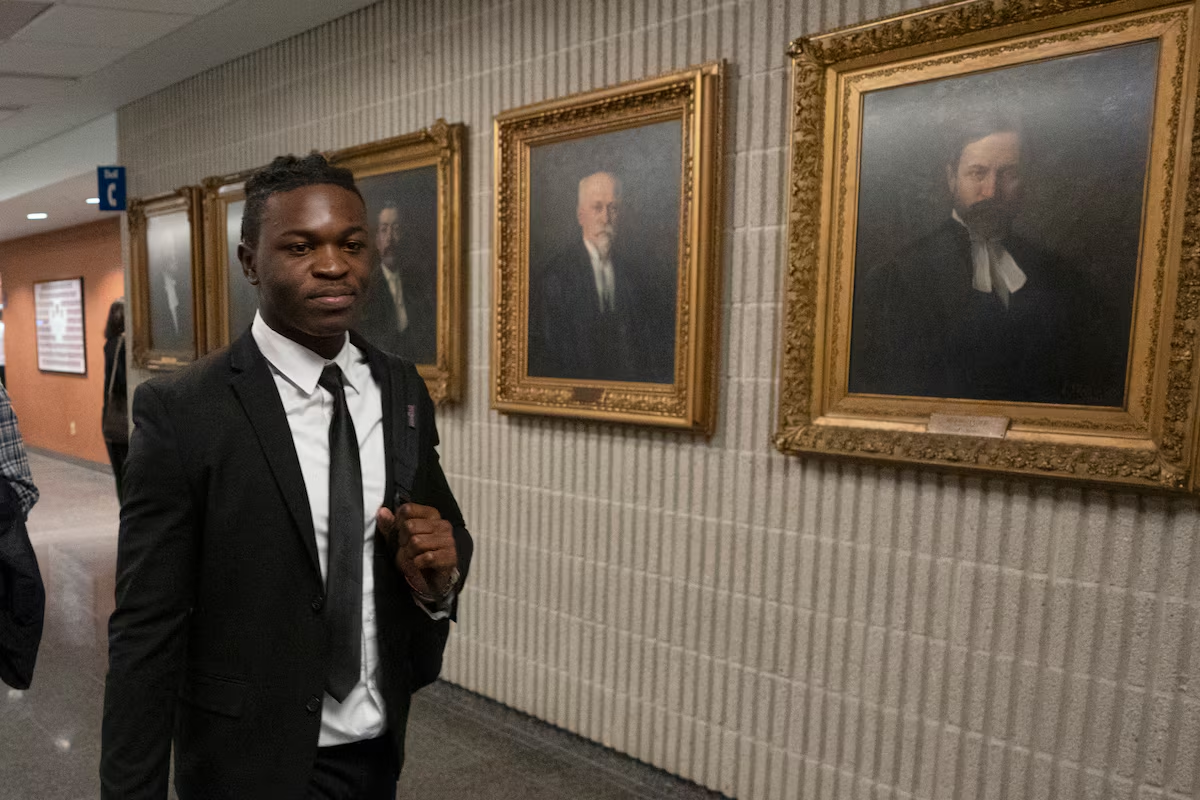
The Supreme Court of Canada began a two-day hearing on Monday to decide whether police may randomly stop drivers without reasonable suspicion. The case stems from a Charter challenge by Joseph-Christopher Luamba, a young Black Quebecker whose repeated stops led Quebec’s courts to rule the province’s law unconstitutional.
Lower courts found the law allowed arbitrary detention and facilitated racial profiling. The high court must now reassess a 1990 precedent that has long permitted suspicionless stops in the name of road safety.
What happened to Mr. Luamba
Mr. Luamba was stopped several times by police in 2019 and 2020 while driving in Quebec. Officers checked his identification and vehicle documents and then released him. Troubled by the pattern, he challenged the provincial statute that enabled police to detain drivers for verification purposes without individualized grounds.
In a 2022 Superior Court ruling, Justice Michel Yergeau described the phrase 'driving while Black' as apt and concluded racial profiling is a real and damaging phenomenon for Black communities. The Quebec Court of Appeal upheld that decision in 2024.
The expression 'driving while Black' aptly reflects this reality. Racial profiling does exist. It is a reality that weighs heavily on Black communities.
Justice Michel Yergeau
The legal precedent under review
At issue is the Supreme Court’s 1990 ruling in R v. Ladouceur, a 5-4 decision that allowed random stops for traffic verification, citing highway safety concerns. The majority accepted the measure as a justified limit on liberty under Section 1 of the Charter, while a dissent warned that the power could be exercised on 'any whim.'
Arguments before the court
Quebec, several provinces and the federal government asked the Supreme Court to reverse the lower-court rulings and reaffirm Ladouceur. They say suspicionless stops serve a vital public safety function. Police and provincial authorities also acknowledged racial profiling as a problem in filings, but argued that the existence of misuse does not negate the law’s purpose.
Mr. Luamba, the Canadian Civil Liberties Association and the Canadian Association of Black Lawyers asked the court to strike down the Ladouceur precedent and to prohibit random traffic stops nationwide. They say the power to detain without cause enables systemic bias against racialized communities.
There isn’t anything random about these suspicion-less stops. We’re not saying all police officers are biased, but there’s a systemic bias, and it’s well-documented.
Harini Sivalingam, Canadian Civil Liberties Association
Evidence on safety and profiling
Experts who testified for Quebec were unable to produce clear data showing that random stops improve road safety. By contrast, academic studies cited in the lower-court decisions found strong disparities in who is stopped. Research in Quebec from 2019 showed young Black men are more than five times likelier to be stopped than their white peers.
The courts have not been asked to revisit the lawfulness of fixed checkpoint stops used to deter impaired driving. Those targeted, stationary checks were upheld by the Supreme Court in earlier cases and remain distinct from the general random stops at issue now.
Interveners and wider implications
More than a dozen groups are intervening, including civil liberties organisations, legal associations and equality advocates. Several present arguments focused on Section 15 of the Charter, which guarantees equality rights and protection from discrimination.
This may be the first time in the Charter’s history that the Supreme Court rules on questions of racism against Black people and Section 15. This is a rare opportunity to directly confront this issue.
Akosua Matthews, counsel, Women’s Legal Education and Action Fund
- If the court upholds Ladouceur, provinces may retain broad power to conduct suspicionless traffic verifications.
- If the court overturns the precedent, laws permitting random stops could be struck down or require major rewriting.
- Either outcome could prompt legislative responses, new police practices or expanded oversight to address profiling and safety concerns.
Criminal defence groups argue the lack of oversight inherent in random stops falls heaviest on racialized communities and is constitutionally untenable. Police leadership cautions that removing the power could hinder traffic safety efforts.
What comes next
The Supreme Court’s decision will shape police powers across Canada and signal how the Charter balances equality rights against public safety arguments. A ruling could take months.
After his 2022 victory, Mr. Luamba wrote on social media that racial profiling stigmatizes and discriminates, and that 'the fight is not over.' The high court’s ruling will determine whether that fight expands from one province to the whole country.
Supreme Court of Canadapolicingracial profilingCharter of RightsQuebec