Trump’s territorial push upends Western security and tests Canadian sovereignty
Trump’s interest in Greenland and broader territorial assertions are unsettling NATO and prompting allied states, including Canada, to reassess dependence on the United States.
Copy link
By Torontoer Staff
President Donald Trump’s recent moves over Greenland and blunt challenges to allies have shifted familiar international patterns. The proposals and rhetoric are prompting governments in Europe and North America to weigh reducing military and strategic dependence on the United States.
What began as a high-profile diplomatic squabble has become a broader strategic test for NATO and for countries that once assumed long-term American security guarantees. The episode has forced diplomats and defence planners to imagine alternative arrangements for deterrence and basing.
What Trump proposed and why it matters
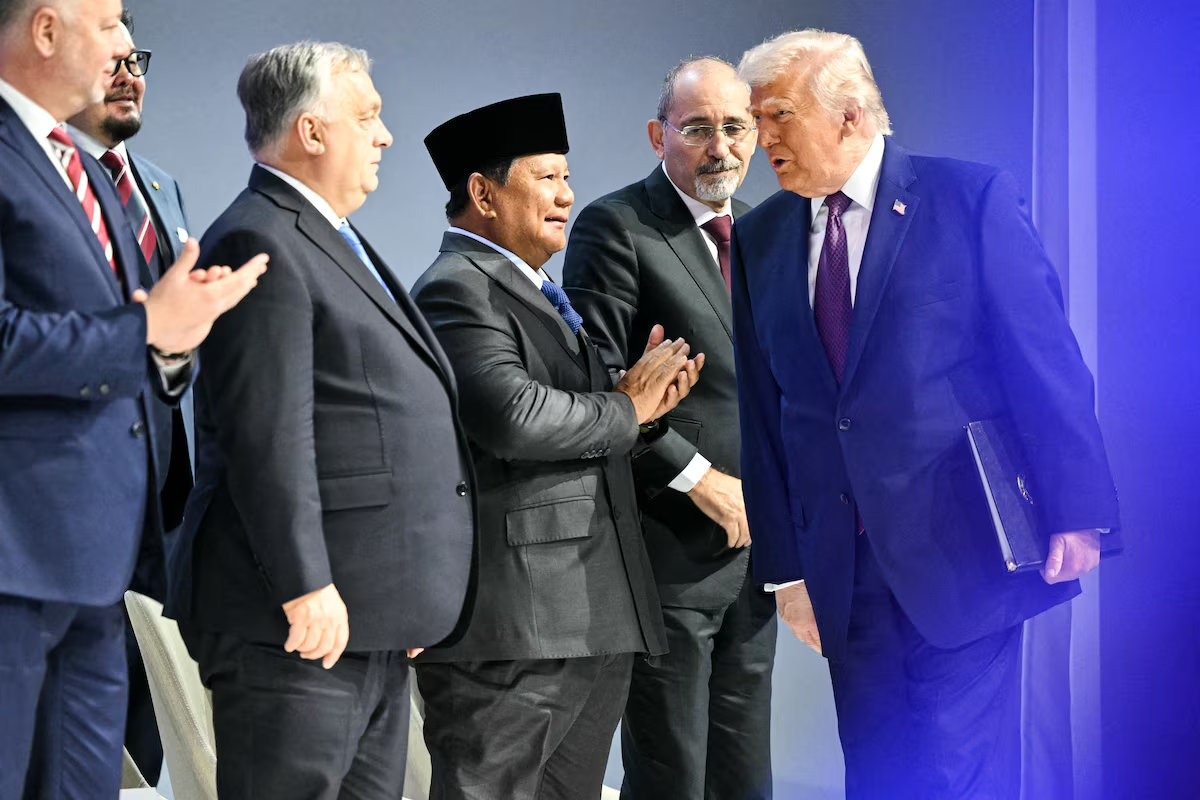
Reports circulated after meetings at the World Economic Forum in Davos suggested a framework could be developed to give the United States access to parts of Greenland. The arrangement would allow U.S. use of territory for bases or missile-defence installations while leaving formal sovereignty with Denmark. For the White House, the stated rationale is to blunt potential military gains by Russia or China in the Arctic.
For allies, the concept raises familiar but acute questions about sovereignty, precedent, and the meaning of alliance commitments. References to arrangements similar to historical American control over strategic sites evoke concerns about a return to territorial approaches that many Western leaders had assumed were passé.
Allies respond, and NATO’s cohesion is tested
The public exchanges at Davos and the uncertainty around Greenland and other interventions placed NATO in an unusual position: managing fear of aggression from outside the alliance while confronting the possibility of unilateral American action. Some members have begun to pursue diversification of defence ties and procurement, mindful that reliance on U.S. forces may no longer be stable.
It is not grandiose to call this the end of the Western alliance.
Bronwen Maddox, director, Chatham House
That assessment has been debated. Critics point out that NATO’s institutional and military capabilities remain substantial, and that formal treaty obligations still bind members. Still, the political dynamics have changed. Longstanding assumptions about unquestioned American leadership are eroding, and allies are adjusting accordingly.
Historical contrast and symbolism
The rhetoric and tactics stand in stark contrast to presidential statements from earlier eras that emphasised non-expansion and anti-imperialism. Franklin D. Roosevelt, for example, spoke against predatory ambitions and territorial expansion decades ago. The current approach, critics say, revives anxieties about great-power competition handled through control of territory rather than cooperation.
Security ripple effects: Europe, the Arctic, and beyond
Allied unease has practical consequences. Baltic states and other eastern members of NATO worry that apparent discord weakens deterrence against Russia. Separately, closer economic and strategic ties between Arctic states and China have accelerated, as smaller powers seek hedges against uncertainty.
Observers also note wider geopolitical implications. A perceived opening in Western cohesion could encourage more assertive policy from Moscow and Beijing, with potential consequences for Ukraine, Taiwan, and other regional flashpoints where territorial control remains central to strategic calculations.
What this means for Canada
Canada finds itself directly implicated. Public discussion of Greenland and of U.S. approaches to Canadian sovereignty has pushed Ottawa to consider more explicit contingency planning. Policymakers are evaluating supply chains, basing arrangements, and regional cooperation with partners beyond Washington.
- Greater emphasis on joint European and North American defence initiatives without exclusive U.S. reliance
- Increased diplomatic outreach to Denmark, Nordic states, and multilateral forums to protect Arctic sovereignty
- Diversified procurement and force posture to reduce single-source dependencies
Those measures reflect a practical shift rather than ideological realignment. Governments aim to preserve deterrence and regional stability while protecting national sovereignty and strategic interests.
Practical takeaways
The Greenland episode is not just a personality-driven dispute. It highlights how choices about territory, basing, and alliance behaviour reverberate through security and diplomatic networks. For citizens, the central questions are straightforward: how will governments protect sovereignty, and how will alliances adapt to new uncertainty?
Allies can respond by clarifying legal frameworks for basing, strengthening regional deterrents, and deepening multilateral cooperation. Doing so would preserve collective defence while reducing the risk that shifts in one capital result in abrupt strategic dislocations across continents.
The long-standing postwar architecture of alliances is under pressure, and governments are no longer assuming American leadership as an immutable constant. How Ottawa and its partners recalibrate in response will shape strategic choices across the Arctic and beyond for years to come.
TrumpNATOGreenlandCanadasecurity