Trump says he has a framework for a Greenland deal, drops threatened tariffs after Davos meeting
At Davos, President Trump said he reached a “framework” on Greenland with Dutch PM Mark Rutte and withdrew tariff threats. He gave no details and repeated his demand for the island.
Copy link
By Torontoer Staff
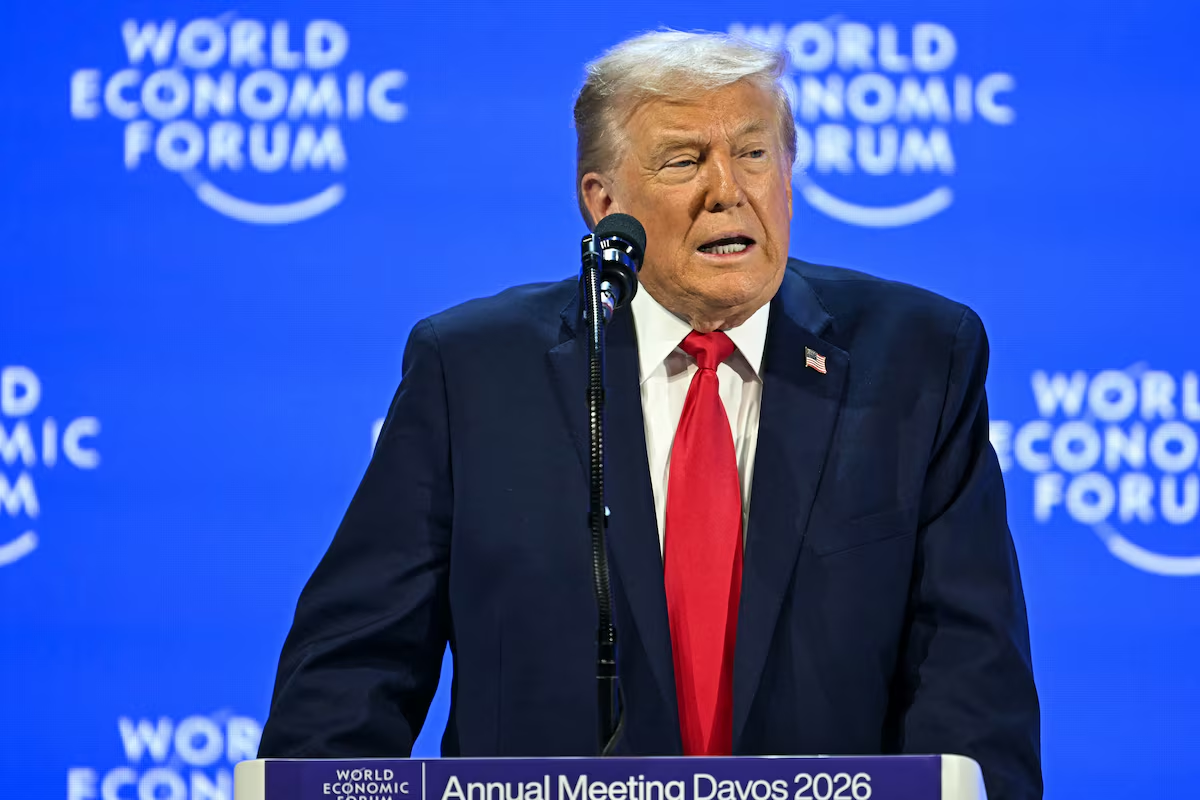
U.S. President Donald Trump told delegates at the World Economic Forum in Davos that he has agreed to a “framework of a future deal” on Greenland after meeting with Dutch Prime Minister Mark Rutte, and that he will not impose the tariffs he had threatened on European allies. He did not provide details of the agreement.
The announcement followed a speech in which Trump reiterated his long-standing demand that the United States secure control of Greenland, and included a direct public rebuke of Mark Carney, who spoke earlier in the forum about threats to the rules-based international order.
What Trump said in Davos
After a meeting with Mark Rutte at Davos, Trump posted on his social feed that he would not move forward with the tariffs he had scheduled for Feb. 1. He said the next phase of talks would be led by Vice-President JD Vance, Secretary of State Marco Rubio and special envoy Steve Witkoff, and described the accord as a preliminary framework rather than a finished deal.
We probably won’t get anything unless I decide to use excessive strength and force, where we would be, frankly, unstoppable. But I won’t do that, I don’t want to use force, I won’t use force.
Donald Trump
Trump repeated his claim that Greenland is strategically vital and should belong to the United States. He said he had abandoned the idea of using military force, but argued that the island would be difficult to defend without U.S. ownership.
The Golden Dome and defence rationale
A central theme of Trump’s remarks was his plan for a so-called Golden Dome missile defence system, which he said would protect North America and explicitly mentioned it would defend Canada. He described Greenland as a sparsely populated territory that the United States should control for strategic reasons.
The U.S. already operates Thule Air Base in Greenland and has rights under a 1951 treaty with Denmark to build and operate military facilities. Denmark and Greenland officials, as well as NATO partners, have long treated sovereignty and defence in the Arctic as matters for Denmark and the semi-autonomous Greenland government.
Responses and diplomatic context
Trump’s public push to acquire Greenland and his remarks at Davos prompted immediate diplomatic concern. Greenland’s population has repeatedly expressed opposition to any transfer of sovereignty, and NATO officials warned that unilateral moves could strain alliances that underpin transatlantic security.
Middle powers must act together because, if we’re not at the table, we’re on the menu.
Mark Carney
Mark Carney, the former governor of the Bank of Canada and the Bank of England, gave a speech at Davos warning of a rupture in the rules-based international order and urging countries to resist economic coercion. Trump singled out Carney by name during his remarks, saying Canada should be more grateful to the United States.
Key moments, at a glance
- Trump meets Dutch Prime Minister Mark Rutte at the World Economic Forum in Davos and announces a “framework” for a Greenland deal.
- He says he will not impose Feb. 1 tariffs on European countries and names a U.S. team to continue talks.
- Trump reiterates his demand that Greenland come under U.S. control, citing a proposed Golden Dome missile defence system.
- Mark Carney speaks at Davos about threats to the international rules-based order; Trump criticises him publicly.
- No formal agreement or written terms were released, and Greenland officials have not endorsed a transfer of sovereignty.
What this means for Canadians
For Canadians, the immediate economic risk from the announced tariff withdrawal is reduced, at least for now. The larger issues are diplomatic and strategic: any U.S. push to change the status of Greenland would involve Denmark and would affect NATO coordination in the Arctic.
Canadian officials have signalled support for strengthening Greenland’s defence through alliance cooperation. The next practical steps will be the follow-up talks Trump outlined, and any formal proposals would require consultation with Greenlandic authorities and Denmark.
At Davos, Trump framed the matter as a security issue. Others called for multilateral processes and respect for the voice of Greenland’s residents.
What to watch next
Expect announcements about the composition and mandate of the U.S. negotiating team Trump named. Watch for statements from Denmark and Greenland clarifying their positions, and for any NATO response on Arctic defence plans. For now, the so-called framework remains an outline without public terms or signatures.
Trump left Davos with a public claim of progress, but key questions about sovereignty, consent and concrete commitments remain unresolved.
GreenlandDonald TrumpDavosCanadaNATO