Trump says 'no going back' on Greenland, shares AI images showing Canada as US
President Trump doubled down on plans for Greenland, posted AI images including one that showed Canada as part of the United States, and leaked messages including one from President Macron.
Copy link
By Torontoer Staff
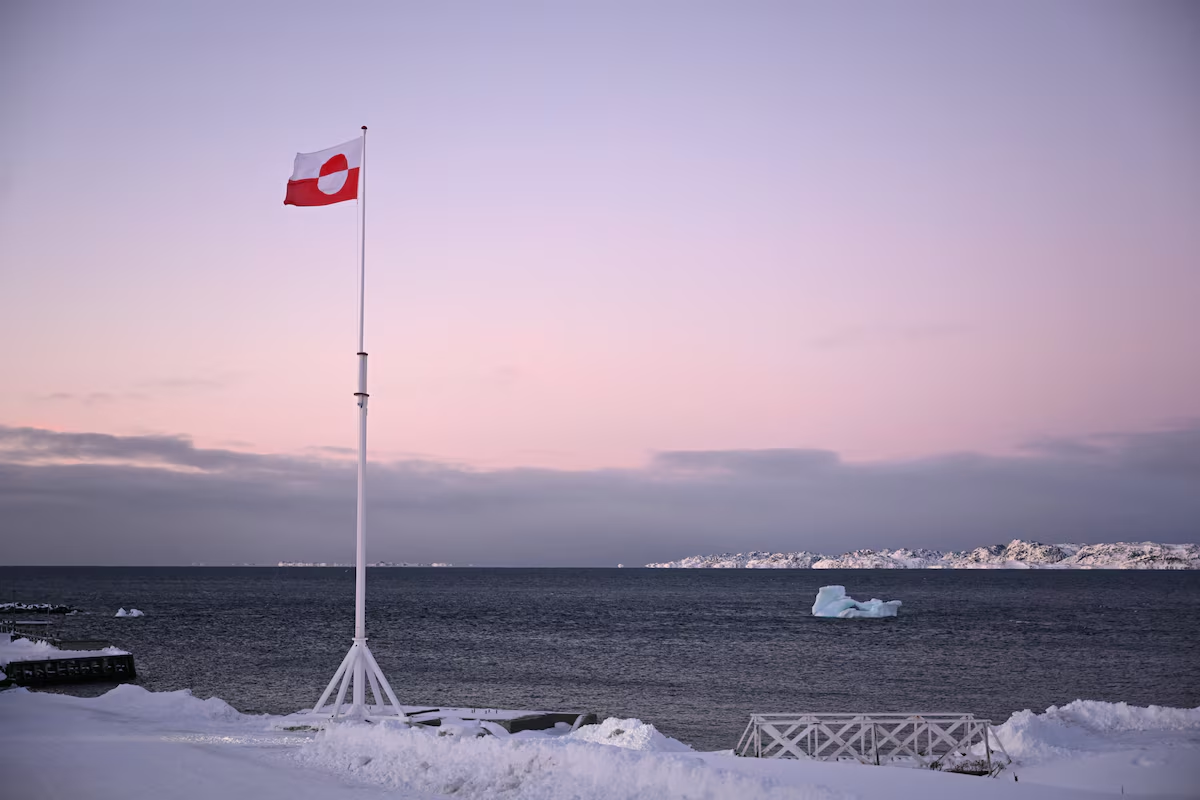
President Donald Trump said there is "no going back" on his push to assert US control over Greenland, refusing to rule out using force and posting AI images that depicted himself in Greenland and a map that showed Canada and Greenland as part of the United States. He also released private messages from world leaders, including French President Emmanuel Macron.
The moves intensified a diplomatic rift with Denmark and alarmed European capitals, while prompting warnings from trade officials that retaliatory measures remain on the table.
What Trump posted and leaked
On social media, the president shared AI-generated images, one showing him planted with a US flag in Greenland and another placing Canada and Greenland within US borders on a map. He framed Greenland as essential to national and global security, and wrote that "there can be no going back" on the issue.
Trump also published excerpts of private exchanges with other leaders. He included a message from President Macron, which the White House summary said questioned what Trump was "doing on Greenland."
Responses from Denmark and the EU
Denmark's prime minister, Mette Frederiksen, told parliament that sovereignty and territorial integrity are non-negotiable, and warned that "the worst may still lie ahead." She said security, investment and economic ties can be discussed, but fundamental issues such as borders and democracy cannot be traded.
We can negotiate about everything political, including security, investments and the economy, but we cannot negotiate our most fundamental values: sovereignty, our country's identity, our borders, our democracy.
Mette Frederiksen
European Commission President Ursula von der Leyen used the World Economic Forum in Davos to call for greater European independence and resilience, saying the current moment presents a permanent shift that the bloc must address.
The seismic change we are going through today is an opportunity, in fact a necessity to build a new form of European independence.
Ursula von der Leyen
Trade options and risks
European officials have warned that trade retaliation remains an option if tensions escalate. The European Union has prepared a package of tariffs on roughly
93 billion of US imports that could take effect after a suspension period, and it may consider deploying the Anti-Coercion Instrument to restrict market access or investments.
- Tariffs covering approximately 93 billion of US goods, suspended for six months
- Use of the Anti-Coercion Instrument to limit access to public tenders or investment
- Restrictions on trade in services, where the US has a surplus
Treasury Secretary Scott Bessent, speaking in Davos, urged calm and downplayed immediate prospects of a trade war, calling alarmist reactions "hysteria" and expressing confidence that leaders would find a solution that protects mutual security interests.
It 's been 48 hours. As I said, sit back, relax. I am confident that the leaders will not escalate and that this will work out in a manner that ends up in a very good place for all.
Scott Bessent
Political fallout and global reactions
The spat has attracted reactions beyond Europe. Russia's foreign minister framed Greenland's history in colonial terms and said the island was not a "natural part" of Denmark, while denying that Moscow had territorial ambitions. Protesters in Zurich carried banners opposing the World Economic Forum and US policy.
Markets registered the uncertainty. Shares in major US indexes fell, gold hit record highs, and investors sought safe havens as concerns about geopolitical and trade friction rose.
What comes next
With leaders set to meet at Davos, attention will focus on whether diplomacy can de-escalate the dispute and keep trade relations intact. The EU has tools ready, but invoking them would carry economic consequences for both sides. In Copenhagen, Frederiksen made clear that Denmark will defend sovereignty and democratic principles; in Brussels, officials have signalled readiness to respond if necessary.
For now, the episode has revealed how quickly digital imagery and private messages can intensify a diplomatic row, and how questions of territory and security can trigger broader trade and political repercussions.
Expectations for a rapid resolution depend on behind-the-scenes diplomacy and whether leaders choose to prioritise alliance management or escalate through public posturing and trade measures.
TrumpGreenlandDenmarkEUtrade