Trump withdraws Carney’s invitation to Board of Peace after Davos absence and rebuke
President Trump says he is rescinding Prime Minister Mark Carney’s invitation to the Board of Peace after Carney skipped its first meeting and gave a Davos speech seen as a rebuke.
Copy link
By Torontoer Staff
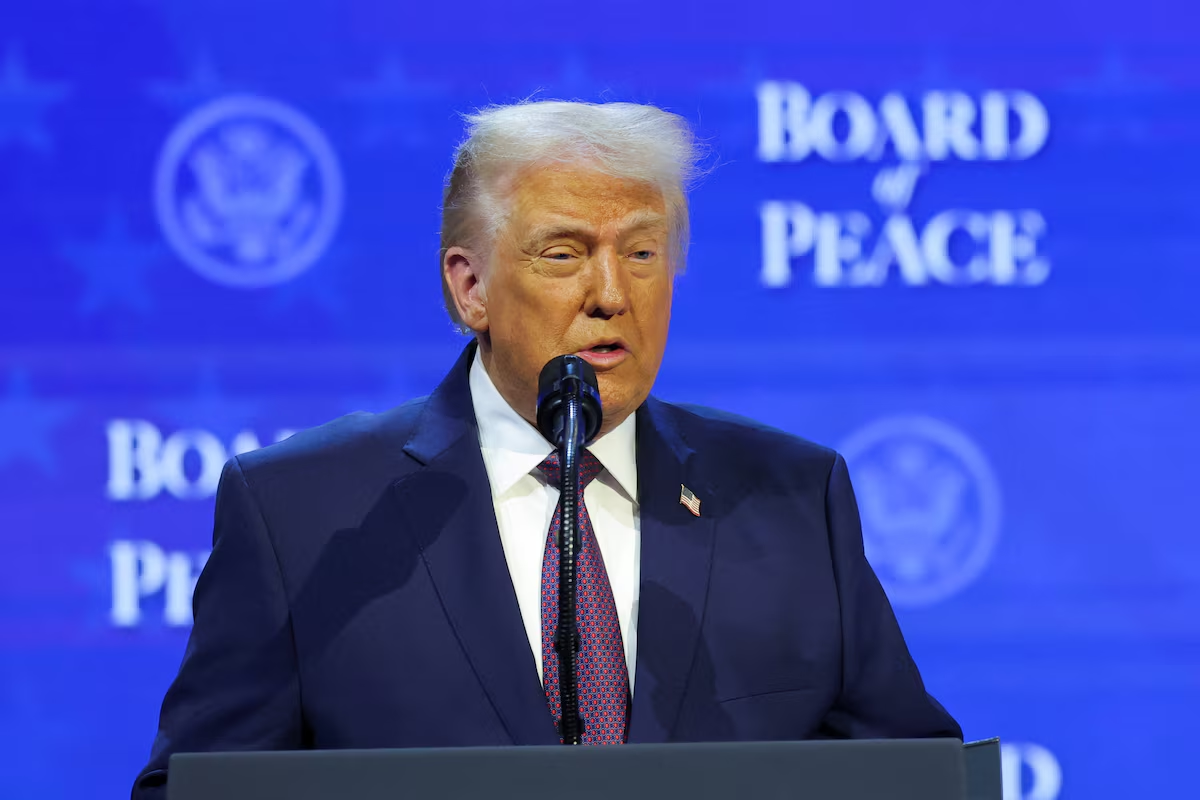
U.S. President Donald Trump announced on Truth Social that he is rescinding Prime Minister Mark Carney’s invitation to join the Board of Peace, after Carney did not attend the group’s inaugural meeting in Davos and delivered a speech widely seen as critical of Trump’s international agenda.
The move comes as the Board of Peace struggled to attract traditional Western allies at the World Economic Forum, and as questions grow about the group’s mandate and membership.
Trump’s announcement and the Davos timeline
Mr. Trump posted the decision while flying back to Washington from Davos. In his message he said the Board of Peace is withdrawing its invitation to Canada to join, calling the board "the most prestigious Board of Leaders ever assembled, at any time."
Officials said Mr. Carney left Davos early the morning the board convened and that the two leaders did not meet. The president later singled out Canada during his own remarks, saying, "Canada lives because of the United States. Remember that, Mark."
What the Board of Peace aims to do, and why it is controversial
The administration presents the Board of Peace as an oversight body for its Gaza peace plan. Critics fear the board could be given a broader remit, operating as a parallel to the United Nations under U.S. direction. The invitations list has included leaders such as Russian President Vladimir Putin and Belarusian President Alexander Lukashenko, raising concerns given Russia’s military action in Ukraine and Belarus’s human rights record.
Several invitees, including Mr. Putin and Israeli Prime Minister Benjamin Netanyahu, are wanted by the International Criminal Court and would have faced arrest if they travelled to Switzerland for the meeting.
Allied responses and diplomatic corrections
Many Western allies declined to participate. French President Emmanuel Macron rejected the invitation outright. Britain, Germany, Italy and most other European countries did not attend. The British foreign secretary told the BBC that her country would not sign on, citing legal and moral concerns about the charter and worry that Mr. Putin could be part of a body discussing peace.
This is about a legal treaty that raises much broader issues, and we do also have concerns about President Putin being part of something which is talking about peace.
British Foreign Secretary Yvette Cooper
The White House briefly listed Belgium as a signatory before the country’s foreign minister corrected the record, saying Belgium had not signed the charter and that Europe sought a coordinated response.
- Countries present at the charter signing included Saudi Arabia, Pakistan, Indonesia and Turkey.
- Several major Western allies declined or stayed silent.
- Some invitees are subject to international arrest warrants.
Carney’s Davos speech and the Canada-U.S. context
Earlier in the week Mr. Carney delivered a speech in Davos that, although it did not name Mr. Trump, attacked moves away from a rules-based international order toward what he described as economic coercion by powerful states. He urged middle powers like Canada to band together against subordination and to push back, including when allies engage in economic bullying.
Those comments were widely read as a rebuke of Mr. Trump’s trade tactics, which have included broad tariffs and pressure to secure favourable deals. Mr. Carney has at times pursued a conciliatory approach with the U.S., including rolling back Canada’s retaliatory tariffs and cancelling a planned digital services tax, but those measures have not yet lifted U.S. tariffs on Canadian goods.
Last week Mr. Carney concluded an agreement with Chinese President Xi Jinping that will see Canada lower tariffs on Chinese electric vehicles in exchange for China reducing duties on canola and other Canadian exports, a move that breaks alignment with the U.S. on trade policy.
Political implications and what comes next
The withdrawal of Carney’s invitation could signal a more unsettled phase in Canada-U.S. relations, but officials on both sides have yet to publicly outline next steps. The Board of Peace itself faces an uphill political and diplomatic challenge if it aims to secure broad international legitimacy.
Mr. Trump proceeded with the charter signing despite the absence of most Western allies. At the event he framed Gaza as an opportunity for development, using a real estate metaphor to describe the territory’s potential.
I’m a real estate person at heart and it’s all about location, and I said ‘look at this location on the sea,’
President Donald Trump
Government offices in Ottawa had not immediately responded to requests for comment. The diplomatic fallout will be watched closely as trade negotiations and broader security discussions continue to shape relations between Canada and the United States.
For now the Board of Peace remains an American initiative with limited Western participation, and the decision to rescind Canada’s invitation highlights the diplomatic costs that can follow public criticism between allied leaders.
Donald TrumpMark CarneyDavosBoard of PeaceCanada–United States relations