US Treasury reaffirms 'strong dollar' policy as greenback rebounds
Treasury secretary Scott Bessent said Washington is not intervening to prop up the yen, sending the dollar higher and easing hopes of a joint US-Japan action. Here’s what that means for markets and everyday Canadians.
Copy link
By Torontoer Staff
The US dollar climbed on Wednesday after Treasury secretary Scott Bessent reiterated that the administration remains committed to a "strong dollar" policy and is not intervening to support the Japanese yen. Bessent told CNBC he expects the dollar to appreciate and denied any plan to step into foreign exchange markets to boost the yen.
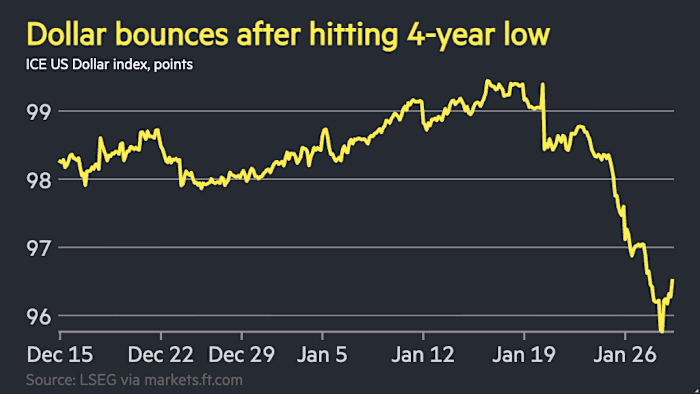
Markets reacted quickly: the dollar rose as much as 0.9 per cent against the euro and 1 per cent versus the yen, while the yen pulled back from near ¥160 to about ¥153.46 per dollar after traders scaled back hopes of coordinated intervention.
What Bessent said and why it mattered
Bessent framed a strong dollar as the result of sound economic fundamentals. "The US always has a strong dollar policy, but a strong dollar policy means setting the right fundamentals," he said, adding that policy choices were making the US "the best place to come" and that lower trade deficits should support dollar strength over time.
His comments were aimed at quashing market speculation that the Treasury was planning intervention after a rate check by the New York Federal Reserve on the dollar-yen rate. Rate checks are sometimes seen as a precursor to intervention, and the disclosure prompted talk of a possible US-Japan action to shore up the yen.
Market reaction and expert takeaways
Investors parsed Bessent’s remarks as a clear rejection of intervention. Meera Chandan, co-head of global FX strategy at JPMorgan, said the clarification "dispelled speculation that there is a massive plot to weaken the dollar," and reassured markets that movements will be driven by normal market forces.
Shahab Jalinoos, head of G10 FX research at UBS, noted the difference between rate checks and actual intervention. "The market clearly believes that there were rate checks last week. There was no actual intervention. In that sense it is strictly correct that the US is not intervening in dollar-yen," he said. Jalinoos added that if the exchange rate reached ¥160 again, traders would expect at least a "soft" policy response.
Why traders were watching the yen
Currency moves between the dollar and the yen draw attention because of Japan’s history of stepping into markets to limit sharp yen weakness. Significant yen depreciation can push up import costs for Japan and disrupt global trade flows, which is why a concerted US-Japan action would have broad implications.
That background helped drive the recent volatility. The dollar had fallen nearly 2 per cent since the previous week amid speculation about possible intervention and comments from President Donald Trump that a weaker dollar could be positive for the US economy.
What this means for Canadians
Most Canadians will not feel immediate effects from a single day of dollar strength, but sustained moves can matter for travel costs, import prices and investments. A stronger US dollar can push up the price of goods priced in US dollars, and it can affect cross-border spending for travellers and shoppers.
- If the US dollar remains strong, imported goods may become more expensive in Canada over time.
- Canadians planning US travel could see better value if the dollar strengthens against the Canadian dollar, though rates can change quickly.
- Investors with US-dollar assets may see gains in Canadian-dollar terms, while Canadian exporters could face tougher competition abroad.
For everyday budgeting, the practical advice remains the same: lock in exchange rates for planned purchases or travel if you need certainty, and consider dollar exposure when reviewing investment portfolios.
How often does the US intervene?
Direct US interventions in currency markets are rare. Since the US adopted a formal strong dollar stance in 1996, there have been only a handful of interventions. That history makes Bessent’s denial meaningful to traders who look for official confirmation before pricing in coordinated action.
Even so, rate checks and public comments can move markets by signalling where officials are focused. That makes clear communication from treasury officials a key element of currency stability.
For now, markets appear to have accepted the administration’s message that the dollar will be driven by fundamentals rather than official intervention, but analysts say pressure on the yen is likely to persist and the market will continue to test that view.
Bessent’s comments removed one immediate source of uncertainty. Investors and ordinary Canadians monitoring prices, travel budgets or cross-border exposure should expect volatility to continue, and plan accordingly.
currenciesUS TreasuryforexeconomyCanada