Why Canada should back Europe in defence of Greenland
Denmark’s sovereignty over Greenland is under pressure from the United States. Canada faces strategic and economic risks if it does not join European efforts to defend territorial norms.
Copy link
By Torontoer Staff
NATO faces an unprecedented internal challenge, and Canada must decide where it stands. Public demands by U.S. leadership that Denmark cede Greenland to the United States go beyond rhetoric, and they directly threaten the post‑1945 norm that borders are not revised by coercion.
This is not abstract diplomacy. If an allied superpower can press a NATO partner to surrender territory, the same logic could be applied to Canada’s Arctic claims, shipping routes and resources. Ottawa’s response will signal whether it defends collective norms or accommodates a major partner’s unilateral pressure.
A challenge to the rules that have held the alliance together
Post‑Second World War Western security rests on the principle that states’ borders are inviolable. Past NATO crises tested that principle without breaking it. In 1956, the Suez crisis prompted Washington to force Britain and France to back down, and Canada brokered a peacekeeping response that stabilised the alliance and earned Lester B. Pearson a Nobel Prize. A decade later, Charles de Gaulle’s decision to withdraw France from NATO’s integrated military command required adjustments, but the alliance endured.
The current crisis differs because the pressure originates in Washington. When a leading NATO power asserts territorial ambitions against a member, the basic moral and legal presumption of post‑1945 order is at stake. That undermines the credibility of Western positions on other territorial aggressions.
Why Greenland matters to Canada
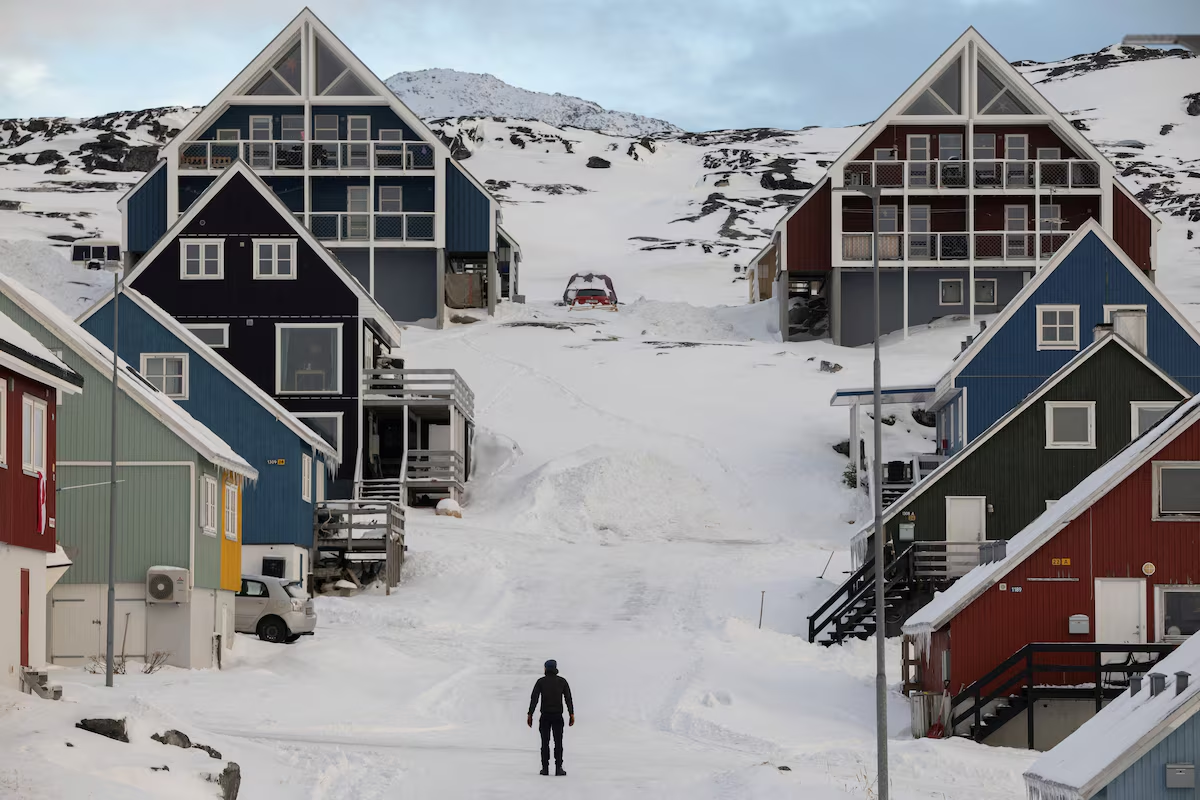
Greenland is a NATO member territory with strategic importance in the North Atlantic. For Canada, which shares Arctic responsibilities and a long northern coastline, the issue is also proximate. Allowing an ally to coerce territorial change would set a precedent that could be cited against Canadian sovereignty claims and Arctic stewardship.
There is also a values dimension. Canada’s diplomatic credibility, including support for Ukraine’s territorial defence, depends on consistent adherence to the principle of territorial sovereignty. Supporting Denmark and Greenland aligns Ottawa’s rhetoric and practice on that principle.
Costs and tradeoffs for Ottawa
Pushing back against the United States risks economic and security repercussions. Recent U.S. administrations have shown readiness to weaponise trade policy, and an uncompromising U.S. president could respond with tariffs, non‑tariff barriers or disruptions to cooperation in NORAD and intelligence sharing frameworks such as Five Eyes.
Still, acquiescence carries its own costs. Surrendering to coercion would weaken the rule that underpins Canada’s international position and expose northern interests to future pressure. The choice is between short‑term economic pain and longer‑term strategic vulnerability.
Practical options for Canadian policy
Ottawa can pursue a range of calibrated measures to support Denmark and Greenland while managing bilateral risk. Coordinated transatlantic diplomacy should be the first step, followed by contingency measures if negotiations fail.
- Coordinate a unified response with EU and NATO partners, emphasising the inviolability of NATO members’ borders
- Consider invoking NATO’s consultative mechanisms, including Article 4, to signal collective concern
- Prepare targeted economic and diplomatic countermeasures to be deployed if coercive action continues
- Bolster Arctic defence and sovereignty postures to deter any advance on Canadian territory or interests
- Maintain channels of bilateral dialogue with Washington to seek de‑escalation while standing firm on principle
If Greenland falls, the next domino could indeed be Canada.
Fen Osler Hampson
Those options carry risks, but inaction risks normalising coercion. A measured, multilateral approach preserves space for diplomacy while signalling that territorial coercion will carry costs.
What Ottawa should signal now
Canada should state clearly that any attempt to force territorial concessions from a NATO partner is unacceptable. That statement need not be inflammatory. It can emphasise respect for self‑determination, support for Denmark’s sovereignty, and a willingness to coordinate responses with allies.
Making that position public and immediate reduces uncertainty for smaller partners and strengthens collective deterrence. It also aligns Canada’s foreign policy with the legal and normative framework that has supported its security and prosperity for decades.
Mr. Trump’s 'next big thing is going to be Canada.'
Steve Bannon
That warning from a former adviser illustrates the stakes. The calculus for Ottawa should be clear: defending the principle of territorial sovereignty now protects Canadian interests later.
Canada has previously played a stabilising role in transatlantic crises. Drawing on that legacy, Ottawa can help ensure that NATO’s founding principles remain intact without closing off diplomatic channels. The choice is strategic, not merely rhetorical.
Canada should stand with Europe in defence of Greenland’s sovereignty, and prepare practical measures to back that stance. Doing so preserves the international rules that protect states large and small, and it protects Canada’s own northern interests.
CanadaGreenlandNATOArcticforeign policy