Why Mark Carney ordered a Hawaiian slice with Doug Ford, and what it signalled
Mark Carney chose a Hawaiian slice during a meeting with Doug Ford. The choice blended Canadiana, nostalgia and a calculated bit of soft power after his Davos speech.
Copy link
By Torontoer Staff
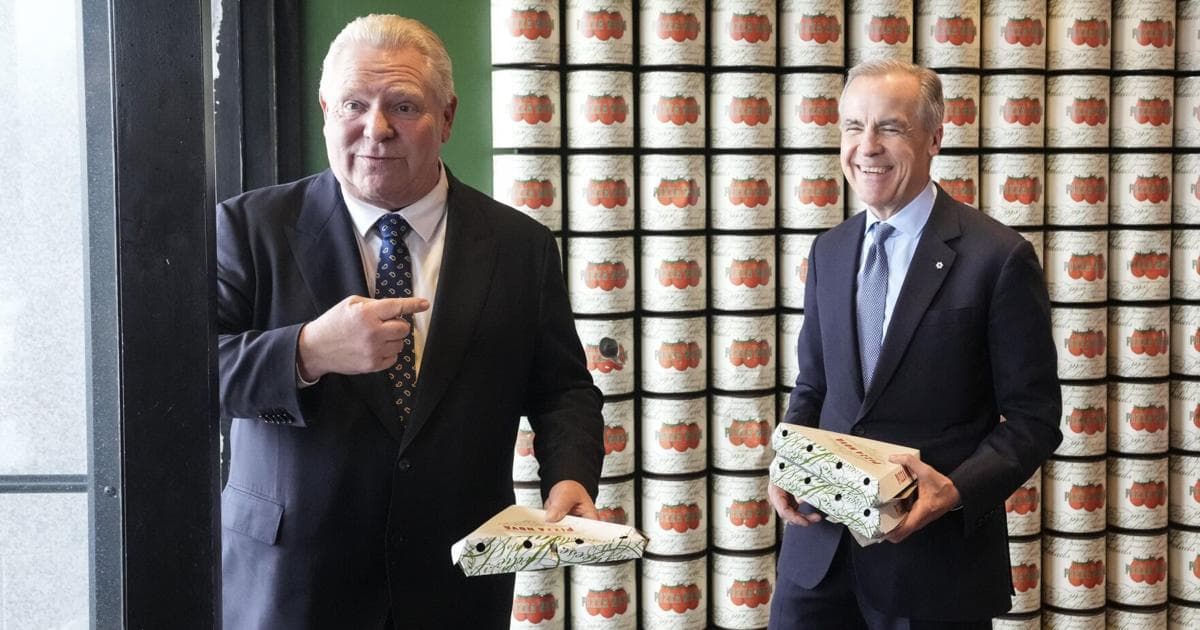
Mark Carney ordered a Hawaiian pizza while photographed eating a slice with Ontario Premier Doug Ford. The moment drew attention not for policy or protocol, but for a topping that keeps turning into a cultural debate: pineapple.
The choice was simple, and the response was layered. In the days after Carney’s speech at Davos, where he urged alliances among small and middle powers, the sight of Canada’s high-profile public figure choosing a dish invented in Canada prompted quick readings about identity, nostalgia and soft power.
A low-stakes choice with a high profile
On its surface the scene looked like a routine photo op: two public figures, casual setting, a quick bite. Observers read beyond the moment. Food choices by public figures often carry symbolic weight. With the backdrop of an international speech, the Hawaiian slice was easy to frame as more than a snack.
Max Valiquette, a communications veteran who served as a senior staffer in federal politics and calls himself a "noted pizza enthusiast," said he was not surprised by the interest. "I feel like my whole life has prepared me for this one particular interview," he told the Star, then offered a pragmatic take: Carney’s office is lean and unlikely to overthink a pizza order, but small signals do get read as deliberate.
I would be stunned if he was told to order Hawaiian, but it is a choice that lands in a particular way.
Max Valiquette
How a Hawaiian slice became Canadiana
Hawaiian pizza, despite its name, is a Canadian invention. A 1962 creation credited to Greek immigrant Sam Panopoulos in Chatham, Ontario, it pairs tomato sauce and cheese with ham and pineapple. Over time it grew from a local novelty to one of the world’s most talked-about toppings.
That origin matters when a Canadian public figure chooses Hawaiian in public, especially near moments of international visibility. The dish can be read as an act of national cultural confidence: a humble, hybrid invention that travelled globally and kept a Canadian origin story attached to it.
Pizza as soft power
Valiquette framed the choice as clever. Days after Carney argued for a world order shaped by alliances of smaller powers, he selected a food item that is a local export. That alignment made the moment feel intentional to some observers, even if the reality was simpler.
The Hawaiian slice also taps into a broader idea: how food functions as cultural shorthand. A photograph of a leader eating a specific dish can be read as a signal about identity, values or priorities, especially when the item carries an origin story tied to the country in question.
Political figures have previously weighed in on pizza toppings and created headlines. In 2017 Iceland’s president said he was "fundamentally opposed" to pineapple on pizza, then backtracked when the comment drew attention. Justin Trudeau publicly declared himself on "Team Pineapple" in that same conversation. These moments show how a minor culinary preference can pick up outsized meaning in public life.
What ordering Hawaiian may signal
- Canadiana: a nod to an invention with Canadian roots, simple and exportable.
- Accessibility: a familiar, everyday food choice rather than a carefully curated culinary statement.
- Nostalgia: many Canadians have personal memories tied to reaching for that particular topping.
- Indifference to controversy: a willingness to accept a divisive preference in public.
- Soft power, subtle: a small cultural image projected without overt policy language.
Those interpretations coexist with an obvious alternative: Carney may simply have chosen what he likes. The line between deliberate signalling and ordinary taste is often blurred in public life.
A final, human detail
Carney has said the topping was "very exotic" when he was growing up, a comment that adds a personal note to the moment. For some public figures, those small admissions humanise them. For others they become material for symbolic readings.
Ultimately, the photograph of Carney with a Hawaiian slice will sit somewhere between a trivial food preference and a useful piece of public theatre. It is an example of how everyday choices by public figures can be interpreted as cultural signals, and how a simple slice of pizza can prompt a far larger conversation.
Mark CarneyHawaiian pizzaDoug Fordsoft powerfood and politics