Year two: how Trump consolidated power at home and began projecting it abroad
After a first year of purges, legal pressure and economic controls, President Trump has moved to project U.S. power overseas, from threats at Greenland to military operations in Latin America.
Copy link
By Torontoer Staff
In his first year back in the White House, President Donald Trump eroded many institutional checks on his authority inside the United States. In year two he has shifted to projecting that power internationally, with threats and military moves that have alarmed allies and neighbours.
Trump has combined legal pressure, personnel purges, tariffs and direct use of federal forces at home with an increasingly interventionist foreign policy. His actions have reshaped relations with governments, businesses and universities, and raised questions about the durability of traditional checks and balances.
Purges and pressure: reordering the federal government
The administration replaced dozens of federal officials and removed roughly 300,000 public employees from the federal payroll, according to internal figures. The Department of Justice has been used against figures Mr. Trump views as political enemies, while presidential pardons and personnel changes have shielded allies implicated in the Jan. 6 riot.
This is a wholesale revision of the norms and guardrails that previously existed in America, the independence of the Justice Department, and the total elimination of rule of law.
Ty Cobb, former White House legal team member
Economic levers and corporate compliance
Tariffs have become a central economic tool. The administration has imposed levies on a wide range of trading partners, and taken partial public stakes in strategic firms from steelmakers to semiconductor companies. Business leaders who resisted have found little success in reversing policy, and several law firms and media companies settled with the President after facing threats to government contracts and licences.
- Tariffs imposed on dozens of countries, aimed at curbing imports
- Partial government ownership or stakes in firms including U.S. Steel and Intel
- Large settlements and pro bono commitments from law firms and broadcasters after pressure
Immigration enforcement and domestic deployments
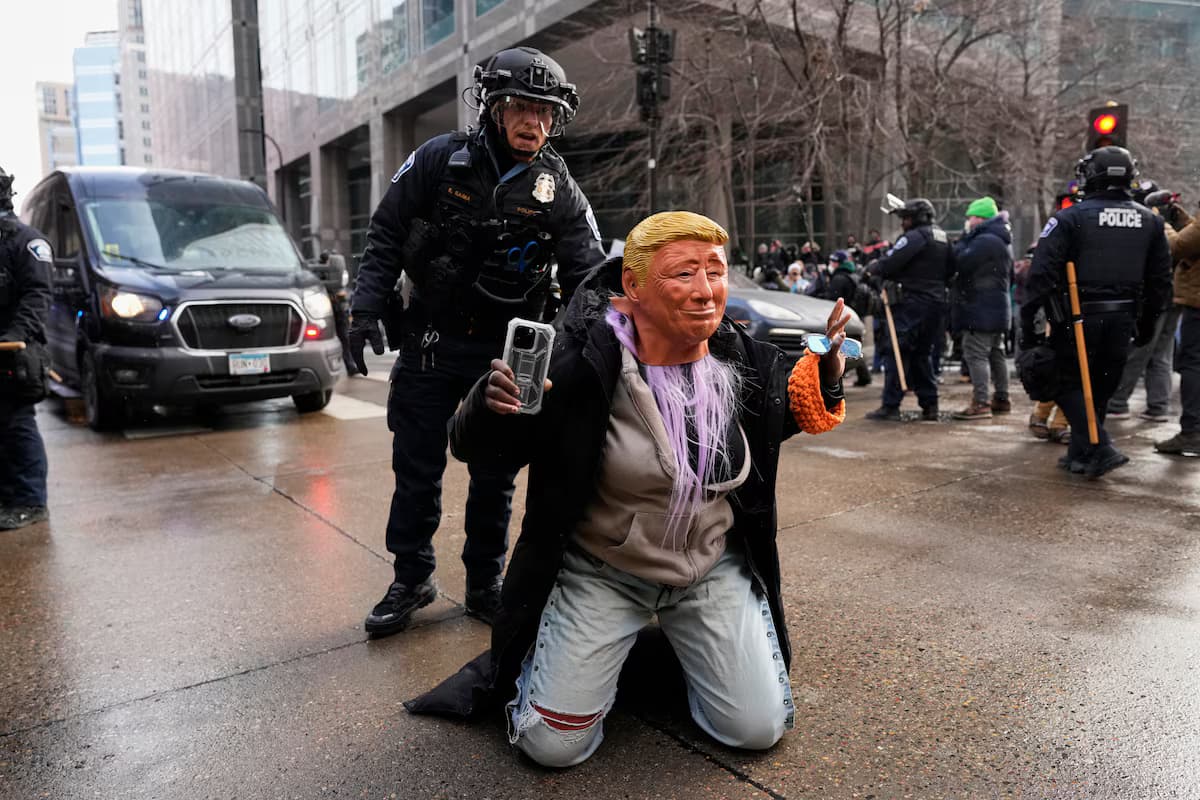
Immigration policy has tightened dramatically. The administration has pursued large-scale deportations, stripped legal status from more than 1.6 million immigrants and frozen many visa processes. Masked ICE agents have carried out raids in cities and at workplaces, and the administration has deployed National Guard units to support enforcement in several municipalities.
Operations have at times provoked violent encounters with civilians and protesters, and prompted widespread demonstrations in response to both tactics and scale.
Universities and civil institutions under strain
Federal funding has been withheld from multiple universities, with the administration demanding policy changes that critics say amount to ideological policing. Several institutions have agreed to pay fines or alter programming rather than risk long legal battles, while at least one, Harvard, remains in litigation with the government.
In an authoritarian regime, you pay a price for opposing the government.
Steven Levitsky, Harvard political scientist
Projecting power abroad: from Venezuela to Greenland
The administration has moved from domestic consolidation to assertive foreign action. In a high-profile operation, U.S. forces removed Venezuelan leader Nicolás Maduro and detained him on narcotrafficking charges. Since then, the President has floated or threatened further measures: seizing Greenland, sending troops into Mexico and Colombia, and authorizing strikes on Iranian nuclear sites.
The President has framed this approach as a renewed hemispheric doctrine, dubbed the Donroe Doctrine, recalling 19th-century U.S. dominance in the Americas. Critics warn such moves risk alienating NATO partners and pushing other powers toward new alignments.
Central to understanding Trump is: he doesn’t have a philosophy, domestic or international. It’s not about policy or strategy. It’s about Donald Trump.
John Bolton, former national security adviser
Why traditional checks have weakened
Several factors have reduced conventional restraints on presidential power. The Supreme Court’s conservative majority has issued rulings favourable to the administration. Congressional Republicans are largely aligned with, or unwilling to oppose, the President’s agenda. And a number of institutions have chosen accommodation over confrontation, accepting settlements or policy changes rather than prolonged conflict.
Observers say the lack of a collective memory of authoritarianism in the United States has made some leaders slow to recognise the risks, which has allowed rapid consolidation of influence across government and civil society.
What comes next
The central question for the rest of the term is how other actors will respond. Continued acquiescence would likely allow further expansion of executive power and more aggressive international posturing. Pushback from courts, Congress or allied governments could slow or reverse parts of the agenda, but so far those checks have been uneven.
Asked recently whether anything could limit him, Mr. Trump told The New York Times, "My own morality. My own mind. It’s the only thing that can stop me." How institutions, political leaders and the public respond to that claim will shape the balance of power at home and abroad.
For now, the combination of domestic consolidation and outward force marks a significant shift in American governance and foreign policy, with consequences for allies, trade partners and institutions that extend beyond U.S. borders.
Donald TrumpUS politicsforeign policyimmigrationinstitutions